

Spanning the red basalt soil of the Central Highlands, across the relentlessly flowing Serepok River, Bridge 14 (also known as Serepok Bridge) stands silently, a witness to the passage of time.
Turning the pages of history, Bridge 14 – the first bridge built across the Serepok River – was constructed in 1941 during the French colonial period. Every steel beam, every girder of the bridge is steeped in the sweat, tears, and even blood of political prisoners and indigenous people forced into hard labor.
On the inauguration day, to demonstrate the bridge's safety, the wife of a French engineer presented the most beautiful Ede girl in the region with a pair of high-heeled shoes, and together, dressed in traditional attire, walked across the bridge. It was an image both proud and imbued with the historical contradiction of the concrete spans – behind which lay the sweat and tears of countless hardships.
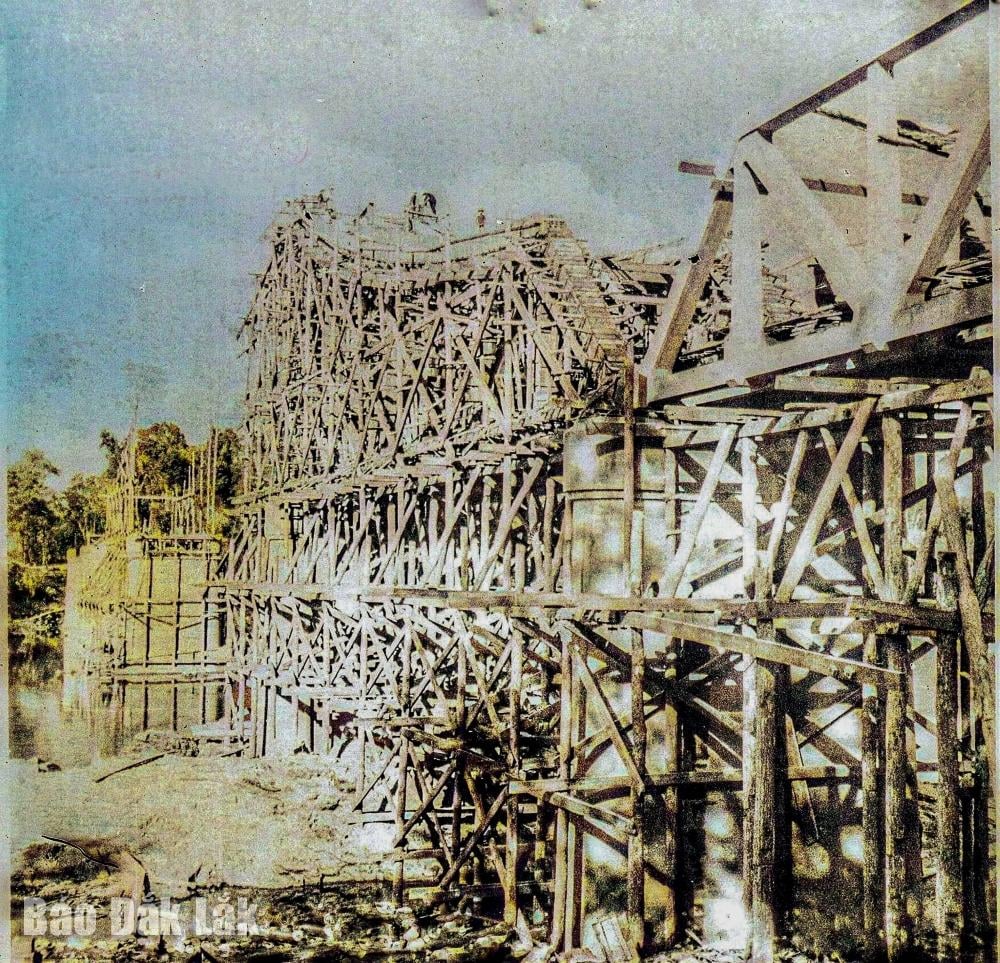 |
| The construction process of Bridge 14. Archival photo. |
During the anti-American war period (1954-1975), Route 14 was thoroughly exploited by the US imperialists and the puppet regime. Recognizing the crucial strategic role of Bridge 14 in military , economic, and political terms, the enemy established checkpoints to block this vital supply route from the North to the South. Simultaneously, they tightly controlled the movement of people and revolutionary bases from the outskirts to the inner city of Buon Ma Thuot, combined with organizing attacks against the Liberation Army forces, gradually expanding and consolidating their strategic foothold, using the Central Highlands as a base for attacks and raids into the North.
Also at this location, on the night of February 2nd and the early morning of February 3rd, 1969, the explosion of 50 kg of explosives and mines carried out by the K2 and H6 Special Forces teams (codename Buon Ma Thuot town) and the V12 unit of the Provincial Military Command destroyed the bunker south of the bridge, shaking the entire area and hindering the mechanized troop movement of the Republic of Vietnam forces providing reinforcements from Buon Ma Thuot to Duc Lap, Quang Duc province.
In the years that followed, the enemy's position began to crumble. In March 1975, when the Central Highlands Campaign officially began, Buon Ma Thuot became a key breakthrough point. The victory at Buon Ma Thuot not only shook the Central Highlands but also paved the way for the general offensive to liberate South Vietnam.
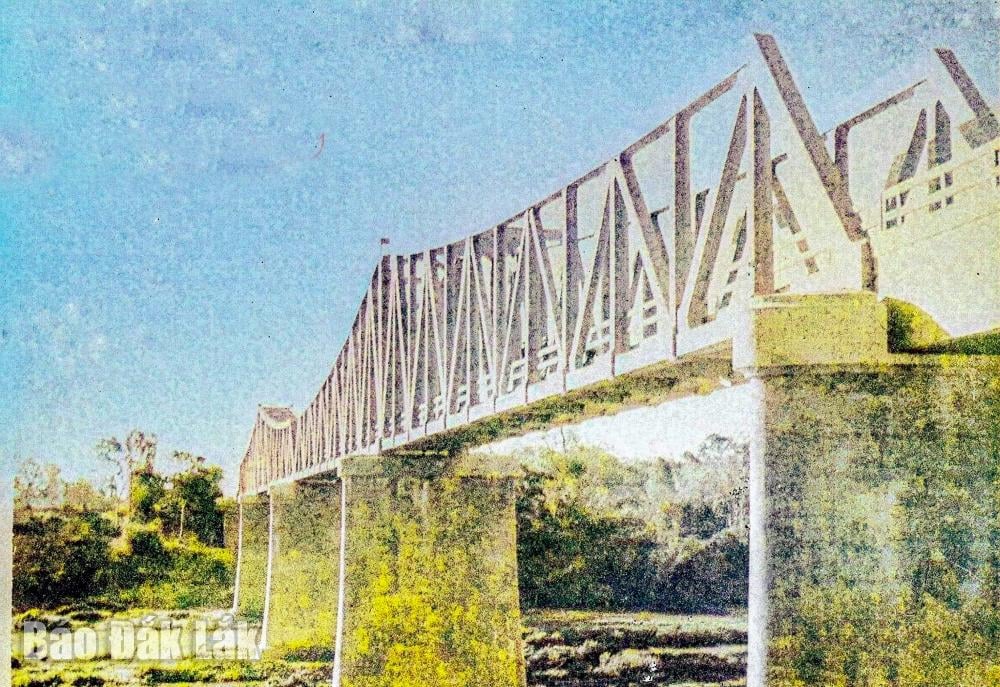 |
| Old Bridge No. 14. Archival photo. |
During those tumultuous days, main army units marched swiftly, crossing fiery red basalt roads, bravely running across bridges, advancing to liberate Saigon.
Mr. Nguyen Quang Luyen, a veteran from Thanh Nhat ward, Buon Ma Thuot city – who directly participated in both the Central Highlands Campaign and the Ho Chi Minh Campaign – recounted with emotion: “At that time, we marched during the day, under the blazing sun of the Central Highlands. Long convoys of vehicles and soldiers stretched in long groups. When we reached a large iron bridge spanning a wide river, I was astonished. The bridge looked no different from the Long Bien Bridge in Hanoi ; the curved steel spans gleamed in the sun. The whole group hurried across the bridge, rushing straight towards Saigon. At that time, I only knew it was a large bridge, like a gateway opening into a new battlefield. Only much later did I learn that it was Bridge 14 – a place marking a historical milestone I had traveled…”
Beneath the wheels, under the boots of the soldiers, the bridge echoed with a rumbling, pounding sound, like the resounding drumbeats urging the troops forward and carrying on its back the eager soldiers marching to a new front, bridging the gap between the victory in the Central Highlands and the day of complete victory.
After April 30, 1975, when the country was fully reunified, Bridge 14 continued to witness the changes in the Central Highlands. Trucks carrying coffee, pepper, and rubber from the plantations traveled back and forth across the bridge; transporting agricultural products to provinces and cities, and to major ports for export.
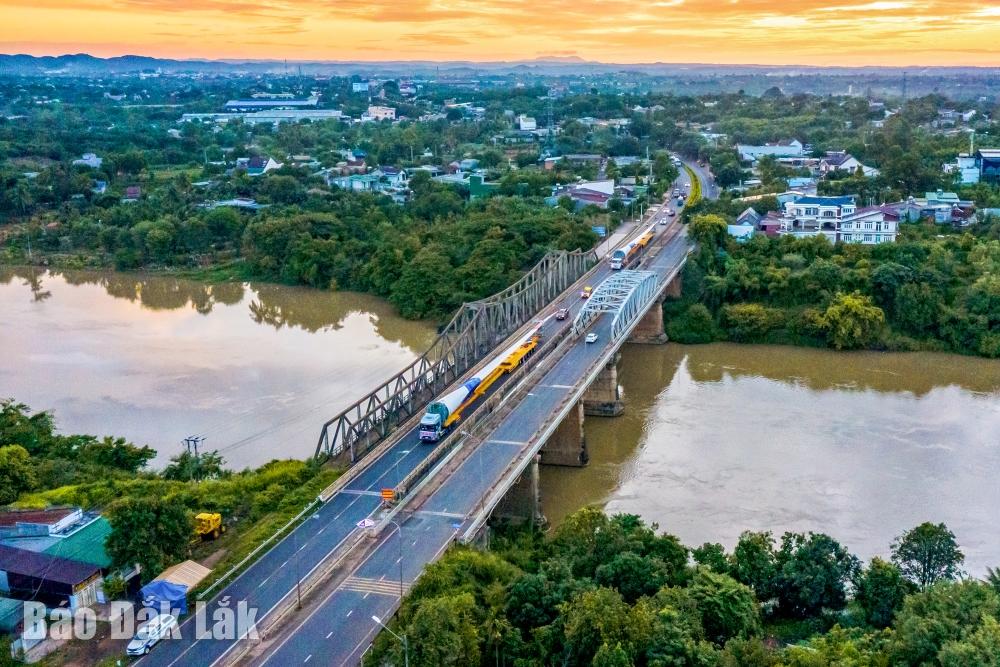 |
| Bridge 14 as it is today. Photo: Nguyen Gia |
With the increasing demand for transportation, the Dak Lak provincial government decided to build a new bridge parallel to the old one, which was inaugurated and put into use in 1992.
In 2014, Dak Lak and Dak Nong provinces continued to build a third bridge between the old and new bridges to meet transportation needs. The old Bridge 14, since then, has ceased to be a main route for vehicles and has begun to be covered in moss, showing the marks of time. Nevertheless, in the minds of many generations, the old bridge still retains its original meaning and historical value.
Amidst the hustle and bustle of life, the fleeting passage of time, Bridge 14 remains quietly and peacefully standing there, not only spanning the river but also crossing realms of memories: from days filled with the sound of gunfire to seasons of radiant peace. That bridge still whispers to the forest breeze and the waves of the Serepok River, telling its own story…
Source: https://baodaklak.vn/chinh-polit/lich-su-truyen-thong/202505/cau-14-va-nhung-mien-nho-f50071f/
![[Photo] Conference announcing the Politburo's Decision on organizational and personnel matters](https://vphoto.vietnam.vn/thumb/1200x675/vietnam/resource/IMAGE/2026/04/01/1775017881825_bnd-2410-1472-jpg.webp)

![[Photo] Conference on the transfer and reception of Party organizations and Party members between the Party Committee of the Government and the Party Committees of the Central Party Agencies](https://vphoto.vietnam.vn/thumb/1200x675/vietnam/resource/IMAGE/2026/04/01/1775036784472_ndo_br_bnd-2620-jpg.webp)
















































![[Photo] Prime Minister Pham Minh Chinh receives the Ambassador of the Russian Federation to Vietnam](https://vphoto.vietnam.vn/thumb/402x226/vietnam/resource/IMAGE/2026/04/01/1775046774818_anh-man-hinh-2026-04-01-luc-19-32-33.png)



















Comment (0)