

Besides conventional medical treatments, thread embedding, a method combining traditional acupuncture and modern techniques, is gaining attention as an effective, sustainable, and low-side-effect supportive solution.
NOSE CLEARANCE FROM THE VERY FIRST THREAD IMPLANTATION
At Da Nang Traditional Medicine Hospital, many patients with chronic rhinitis have chosen acupuncture thread embedding to improve their condition. Ms. TTTH (25 years old, from Dai Loc, Quang Nam) said she had allergic rhinitis for more than 10 years. Ms. H. experienced constant sneezing, runny nose, nasal congestion, forehead pain, and difficulty breathing, which worsened particularly in the evening or when the weather changed suddenly.
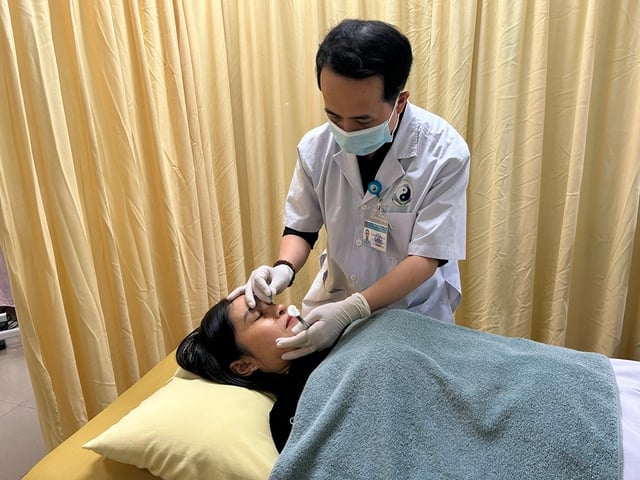
A patient with chronic rhinitis chose acupuncture thread embedding as a treatment method at Da Nang Traditional Medicine Hospital.
PHOTO: AN DY
At the hospital, after being diagnosed with allergic rhinitis, deviated septum, and edema of the right turbinates, Ms. H. was prescribed a thread embedding treatment. According to Dr. Nguyen Cong Ly, Head of Clinic 2 at Da Nang Traditional Medicine Hospital, the patient received thread embedding at the following acupuncture points: Yingxiang, Yintang, Hegu, Quchi, Fengchi, Zusanli, Feishu, Gaohuangshu, Xuehai, Fenglong… The purpose was to reduce inflammation, edema, allergies, improve blood circulation, drain the nasal and sinus areas, alleviate congestion, and boost immunity.
"My nose cleared up right after the first implantation, and the symptoms started to subside, such as reduced nasal discharge, less forehead pain, and less sneezing. After the second implantation, the nasal congestion, shortness of breath, and headaches were almost completely gone, making me feel significantly better," Ms. H. said.
Another case is patient LNAD (44 years old, from Da Nang) who suffered from congenital frontal and ethmoid sinusitis, allergic rhinitis, etc., for over 40 years. The patient was prescribed a course of three thread embedding treatments (each spaced 15 days apart) to increase effectiveness. Ms. D. stated that after each thread embedding session, symptoms significantly decreased, such as reduced sensitivity to weather and smells, and clearer airways. Ms. D. was also advised to combine a balanced diet, outdoor exercise, and keeping warm to support the treatment process.
Improves blood circulation, reduces respiratory spasms.
Thread embedding (also known as thread implantation or thread insertion) is a technique that involves inserting absorbable threads into acupuncture points to maintain long-lasting stimulation, helping to improve blood circulation, regulate immunity, and reduce inflammation. Compared to traditional acupuncture, the effects of thread embedding last longer, usually from 10 to 14 days.
Regarding the mechanism of action, modern medicine recognizes that acupuncture helps increase local blood circulation, reduce respiratory tract spasms, and regulate immunity. Meanwhile, according to traditional medicine, this is a method of tonifying the body and expelling pathogens, strengthening vital energy to repel wind, cold, and dampness, the main causes of disease.
According to Doctor Nguyen Cong Ly, the acupuncture point embedding formula is determined based on the type of disease, the severity of symptoms, and the patient's constitution. Although it is a safe method, acupuncture can still cause some complications if performed incorrectly or at a substandard facility.
"Therefore, patients need to choose licensed medical facilities and doctors specializing in traditional medicine and thread embedding techniques. The thread embedding process must ensure sterility, use high-quality threads, and be performed with the correct technique," advised Dr. Ly.
In addition to undergoing acupuncture treatment, patients need to adhere to health care principles such as: keeping the head, face, and neck warm; avoiding contact with dust and dirt; cleaning the nose daily with saline solution; limiting spicy, hot, and cold foods; supplementing with foods that have natural anti-inflammatory properties such as ginger, garlic, and honey; and increasing physical exercise.
The prevalence of allergic rhinitis in Vietnam exceeds 20% of the population.
Dr. Nguyen Van Anh, Director of the Da Nang Traditional Medicine Hospital, shared data from the Ministry of Health and epidemiological studies showing that the incidence of allergic rhinitis in Vietnam has been increasing significantly in recent years, affecting more than 20% of the population, amidst the complexities of pollution, fine dust, and climate change. "The number of patients in Da Nang and the Central region seeking treatment for respiratory diseases and rhinitis at the hospital is increasing. More and more patients are choosing acupuncture thread embedding to treat chronic rhinitis," Dr. Anh said.
According to traditional medicine experts, acupuncture thread embedding for the treatment of allergic rhinitis is a worthwhile option among conservative treatment methods, especially for patients with chronic allergic rhinitis that is difficult to control with Western medicine. However, the effectiveness and safety of this method largely depend on the doctor's skill and the patient's active cooperation in care, lifestyle adjustments, nutrition, and living environment.
Source: https://thanhnien.vn/cay-chi-dieu-tri-viem-mui-di-ung-185250421174448487.htm



![[Photo] “Red Journey” 2026: Vietnamese Youth Continue Building the Bridge of Friendship Between Vietnam and China](https://vphoto.vietnam.vn/thumb/1200x675/vietnam/resource/IMAGE/2026/04/20/1776629730866_4055880775670638308-9618-4200-jpg.webp)


































































Comment (0)