

During last year's AI boom, Nvidia played a central role with its expensive server graphics processing units (GPUs), including the H100. These were essential for training and deploying generative AI like OpenAI's ChatGPT.
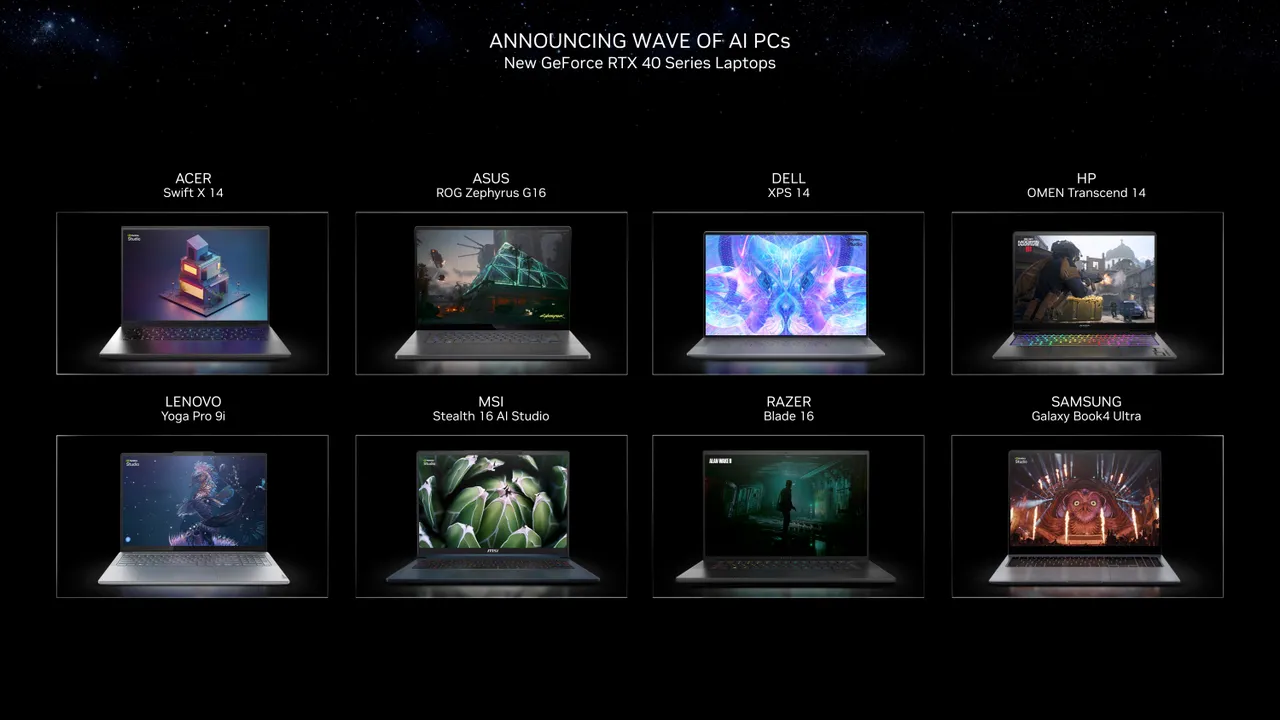
Not stopping there, Nvidia continued to demonstrate its strength in the consumer GPU market by announcing three new graphics cards at CES 2024: the RTX 4060 Super, RTX 4070 Ti Super, and RTX 4080 Super, priced from $599 to $999. These cards feature additional "tensor cores," designed to run generative AI applications. Furthermore, Nvidia also supplies graphics cards for laptops from Acer, Dell, Lenovo, and others.
Demand for Nvidia's enterprise GPUs – which cost tens of thousands of dollars per chip and are typically used in systems of eight GPUs working together – helped the company record a surge in sales, boosting its market capitalization to over $1 trillion.
GPUs for PCs have long been Nvidia's cash cow, primarily for video games. However, the company says this year's graphics cards have been improved and are geared towards running AI models without sending data back to the cloud. For example, the RTX 4080 chip can create AI video 150% faster than its predecessor. Other software improvements enable processing large language models up to five times faster.
Justin Walker, Senior Director of Product Management at Nvidia, said the company has sold 100 million RTX GPUs. Nvidia hopes AI applications launching next year will leverage the power of the new GPUs. Microsoft is preparing to announce Windows 12, the new version of Windows, later this year.
Nvidia's new chip can be used to create images in Adobe Photoshop's Firefly tool or to remove backgrounds during video calls. Nvidia is also developing tools to allow game developers to integrate AI generation into their games.
According to CNBC, the chips suggest that while Nvidia remains most focused on server GPUs, it will compete with Intel, AMD, and Qualcomm in the local AI market. All three rivals have announced new chips for use in “AI PCs.” The tech industry is exploring the best ways to apply generative AI – which requires massive computing power and is expensive to run in the cloud.
One technical solution promoted by Microsoft and Nvidia's rivals is called "AI PC," or sometimes referred to as "edge compute." Instead of using powerful supercomputers over the internet, the device would possess more powerful AI chips internally and could run large language models or image-creating applications, albeit with some limitations.
The new graphics card will comply with US export restrictions and may be sold to China. This is an alternative for Chinese researchers and companies that cannot purchase Nvidia's most powerful server GPUs.
(According to CNBC)
Source

![[Photo] “Red Journey” 2026: Vietnamese Youth Continue Building the Bridge of Friendship Between Vietnam and China](https://vphoto.vietnam.vn/thumb/1200x675/vietnam/resource/IMAGE/2026/04/20/1776629730866_4055880775670638308-9618-4200-jpg.webp)































































































Comment (0)