

 - Over the past period, the project "Strengthening Vietnamese language skills for preschool children and primary school students in ethnic minority areas in the period 2016 - 2020, with a vision to 2025" has been implemented systematically and flexibly by the provincial education sector, helping ethnic minority students confidently learn and develop skills.
The project "Strengthening Vietnamese language skills for preschool and primary school children in ethnic minority areas, giai đoạn 2016 - 2020, with a vision to 2025" was implemented from 2016 according to Decision No. 1008/QD-TTg, dated June 2, 2016, of the Prime Minister . The content of the project has become an important task in the journey to improve the quality of education in mountainous areas.
Flexibility in implementation
Starting from the 2016-2017 school year, the education sector proactively issued a plan to implement the project, specifying it through regular directives and guidelines for each school year. The project's content was flexibly integrated into school educational plans, with the motto "every day at school is a day to practice language," tailored to each age group, grade level, and regional specificities.
For preschools, educational activities are organized in a child-centered manner, making the most of storytelling, poetry reading, games, and outdoor activities to integrate the development of Vietnamese listening and speaking skills. For primary school students, schools proactively adjust teaching plans, increase the time allocated to Vietnamese language lessons, and organize tutoring and support specifically for students with weak language abilities, helping them gradually catch up with the curriculum.
Mr. Ho Cong Liem, Deputy Director of the Department of Education and Training, said: “From the early years of implementation, the department has directed a unified approach from the provincial level to the grassroots in developing plans, selecting priority content, and establishing a rich Vietnamese language environment. Besides professional activities, coordinating with families and the community to establish a Vietnamese language learning environment is considered a key solution by the education sector, creating a sustainable foundation.”
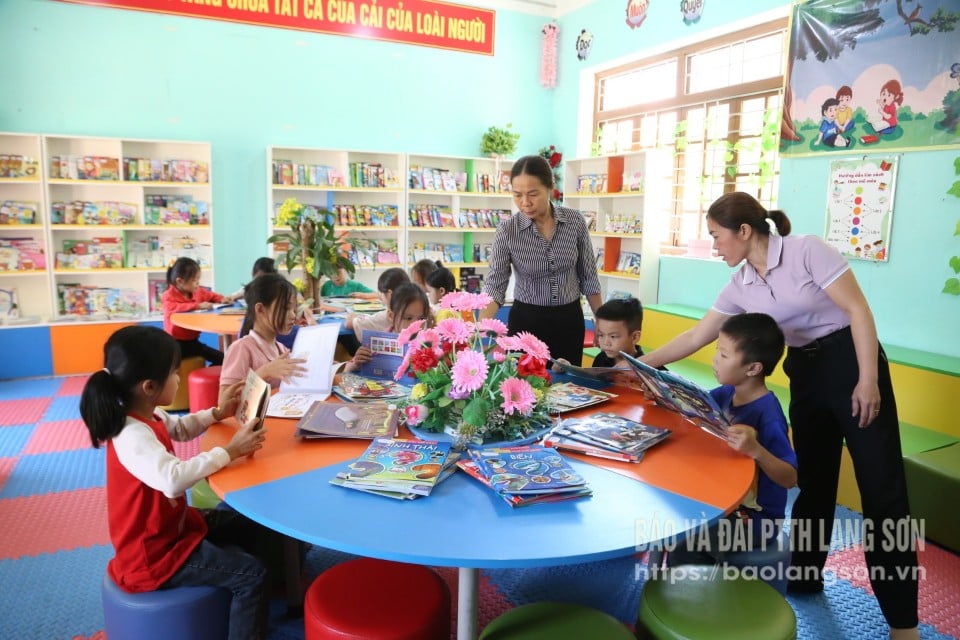
One of the notable highlights is the focus on investing in and promoting a learning environment rich in the Vietnamese language. Between 2016 and 2025, the entire province established nearly 500 "Vietnamese language learning corners" in preschool and primary school classrooms in ethnic minority areas. Each corner is vividly designed with pictures, flashcards, word boards, comic books, and age-appropriate books. School libraries have been supplemented with tens of thousands of new books, and many schools organize group reading activities and picture-based storytelling to help children develop natural expression skills in Vietnamese. In particular, 95% of schools have guided parents in setting up learning corners at home, strengthening the connection between schools and families in supporting children's language learning.
Alongside this, the training and capacity building of teachers has been emphasized. Over the past nearly 10 years, the province has organized more than 600 training courses for over 75,000 preschool and primary school administrators and teachers. The training content has been in-depth, focusing on child-centered language development methods, skills in creating a friendly Vietnamese language learning environment, and integrating bilingual education in classrooms with ethnic minority students.
Ms. Linh Thu Huong, a teacher at Binh Phuc Commune Kindergarten in Van Quan District, shared: “Through specialized training courses, we have gained a deeper understanding of the psychological and linguistic characteristics of ethnic minority children, and thus choose appropriate teaching methods. In class, I often use drawings, toy models, poetry readings, and storytelling combined with illustrative actions to help children remember easily and become more confident in communication.”
Beyond the classroom setting, the provincial education sector has implemented a comprehensive approach involving collaboration with parents and the community. From 2016 to 2025, the province organized 1,590 training courses for parents, attracting nearly 90,000 participants. These courses not only provided basic knowledge on methods for teaching children Vietnamese but also offered specific guidance on storytelling, reading with children, and fostering the habit of using Vietnamese in daily life. As a result, ethnic minority parents are becoming increasingly proactive, contributing to expanding the Vietnamese language learning environment at home and ensuring continuity in children's language acquisition and practice.
These comprehensive and practical solutions not only help children in ethnic minority areas effectively access Vietnamese, the main language in the education program, but also contribute to improving the overall quality of teaching and learning.
Make a noticeable change.
After nearly a decade of persistent implementation of the project, students' language skills and learning quality have shown positive changes. At the preschool level, statistics show that the percentage of children meeting language development requirements annually reaches 96.3% or higher, with 100% of 5-year-olds meeting the standards and ensuring readiness for first grade. This is a crucial age group; if children are well-equipped with Vietnamese, they will be able to absorb lessons quickly and no longer feel afraid or lost when entering a formal learning environment.
The changes are also clearly evident at the primary school level, where Vietnamese is not just an independent subject, but also a foundation for students to access the entire education program. Thanks to increased learning time, appropriate teaching methods, and a rich Vietnamese-speaking environment inside and outside the classroom, the quality of Vietnamese language instruction in schools has improved positively year after year. While in the 2021-2022 school year, the percentage of students who successfully completed Vietnamese was only 54.8%, by the 2024-2025 school year, this number had increased to 67%; meanwhile, the percentage of students who did not complete the subject decreased from 0.6% to 0.43%.
Along with improved academic performance, the effectiveness of mobilizing ethnic minority students to attend school and maintaining student enrollment numbers is also becoming increasingly sustainable. During the period 2016–2025, the enrollment rate of 5-year-old ethnic minority kindergarten children reached 99.9%, consistently maintained over the years. At the primary school level, the number of students attending two sessions per day increased rapidly, reaching 100% from the 2021–2022 school year, creating favorable conditions for strengthening Vietnamese language support and organizing communication and practical learning activities in the standard Vietnamese language. This is an important foundation for students to access subjects and simultaneously develop their thinking and problem-solving skills in Vietnamese, a key requirement of the new general education program.
In many communes, activities to enhance Vietnamese language skills have been flexibly and effectively integrated into specific learning models. At Yen Khoai Commune Kindergarten (Loc Binh District), all kindergarten classes have picture-based storytelling corners, where children actively choose pictures and retell the content in their own words. Mau Son Primary School (Cao Loc District) implements a "Creative Reading Corner" model, where students not only read aloud but also share with their peers what they understand from the books they have just read. That Khe Town Primary School (Trang Dinh District) organizes a "Friendly Library" thematic program, maintaining the habit of daily reading of Vietnamese books for ethnic minority students. These practical models are gradually forming a close and effective Vietnamese language learning ecosystem in the highland school environment.
Phung Thi My Hanh, a student in class 3A at Lien Hoi Ethnic Boarding Primary and Secondary School (Van Quan district), shared: “In class, the teacher often lets us participate in storytelling, role-playing, and playing games in Vietnamese. Thanks to this, I speak Vietnamese more fluently and confidently in front of the class. At home, I also try to talk to my parents in Vietnamese to get used to it, and if there are any words I don't understand, I ask my teacher or friends.”
From a teacher's perspective, Ms. Nguyen Thi Phuong from Dinh Lap Town Primary School expressed: "As a teacher directly involved in teaching, I clearly feel the change in students' ability to acquire knowledge and language skills year after year. Previously, many students were often hesitant and reluctant to speak up due to their limited Vietnamese vocabulary. But thanks to enhanced training from grade 1, through activities such as storytelling, role-playing, language games, and the organization of a Vietnamese language learning corner, they are more confident and speak and write much better. In particular, they grasp other subjects more quickly because they understand the lesson requirements more clearly."
The positive changes mentioned above not only affirm the effectiveness of the project but also contribute to narrowing the language gap between students in disadvantaged and more privileged areas, improving the overall quality of education.
Source: https://baolangson.vn/vung-tieng-viet-sang-tuong-lai-5049819.html

![[Photo] Heartwarming "Journey Home for Tet" in the Year of the Horse at the People's Police Academy](/_next/image?url=https%3A%2F%2Fvphoto.vietnam.vn%2Fthumb%2F1200x675%2Fvietnam%2Fresource%2FIMAGE%2F2026%2F02%2F04%2F1770198043990_hv-cong-an-13-1206-jpg.webp&w=3840&q=75)


![[Image] Ring road costing over 1.3 trillion VND runs through rubber forest.](/_next/image?url=https%3A%2F%2Fvphoto.vietnam.vn%2Fthumb%2F402x226%2Fvietnam%2Fresource%2FIMAGE%2F2026%2F02%2F04%2F1770196533795_image.jpeg&w=3840&q=75)


Comment (0)