

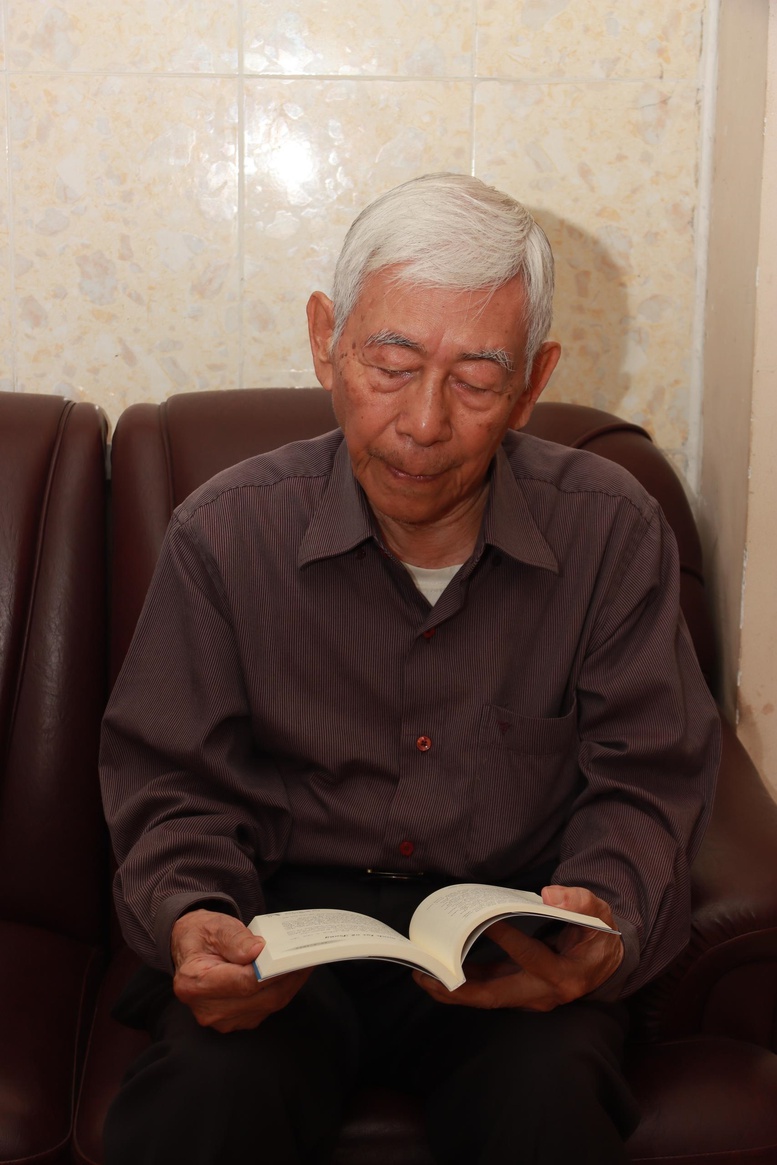
Mr. Nguyen Huu Phuoc
"A glowing ember" waiting to burst into flames.
In 1961, after graduating from Hue National High School, Nguyen Huu Phuoc enrolled at the Saigon University of Science. His entry into the university marked the beginning of his open revolutionary activities. Saigon at that time was a complex political center, but within the universities, the flame of patriotism still smoldered. He quickly connected with the student movement and was inspired by predecessors such as Nguyen Dien, Le Quang Vinh, and Pham Chanh Truc.
During this period, the student journalism movement at the University of Science suffered a great loss when its core group disbanded; some went to the resistance zone and died, some were captured, and some had to flee to France for refuge. Only Ton That Quynh Tan remained, but he was only a supporter and did not participate in the revolutionary organization. Following instructions from the City Youth Union through Pham Chanh Truc and Le Van Tan (Ba Phu), the task of those who remained was to maintain the movement like "a glowing ember, not letting it go out, waiting for the opportunity to flare up again."
Along with Ton That Quynh Tan and Truong Dinh Vinh Long , Nguyen Huu Phuoc became the core of the school's press committee. They not only maintained the publication of two special issues per year but also launched "Student News," a mimeographed newspaper measuring 21x31cm with a blue title, published twice a month. This was considered the newspaper with the highest circulation in the student press movement before 1975, with over 100 issues published over three years.
The newspaper's content was both relatable and relevant to student life through its "Student Life" column, and served as an ideological banner for various protest movements. In particular, the newspaper became an effective tool, contributing to the success of the movement demanding the translation of French into Vietnamese at the University of Science.
Behind those newspaper pages were long, sleepless nights. He and his colleagues had to stay up all night preparing, editing, hiring typists, correcting errors, and printing. The work was arduous, sometimes forcing them to neglect their studies. He will never forget the silent support of Mr. Hoa, the owner of the "Roneo Hoa" shop, who wholeheartedly helped, almost without asking for anything in return, and readily allowed revisions to the manuscript many times despite the extremely difficult work with the mechanical typewriters of that era. Memories of those nights working on the newspaper, of the people who silently supported that "glowing ember," have become an indelible part of his mind.
By mid-1964, when mass movements erupted, drawing students in, the "glowing embers" they had nurtured truly burst into flames. He and Quynh Tan handed over their journalistic work to the next generation to move to a new area of operation.
The pen reaches far, joining with major movements.
After leaving the University of Science, Nguyen Huu Phuoc continued his studies and activities at the University of Literature (1964-1965) and then at the University of Agriculture, Forestry and Animal Husbandry (1965-1968). At each institution, he left his mark as a passionate student journalist. While at the University of Literature, he only managed to "intervene to sow the initial seeds" in a complex political environment, at the University of Agriculture, Forestry and Animal Husbandry, his work was extremely successful.
The majority of students at the Faculty of Agriculture, Forestry and Animal Husbandry came from disadvantaged families and were close to farmers, thus possessing a strong sense of patriotism and revolutionary sentiment. Along with like-minded comrades such as Nguyen Van Thuan, Tran Quang Vien, and Phan Dung, he continued to publish special issues and the "Agricultural, Forestry and Animal Husbandry Student Newsletter." This school, along with the Faculty of Pharmacy and the Faculty of Literature, formed an "iron triangle," serving as a base for vibrant demonstrations, and student journalism was an effective ideological and propaganda tool.
His writing wasn't confined to the school environment; it extended to and immersed itself in major mass movements. In 1965, when the Vietnamese National Self-Determination Movement was founded, Le Van Tan (Ba Phu) arranged for him to work as a secretary for the Executive Committee and editor for the movement's newspaper, " Self-Determination ." He contributed to drafting "The Call for Peace of Vietnamese Youth, Students, and Pupils" and directly typed the historic resolution calling for an end to the war and demanding national self-determination. The emotion of typing each word of the resolution on a rudimentary typewriter became an unforgettable memory in his life.
In early 1966, he was again assigned by the City Youth Union to join the editorial board of the newspaper Hon Tre (Youthful Soul ). This was a legitimate newspaper, taken over by the City Youth Union as a propaganda tool. The editorial board consisted of five people: journalists Xuan Trang, Thao Lam, Yen Hoai, Huu Phuoc (with the pen name Tuyet Huu), and Ms. Hoang Le Tuyet Ngoc (with the pen name Tam Bich) – who later became his life partner. Together, they transformed Hon Tre into a widely influential newspaper, attracting a large number of contributors including intellectuals, teachers, writers, and student journalists.
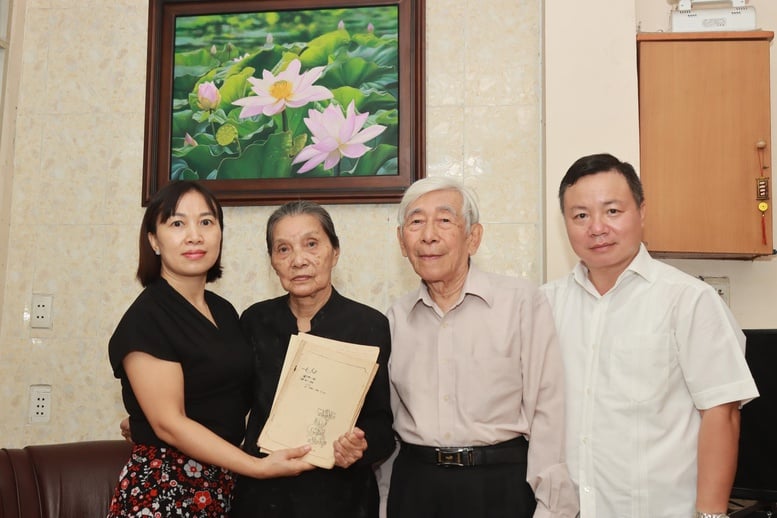
Mr. Nguyen Huu Phuoc donated artifacts to the Museum of the Vietnam Fatherland Front.
"The Express Newspaper" for the historic night
In late 1967, driven by the idea of uniting student newspapers, and under the guidance of the City Youth Union, Nguyen Huu Phuoc successfully organized the Saigon Student Journalism Congress, which brought together approximately 60 student journalists. The Congress elected an Executive Committee, and he was entrusted with the position of President.
In the association's statement, he wrote these spirited lines:
"The voices of students today, although only partially expressing the meaning and truth of the immense national humiliation, have courageously begun to speak out on issues of war, peace, and democracy… Each step forward is built upon the blood and imprisonment of the people, including students… "
Just before the Tet Offensive of 1968, the Association received an urgent and unexpected task from Brother Ba Triet (Nguyen Ngoc Phuong): to immediately publish a typographically printed newspaper to serve the "Cultural Night Celebrating the Quang Trung Tet Holiday," with a deadline of only one day and one night.
It was a seemingly impossible challenge. He had to shoulder everything alone: being the editor-in-chief, managing editor, running the printing press, proofreading, distribution, and treasury. In his small house on Phan Thanh Giản Street, he stayed up all night writing. He completed the editorial "Quang Trung's Flame Burning in Our Hearts" in a surge of emotion. To fill the newspaper pages, he gathered news, then suddenly remembered the poetic drama "The Call of Lam Sơn" by poet Trần Quang Long and decided to quote a long passage.
The next morning was a race against time to find a printing house. All the usual places refused because it was so close to Tet (Lunar New Year). Finally, he took a chance and went to the Phuong Quynh printing house of Professor Ton That Duong Ky's family, an address that might be under security surveillance. Fortunately, Mrs. Duong Ky and the workers agreed and put aside everything else to help him. By afternoon, 3,000 newspapers were ready. He hurriedly transported them to the National School of Administration, where the cultural performance was about to take place.
The newspapers were distributed to the masses like legitimate leaflets, accompanied by the stirring drumbeats from the brightly lit stage. Joy erupted as he completed his mission. Only a few days later, when the gunfire of the Tet Offensive rang out, did he fully understand the sacred significance of his work. That "express newspaper" was a rallying cry, a preparation of the masses' spirit right before that historic moment.
Three sleepless nights and acts of kindness
The Tet Offensive of 1968 transformed student journalist Nguyen Huu Phuoc into a true soldier on the streets of Saigon. He spent three sleepless nights, three nights of waiting, courage, and love.
On the night of the 1st, he and 12 students, mostly medical students, including Truong Thin, anxiously awaited weapons to launch an uprising at Vuon Chuoi market, but the delivery failed. Medical students rarely protested, but when the need arose, they were ready to sacrifice themselves. On the night of the 2nd, he was assigned to Binh Dan Hospital to transport the wounded. Facing pools of blood and bodies ravaged by bombs and bullets, he was deeply moved and wrote the poem "A Few Months of Life" that very night. The poem was later published in the "Hand in Hand, Covering Each Other" newspaper of the Committee for the Relief of Compatriots.
After those horrific nights, he and the Saigon Student Union established several relief centers for victims of the disaster, including a relief center at Phan Dinh Phung Primary School. He was assigned to be the Deputy Head of the Internal Affairs Department, and was jokingly called "Grandpa" by his colleagues. There, he not only handled the provision of rice and medicine but also carried out propaganda work, instilling ideals in young people. Once again, he demonstrated his organizational talent and subtlety in mass mobilization work.
He managed to win over the group of unruly and disruptive "street youths," transforming them into an active "transportation and order-keeping team" for the center. It was also thanks to their trust that he calmly handled the situation and ensured the safety of a female officer from the North who had gotten lost, avoiding suspicion from those around her.
It was also at this relief center that the love between him (Tuyet Huu) and Tuyet Ngoc (the person in charge of children's education) deepened. The poem "The Project" that he wrote for her is proof of a love that blossomed amidst the smoke and fire of war, a rare joy during those tense days.
Nguyen Huu Phuoc's eight years as a student journalist (1960-1968) came to an end after the Tet Offensive. He continued his work for the revolution, was arrested by the enemy in 1973, and it was during this time that his family was forced to burn all the precious stacks of student newspapers he had kept. The physical newspapers may be gone, but the flame that he and his generation ignited will never be extinguished. It has become a part of history, a heroic memory of a time when Saigon students lived, loved, and fought wholeheartedly for the independence and peace of the nation.
Chu Van Khanh
Source: https://baochinhphu.vn/chang-sinh-vien-sai-gon-thap-lua-cho-mot-the-he-102260109180635126.htm

![[Image] Bridges and roads connecting the eastern part of Ho Chi Minh City](https://vphoto.vietnam.vn/thumb/1200x675/vietnam/resource/IMAGE/2026/04/16/1776328595108_ndo_br_bh-vt5-jpg.webp)





































![[Infographic] Details of the Hanoi-Quang Ninh High-Speed Railway Project](https://vphoto.vietnam.vn/thumb/402x226/vietnam/resource/IMAGE/2026/04/16/1776338188424_anh-man-hinh-2026-04-16-luc-18-16-10.png)
![[Photo] National Assembly Chairman Tran Thanh Man meets with the Speaker of the Georgian Parliament](https://vphoto.vietnam.vn/thumb/402x226/vietnam/resource/IMAGE/2026/04/16/1776338494029_anh-man-hinh-2026-04-16-luc-18-21-21.png)












Comment (0)