

 |
The launch of ChatGPT Translate may just be the "opening shot" for OpenAI. Photo: Bureauwork . |
For many years, Google Translate has been an indispensable companion for millions of people needing to break down language barriers. However, a formidable competitor has just officially emerged. OpenAI has quietly launched a specialized translation tool called “ChatGPT Translate,” marking a strategic move to challenge Google's dominance in this field.
OpenAI chose a safe approach by almost perfectly mimicking the user experience from its competitors. The ChatGPT Translate interface feels familiar at first glance with its traditional layout of two parallel text boxes. From automatic input language recognition to support for over 50 languages, this tool incorporates all the fundamental features that Google Translate users consider standard.
However, the real difference with ChatGPT Translate lies not in the translation itself, but in the "post-processing" part. While traditional tools often only achieve the most accurate translation possible, OpenAI focuses on its AI strengths.
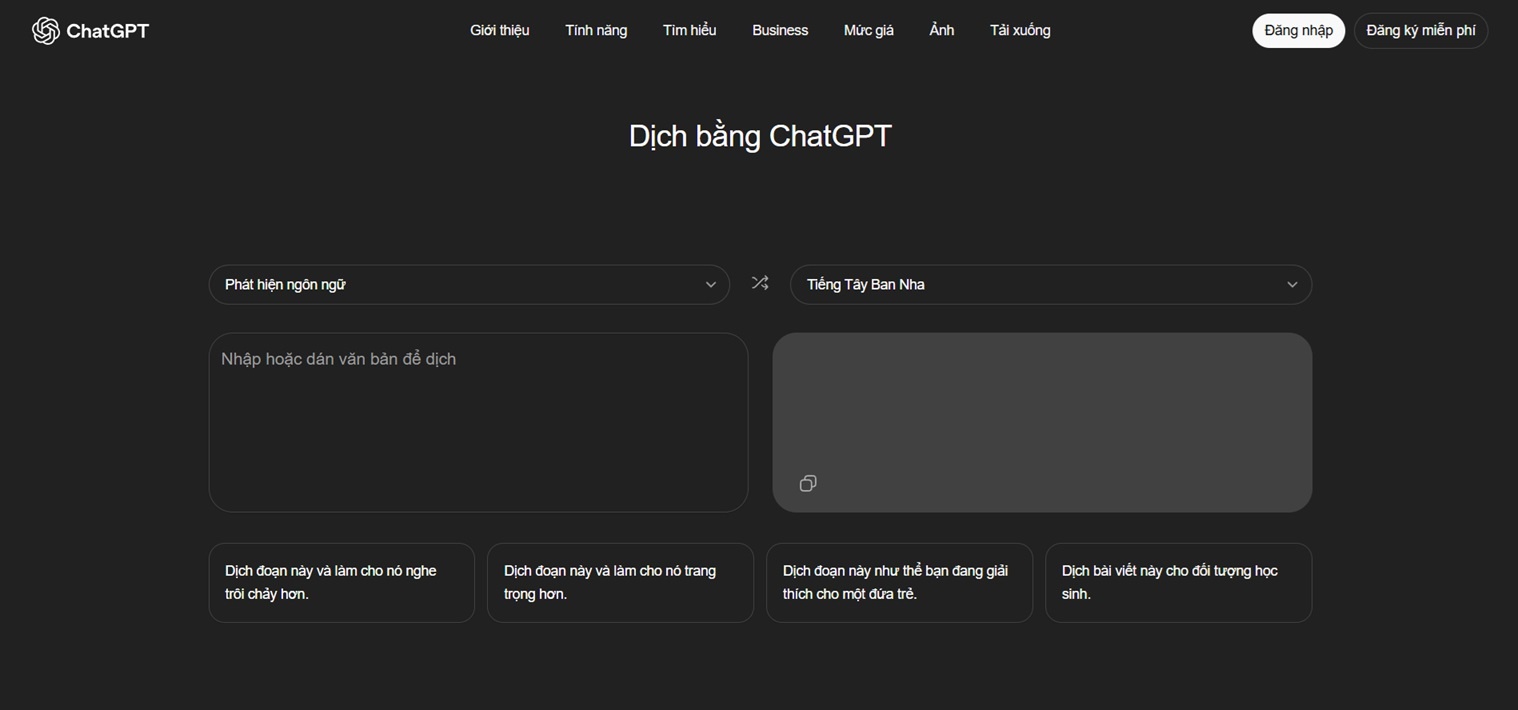 |
The ChatGPT Translate interface. |
Below the translation interface are quick adjustment shortcuts. With just a tap, users can ask the AI to rewrite the translation in a formal style for business partners, simplify the content so that even children can understand it, or transform it into specialized academic language.
When these options are selected, the system will redirect the user to the main ChatGPT interface with pre-written commands, allowing for deeper customization based on context and target audience.
According to Android Authority , ChatGPT Translate's greatest strength lies in its ability to understand tone and context—something traditional translation tools often overlook. Instead of just being a smart dictionary, ChatGPT acts as a language editor, making translations sound more natural.
However, OpenAI still has a long way to go to dethrone Google. Currently, ChatGPT Translate still shows clear weaknesses in terms of functionality. This tool mainly supports plain text on computers and voice input on mobile devices.
Advanced features that Google has perfected over the years, such as live web page translation, translation of complex documents (PDF, Word), handwriting translation, and real-time conversational translation, are still absent from OpenAI's platform. Furthermore, ChatGPT's support for over 50 languages is still quite modest compared to Google's vast catalog.
On Google's part, the company has also just announced major updates to its translation tool, powered by the powerful Gemini model. The tech giant is focusing on handling slang, idioms, and local expressions, while also testing a feature for translating conversations directly through headphones.
The quiet launch of ChatGPT Translate may just be the opening salvo. “Currently, Google is clearly still ahead. But ChatGPT Translate hints at a different future, where translation isn’t just about accuracy, but also about adapting to the person you’re talking to,” Android Authority noted.
Source: https://znews.vn/chatgpt-tuyen-chien-with-google-dich-post1620358.html


















































































Comment (0)