On June 26, the horrific scene of devastation was evident after two powerful earthquakes measuring 7.2 and 7.5 magnitude struck Venezuela on the night of June 24 local time.
The death toll from the earthquake continues to rise sharply and risks reaching thousands. However, rescue efforts remain slow, and with each passing hour, the chances of survival for those trapped diminish.
The sound of despair
The state of La Guaira in northern Caracas is one of the hardest-hit areas. Interim President Delcy Rodriguez has declared the region a "disaster zone".
Venezuelan authorities said that around 250 buildings were destroyed or severely damaged. At least eight hospitals, the headquarters of the Venezuelan Red Cross, and the French embassy were among the affected.
Health Minister Carlos Alvarado said at least 235 people have died and around 4,300 have been injured. However, the death toll is expected to rise as hundreds remain trapped and tens of thousands are still unaccounted for.
Experts say that the chances of survival for those trapped without a water source decrease rapidly after the first 48-72 hours.
The U.S. Geological Survey (USGS) forecasting model suggests the final death toll could reach thousands, possibly even exceeding 10,000.
"This is a disaster zone," declared Venezuela's interim leader, Delcy Rodriguez, adding that the government is calling on private companies to provide heavy equipment and expedite rescue efforts.

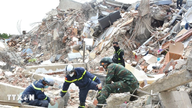
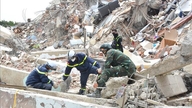
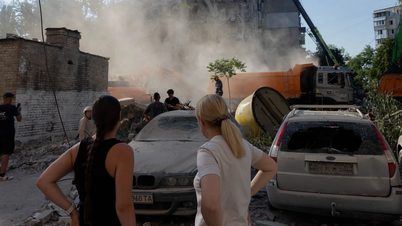
But the rescue operation has yet to speed up. An anonymous rescuer said working conditions are currently very difficult due to a shortage of trained personnel and significant limitations in technical equipment. What is being used are excavators, sledgehammers, and bare hands.
At a flattened building, rescuers used sledgehammers to break through the rubble and called for "absolute silence" so they could hear the voices of survivors. In La Guaira, the hardest-hit area north of the capital Caracas, a mother dug through massive piles of concrete with her bare hands in search of her son.
"It's all rocks, and using only your bare hands is useless," she said in despair. Elsewhere, a young girl died after being trapped for hours, while onlookers watched helplessly, according to AFP.
International aid began to arrive.
International rescue teams have begun arriving in Venezuela to participate in the search for survivors. "We have requested international aid, and support from our brother nations will begin arriving in the coming hours," said Ms. Rodriguez while in La Guaira assessing the damage. Venezuela's main airport in the state has also been damaged, posing a significant infrastructure challenge for the international forces.
The US announced it would deploy two warships, transport aircraft, and helicopters, and mobilize $150 million in aid. US Secretary of State Marco Rubio pledged a "comprehensive" response, asserting that the assistance would be "large-scale, rapid, and effective."
Senior US military officials have arrived in Caracas to coordinate Washington's relief efforts. The US Treasury Department has also temporarily lifted some sanctions against Venezuela to facilitate aid following the earthquake.
On the morning of June 26, a team of 80 Swiss rescuers arrived in Venezuela, while a team of 65 Dutch rescuers, sniffer dogs, and equipment had already departed.
Rescue teams from neighboring Latin American countries including Chile, Dominica, El Salvador, and Mexico have also arrived. In addition, Spain, France, Portugal, China, India, Brazil, Cuba, and Iran have offered assistance.
United Nations Secretary-General Antonio Guterres said he was "deeply saddened" by the disaster and that the UN was committed to supporting Venezuela in responding to the earthquake's aftermath.
UN emergency relief coordinator Tom Fletcher said the world will need "a large-scale collective effort" to help Venezuela overcome this disaster.
Vietnamese people in Venezuela are still safe.
Speaking to Tuoi Tre newspaper on June 26, Vietnamese Ambassador to Venezuela Vu Trung My said that at the time of the double earthquake on June 24, there were 42 Vietnamese people in the country, mainly embassy staff and some Vietnamese expatriates.
To date, everyone is safe, in stable spirits, and sharing the difficulties with the local people.
Immediately after the natural disaster occurred, the Embassy activated consular services and formed a group to inform and connect with the Vietnamese community. People were advised to follow the instructions of local authorities and maintain regular contact with the embassy.
The Vietnamese representative agency has emphasized the need for Vietnamese citizens to move to secluded areas and stay in low-rise buildings to avoid dangerous aftershocks.
Source: https://tuoitre.vn/chay-dua-tim-mang-song-o-venezuela-100260627081144326.htm