

On June 14th in Hanoi, the Ministry of Education and Training (MOET) held a conference to implement projects on human resource development and cooperation between the state, schools, and businesses.
Lack of mechanisms to attract and utilize talent.
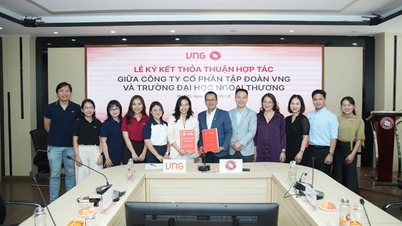
Deputy Minister of Education and Training Nguyen Van Phuc emphasized that cooperation among the "three parties" (state - schools - businesses) plays a crucial role in closely linking training, scientific research with the labor market and the economy , and enhancing national competitiveness. In this collaboration, the state plays a key role in creating and formulating institutions and policies, creating a favorable legal environment to encourage linkages and knowledge transfer, and investing state budget funds. Schools are not only places of training but also centers for knowledge creation, scientific research, and technology transfer, and need to be encouraged to be more closely linked with businesses, with more investment to meet practical needs and market demands. Businesses are not only employers of graduates from schools but also providers of research results, implementing and commercializing them, making them the most important partners for schools.

Students from Ho Chi Minh City University of Technology and Education participate in the "Students and Young Entrepreneurs with Startup Ideas 2025" competition. Photo: NGUYEN HUYNH
Associate Professor Pham Bao Son, Vice Director of Vietnam National University, Hanoi, emphasized that the Party and State have issued many resolutions to develop science and technology and innovation, but the full potential has not yet been realized due to many obstacles. Prominent among these are the lack of synchronized policies and mechanisms, the absence of mechanisms to attract and utilize talent leading to a "brain drain," limited connections between businesses in research and development activities preventing them from truly becoming centers of innovation, inflexible financial mechanisms, and complex administrative procedures.
Associate Professor Vu Dinh Tien, representing Hanoi University of Science and Technology, expressed that for many years, the common model for promoting research cooperation among the three parties has been science and technology projects using state budget funds and matching funds from businesses, carried out by higher education institutions. This model has achieved some notable successes; however, facing the reality, many inherent limitations still exist, creating "bottlenecks" that hinder its effectiveness. These bottlenecks relate to motivation and commitment, as the primary source of research funding in this model inadvertently reduces commitment and pressure for success from businesses. The "matching" funds are sometimes merely symbolic; businesses do not truly consider the implementation of science and technology projects as a vital strategic investment. From the perspective of higher education institutions, the greatest pressure comes from scientific publications and the complex administrative procedures and accounting processes, rather than the pressure to create a commercially viable product. This conflict of goals is the biggest obstacle.
The "strategic triangle" opens up many opportunities.
Associate Professor Tien also argued that the intellectual property mechanism in projects funded by the state budget still has many unclear and complex points. Who is the ultimate owner of the product? What is the profit sharing ratio? This lack of transparency makes businesses hesitant to invest deeply in the commercialization phase, fearing legal risks and future disputes. Another bottleneck is the "Valley of Death": Projects often stop at the prototype stage or laboratory results. The gap from here to a finished product, ready for mass production and market acceptance, is a "valley of death" requiring very large investment resources. The current model almost completely ignores this stage, causing most research results to fail to overcome the "valley of death" to create economic value. As a result, despite significant investment from the state budget and businesses, the number of high-tech products "made in Vietnam" from these collaborative projects that are competitive in the market remains very modest.
Associate Professor Pham Bao Son emphasized that the model of linking the state, universities, and businesses will effectively utilize resources and maximize investment efficiency. Professor Nguyen Thi Thanh Mai, Vice Director of the Vietnam National University Ho Chi Minh City, also stressed that "one tree alone cannot make a forest. Three trees together can make a high mountain." According to Professor Mai, the tripartite cooperation must operate based on common principles: joint design, joint implementation, and shared values. In this model, the state creates policies and institutions in the spirit of Resolution 66; universities train high-quality human resources and develop science and technology as directed by Resolution 57; and Resolution 68 emphasizes businesses commissioning training, collaborating on research, and commercializing products from universities. "When this 'strategic triangle' operates effectively, the nation will have the opportunity to 'leapfrog' ahead, escape the middle-income trap, and rise strongly," Professor Nguyen Thi Thanh Mai stated.
Boost "order placement"
Hanoi University of Science and Technology proposes a new model of cooperation with businesses, placing the market and businesses at the center. From "matching" to "ordering," the policy should strongly promote a model where businesses directly commission research from higher education institutions. In this model, businesses set the research topics, clearly define the output requirements, and are the primary source of funding. The State needs to gradually shift its role from "funding provider" to "creator and supporter."
Source: https://nld.com.vn/chia-khoa-dot-pha-nhan-luc-va-doi-moi-196250614212535828.htm


![[Photo] Prime Minister Pham Minh Chinh receives the Chinese Ambassador to Vietnam](https://vphoto.vietnam.vn/thumb/1200x675/vietnam/resource/IMAGE/2026/04/05/1775397481797_ndo_br_dsc-5512-jpg.webp)












































































Comment (0)