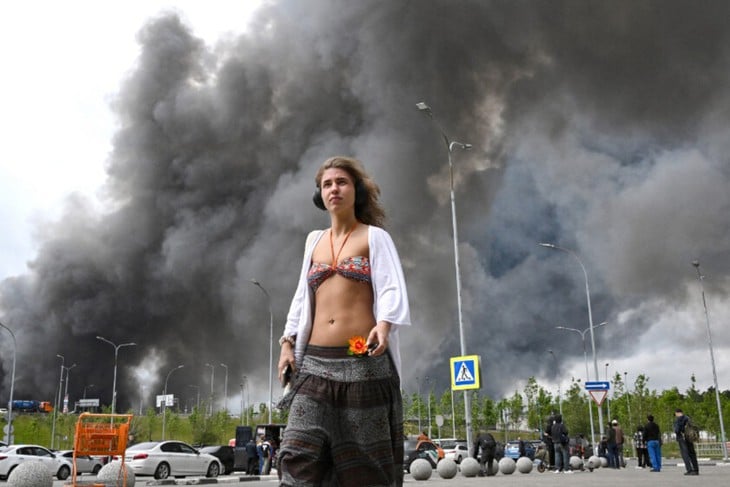
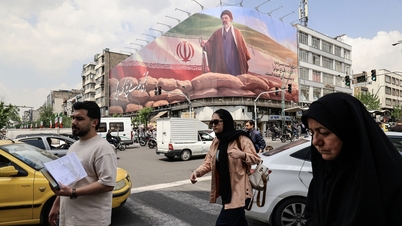
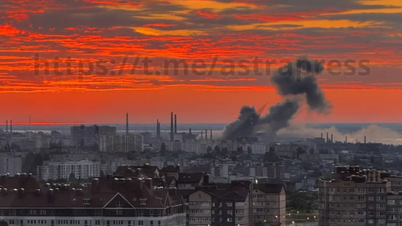
A young woman walks outside a shopping center as black smoke rises from the Moscow oil refinery of oil producer Gazprom Neft in the southeastern suburbs of Moscow on June 18 - Photo: AFP
Russian air defense systems shot down at least 194 drones heading toward the capital overnight, according to Moscow Mayor Sergei Sobyanin.
Across Russia, the attacks injured at least 17 people, and Russian air defenses intercepted nearly 1,000 drones, according to the Russian Ministry of Defense .
Flights at all major airports in the Moscow region were temporarily suspended on June 18, Reuters reported, citing the Russian aviation authority.
Nearly 1,000 drones were intercepted.
Kyiv has been increasingly targeting Russian energy infrastructure in recent long-range attacks – something Ukrainian President Volodymyr Zelensky increasingly views as a key counter-strategy for Kyiv.
Zelensky called the attacks on June 18 a "justified" response, following Russia's airstrike that damaged a UNESCO-recognized historical monastery complex in central Kyiv earlier this week.
"We don't want this war and never did – everyone knows that, and our partners know that," CNN quoted Zelensky as saying. "But if Ukraine is engulfed in flames, so will Moscow. That is why we emphasize once again that it is time to end the aggression, it is time to end this war."
Among Ukraine's targets is the Moscow oil refinery, located just 15km from the Kremlin in the southeastern district of the capital, Kapotnya.
Video, geo-verified by CNN, shows a projectile launched from the ground onto a road as drones approach the oil refinery, followed by thick black smoke rising into the air.

Another clip shows a massive explosion rocking the entire plant complex, blowing the roof of a giant fuel storage tank into the air.
Russia retaliated against Ukraine with seven missiles and 239 drones, according to the Ukrainian Air Force. The Russian attack hit a residential house, an energy infrastructure facility, an aircraft hangar, and oil facilities in the Kyiv and Poltava regions, according to Ukrainian and Russian authorities.
Kyiv's new strategy
Ukraine's drone strike strategy deep into Russian territory in recent months has become increasingly organized, widespread, and targeted oil refineries and storage facilities, naval bases, and transit ports. According to analysts, oil accounts for about one-third of Russia's state revenue.
The refinery in the Kapotnya district supplies 40% of Moscow's gasoline and about half of its diesel.
Videos circulating online show Ukrainian drones flying over the city virtually unimpeded, implying that Kyiv may have mastered the technology to penetrate Moscow's particularly dense, multi-layered defenses, especially around sensitive targets.
From a tactical standpoint, these attacks demonstrate that Ukraine not only used drones, but also employed a certain degree of coordination between various weapons and local forces.
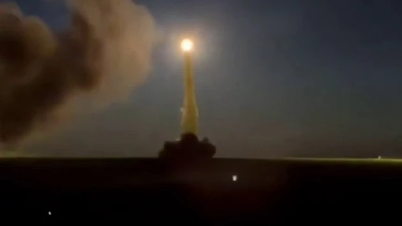
Experts believe that Ukraine used rocket-powered drones to launch missiles during the June 18th operation.
Kyiv publicly displayed several such drone-launched missile systems in late 2024 and early 2025, including the Bars hybrid drone cruise missile, which military sources believe was involved in the latest airstrike.
Faster and harder to intercept than conventional propeller drones, these advanced drones stem from the practical needs of a war now in its fifth year. They pose an increasing challenge to air defense systems, which are still largely based on "pre-drone" warfare designs.
Beyond the direct impact of destroying energy infrastructure, by targeting plants like the one in Kapotnya, Ukraine also hopes to make ordinary Russians aware of the consequences of the war.



Whether that goal is achieved will depend on the extent of damage to the plant, Russia's ability to redirect fuel supplies elsewhere, and Ukraine's capacity to sustain the attacks.
Russia declares large-scale retaliation.
According to the Telegraph , hardliners in Russia have called on the Kremlin to respond to Ukraine's latest attack with force in order to prevent any future cross-border attacks.
Russian Foreign Minister Sergey Lavrov stated: "It is no coincidence that some time ago, after another reckless act by terrorist elements in Kyiv, the President (Putin) announced that we would now carry out large-scale attacks on a regular basis."
Source: https://tuoitre.vn/chien-luoc-moi-cua-ukraine-100260619231941095.htm



![[Photo] A phone-free summer afternoon at the village library](https://vphoto.vietnam.vn/thumb/1200x675/vietnam/resource/IMAGE/2026/06/27/1782551770949_anh-1-jpg.webp)
![[Photo] "Hanoi Lotus Festival" honors the lotus flower that has been associated with Vietnam for thousands of years.](https://vphoto.vietnam.vn/thumb/1200x675/vietnam/resource/IMAGE/2026/06/27/1782516943048_sen-ha-noi-2026-minh-duy-1-jpg.webp)






















































![[Infographic] 16 fireworks display locations to celebrate the 50th anniversary of Ho Chi Minh City being honored with the name of President Ho Chi Minh](https://vphoto.vietnam.vn/thumb/402x226/vietnam/resource/IMAGE/2026/06/27/1782539591308_man-ban-phao-hoa-ruc-ro-dem-khai-mac-638jpg-17242995540161175940469.jpeg)