Behind every article and news report in Vietnamese lies the immense effort of the students and the dedication of the instructors. This journey not only trains journalists for Laos , but also contributes to building bridges of knowledge, culture, and lasting friendship between the Vietnamese and Lao people.
Special classes in journalism school.
During news writing skills classes at the Department of Archival and Journalism Studies, Santiphap – the class leader of the Lao Military Journalism Class K4 – was always one of the most meticulous note-takers. Next to the lecture notes was a worn-out notebook, densely filled with bilingual Vietnamese-Lao writing. For each new term that appeared, Santiphap would mark, compare, and annotate it using different colored inks.
Behind the worn-out notebook, weathered by each semester, lies a long journey of overcoming language barriers for Lao students on their path to a career in journalism.
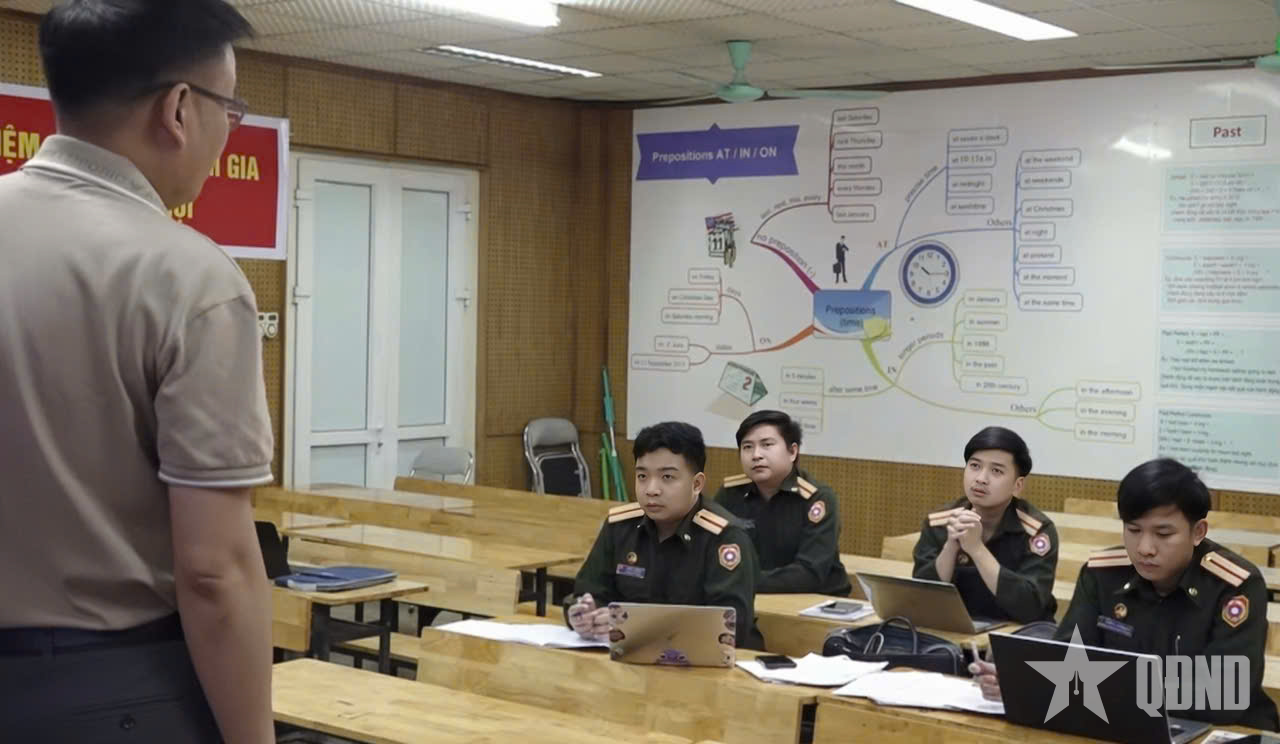 |
Santiphap, a student in the Lao Military Journalism Class K4 (seated at the first table from the right ), and his classmates attentively listen and take notes during the lecturer's lecture. |
In 2020, the Military University of Culture and Arts began admitting its first cohort of Lao students to study Military Journalism. To date, the university has trained six cohorts of Lao students, two of whom have already graduated. Currently, the Faculty of Archival and Records Management and Journalism is training 18 Lao students in cohorts K3, K4, K5, and K6.
What's special is that the entire training program is conducted in Vietnamese. Therefore, in addition to acquiring specialized knowledge in journalism, students also have to overcome a significant language barrier during their studies.
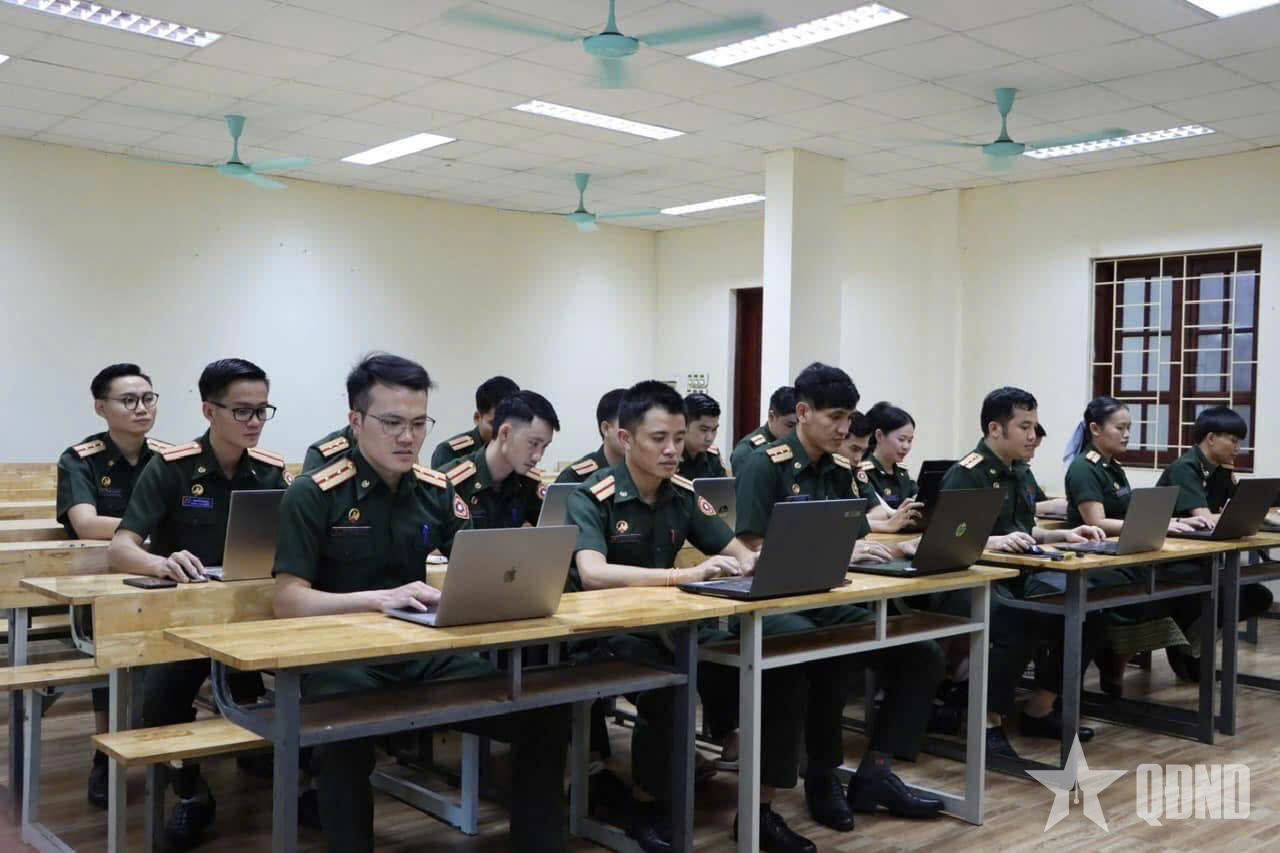 |
| Lao students during a class in 2024. |
For Santiphap, the biggest challenge wasn't the sheer volume of specialized knowledge, but rather the ability to learn and use Vietnamese in a journalistic environment. In the early days, Santiphap frequently recorded lectures to listen to again in the evenings, and also spent a lot of time researching vocabulary and editing sentences. Some assignments, even those with only a few hundred words, took hours to complete.
Language barriers become even more apparent when approaching specialized concepts such as timeliness, sources, perspectives, work structure, style, and genre. These concepts require learners not only to memorize them but also to deeply understand and accurately apply them in practical work.



“When I first started studying, I faced many difficulties because I didn't fully understand the specialized terminology in journalism. During lectures, there were some topics I had to record to listen to again later. Writing a short news report also took a lot of time because I had to look up words and edit sentences,” Santiphap shared.
From Santiphap's story, I realized that learning journalism in a second language is not just about learning vocabulary, but about learning how to think and organize information according to professional standards. Each genre of journalism has its own "language," requiring long-term training.
It's not just Santiphap; many students in other courses are also on a similar journey, with notebooks full of terminology and hours of self-study after each class…
Bridging the gap through professional practice.
During a field trip to VTVcab Vietnam that I had the opportunity to accompany the group of students, Santiphap and her classmates continuously took notes, exchanged ideas, and asked questions about new concepts. The learning atmosphere became more lively as the Lao students proactively sought to understand the content using their steadily improving Vietnamese language skills.
 |
| Lao Military Journalism trainees on a field trip at VTV Cab Vietnam. |
While language may be a barrier in the classroom, practical activities and professional experience become an "open classroom," where students are compelled to use Vietnamese more naturally. Outside of class, Lao students maintain a habit of reading online newspapers, following current events, and practicing writing daily. Glossary notebooks become indispensable tools in their studies. In particular, participation in practical activities such as writing news, conducting interviews, taking photos, filming, and processing information on location has helped students gradually improve their Vietnamese language skills in a real-world journalistic environment.
Colonel, Master's Degree holder Ho Thi Hoang Ha, Head of the Department of Archival and Journalism, stated: "Training Lao students is an important task, contributing to strengthening Vietnam-Lao relations while comprehensively focusing on professional expertise, Vietnamese language skills, and adaptability; the training process is implemented flexibly, linking theory with practice, with close support and guidance from lecturers."
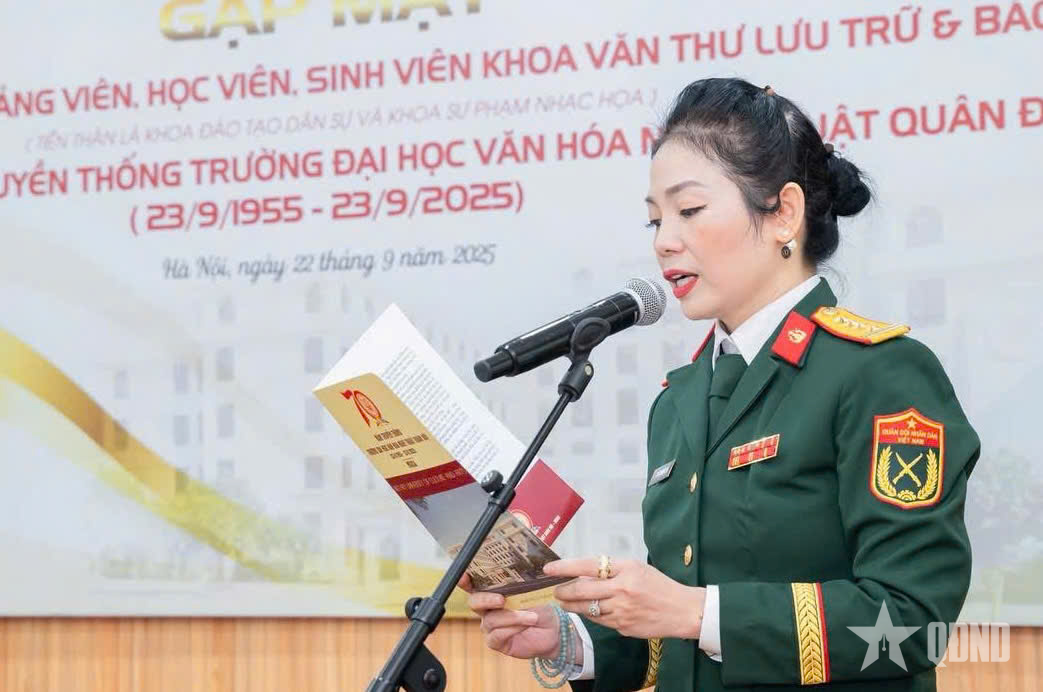 |
| Colonel, Master's Degree holder Ho Thi Hoang Ha, Head of the Department of Archival and Journalism Studies, shared information about the training of Lao students . |
From a journalist's perspective, I found the flexibility and dedication of the teaching staff to be crucial in bridging the language gap for Lao students. Besides imparting professional knowledge, the instructors proactively adjusted their teaching methods and expressions to suit the learning abilities of each student, helping them gradually and effectively access journalistic knowledge.
Major, Dr. Nguyen Minh Tuan, lecturer at the Faculty of Archival and Journalism, shared: “Lecturers need to flexibly adjust teaching methods to suit international students, especially in terms of language and approach to knowledge. In addition, field trips are increased to help students connect theory with practice, improve skills and adaptability.”



In the context of journalism undergoing a strong transformation towards multimedia and digitalization, the challenge for Lao trainees is not only the Vietnamese language but also the need to adapt to new professional skills. Many articles require multiple revisions, but this process helps them improve daily. From clumsy news reports to more clearly structured articles, maturity is gradually evident in each journalistic product.
Despite the many challenges ahead, the training of Lao students in journalism in Vietnamese at the Faculty of Archival and Records Management is proving to be highly effective. This is not only a professional training activity but also a vivid testament to the effectiveness of educational and defense cooperation between Vietnam and Laos.
I left the Journalism Faculty lecture halls well past 11 a.m. However, looking at Santiphap's desk, I still saw the bilingual notebook that had accompanied her throughout her years of study in Vietnam. The pages, growing thicker with time, bore the mark of a persistent journey.
Behind the classroom, the story of the Lao students continues – a story of conquering a new language to enter the field of journalism, and further, a journey back home with knowledge, experience, and beautiful memories of Vietnam and its people. They are not only learning how to be journalists, but also how to become "bridges" fostering Vietnam-Lao friendship through their chosen profession.
Source: https://www.qdnd.vn/giao-duc-khoa-hoc/nha-truong-quan-doi/chinh-phuc-tieng-viet-de-hoc-lam-bao-1045904