

 |
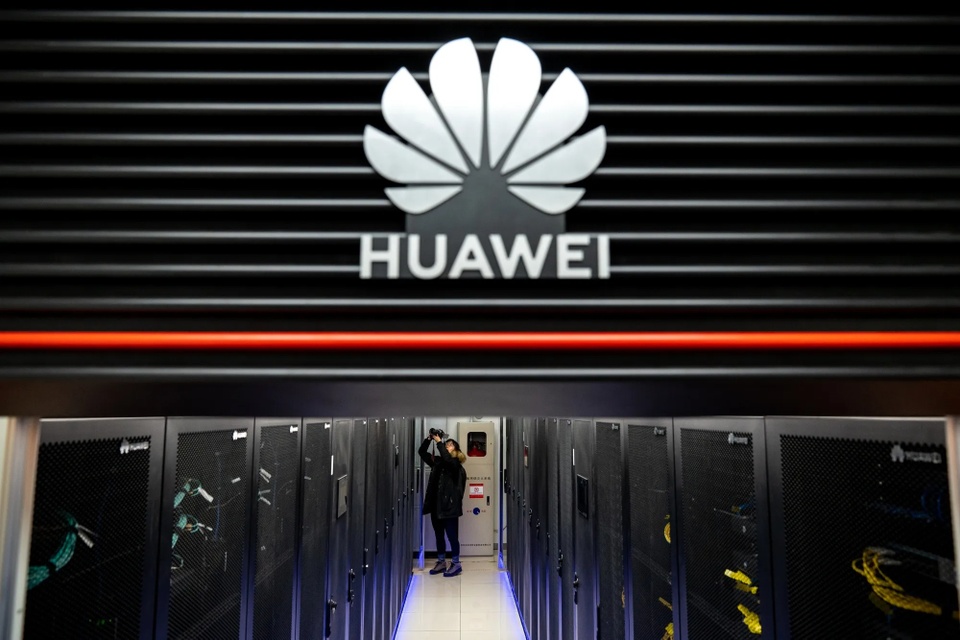
Huawei is confident its new chip line can replace its supply from Nvidia. Photo: Bloomberg . |
On April 9th, US President Donald Trump extended the ban on exporting AI chips to China, including the high-performance Nvidia H20 series. Just one day later, Huawei announced the Ascend 920, its next-generation AI processor, at a partner conference.
DigiTimes Asia reports that the Ascend 920 is expected to enter mass production in the second half of 2025. Additionally, industry experts suggest it could replace the H2O, as China may lose access to that product in the near future.
Currently, Nvidia's H20 chips remain a popular choice for Chinese companies, despite their perceived inferiority compared to Nvidia's latest AI products. The American semiconductor company earns billions of dollars selling chips to partners in China, with sales reportedly increasing by 50% each quarter.
However, Nvidia suffered significant losses following the latest US ban on AI chip exports, with potential losses reaching up to $5.5 billion .
Conversely, this presents a significant opportunity for Huawei, as the company has been working for years to catch up with Nvidia. The company's current AI chip, the Ascend 910C, offers approximately 60% of the inference performance of the Nvidia H100.
On the other hand, the next-generation Ascend 920 will utilize a 6nm process, is expected to surpass 900 TFLOPs (one trillion floating-point operations per second), and boast a memory bandwidth of 4TB/s when using HBM3 modules. Furthermore, the 920C variant, built for the Transformer and Mixture of Experts models, is reported to offer performance improvements of approximately 30-40% over the previous generation.
Huawei's unveiling of the Ascend 920 surprised experts, especially since it came shortly after the White House announced the ban. The expansion of export controls had been underway for months. Therefore, Huawei had to consider various options to find its own way out.
Alongside the Ascend 920, the Chinese company also introduced its CloudMatrix 384 AI solution. This rack-scale tool offers higher performance than the Nvidia GB200, but at the cost of higher power consumption. Nevertheless, it could attract attention from Chinese companies, especially as neighboring countries like Singapore and Malaysia crack down on semiconductor smuggling.
Source: https://znews.vn/buoc-ngoat-cua-huawei-trong-nganh-chip-post1547780.html
















![[Photo] Prime Minister Pham Minh Chinh presides over the conference announcing the establishment of the International Finance Centre in Vietnam.](/_next/image?url=https%3A%2F%2Fvphoto.vietnam.vn%2Fthumb%2F1200x675%2Fvietnam%2Fresource%2FIMAGE%2F2025%2F12%2F21%2F1766309817714_ndo_br_dsc-3400-jpg.webp&w=3840&q=75)




















































Comment (0)