


Every year, as spring arrives and the first light rains begin to fall, people everywhere remember a special market that only convenes once a year: the Vieng Market. The Vieng Market has become a familiar meeting place for generations of people in the surrounding areas. For many, attending the Vieng Market at the beginning of spring is also a custom to start the new year with good fortune and hope.
Folklore still preserves the simple folk song: " Vieng Market only has one session a year / So that young men and women spend money on betel nuts and leaves ." This song contains a witty yet truthful perspective on the market, a place where visitors come to buy and sell for good luck and to meet and mingle with the festive atmosphere.
Nam Dinh has four Vieng markets, but when mentioning Vieng markets, everyone thinks of Vieng Nam Truc market and Vieng Vu Ban market - two spaces that are close to each other, both associated with unique religious heritage, and evoke the rich nuances of the life of the people in the Son Nam Ha region.
The Vieng Nam Truc Market is located right in front of Dai Bi Pagoda, on a flat piece of land in the old Nam Giang town (now Nam Truc commune). This location gives the market a unique tranquility, even though it's always crowded at night. Many people call it the "antique market," because its most noticeable feature is the long rows of old and antique items displayed directly on the ground. The electric lights on New Year's Eve illuminate the brass surfaces of incense burners, trays, and pots; the glaze on old bowls and plates adds to the market's mysterious atmosphere. Each item bears the mark of time, of the once-famous craft villages of Son Nam Ha town.
The antique section is always the busiest, but not everyone who comes to the market is looking for these items. Many people just browse for fun, while others search for something that catches their eye. Sellers tell stories about the origin of their goods, and buyers listen and consider their options. This atmosphere creates a unique charm at Vieng Nam Truc Market, where old and antique items seem to carry the flavor of the past, continuing into the present.
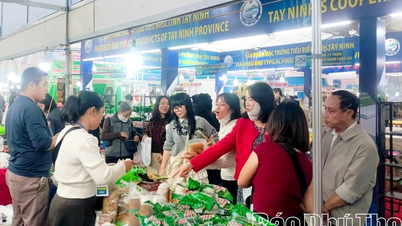
Along the walkway are displays of traditional handicrafts from the surrounding villages: Vân Chàng - Đồng Côi metalworking; Vĩnh Hào - Vụ Bản rattan and bamboo weaving; Cát Đằng - Ý Yên lacquerware; and flowers and ornamental plants from Vị Khê. These products are both familiar and vibrant, reflecting the resilience of traditional crafts in the modern era. From the afternoon of the seventh, trucks carrying ornamental plants from all over began arriving, filling the entire market. Ancient-style trees, miniature trees, fruit trees… all kinds, creating a green expanse stretching from one end of the market to the other.
One reason many people like Vieng Market in Nam Truc is its clearly defined layout. The antiques section, the ornamental plant section, the mechanical goods section, the entertainment section… are all located next to each other but are distinct. Even with the crowds seemingly overwhelming, the market maintains its order, reflecting a way of life that has been practiced for generations.
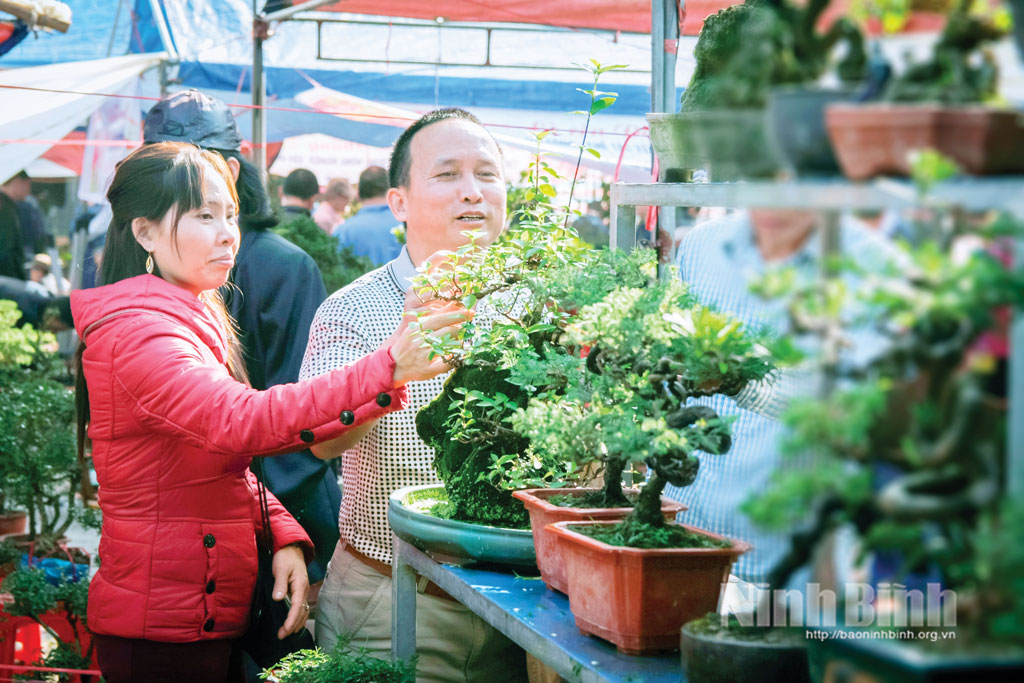
Not far from Nam Truc is Vieng Vu Ban Market – a place that preserves the long-standing traditions of the people around Phu Day area. The old folk song: “ On the first day of Tet, celebrate at home / On the second day, visit the village shrine, on the third day, visit the communal house / On the fourth day, visit Qua Linh Market / On the fifth day, visit Trinh Market, on the sixth day, Non Coi Market / After the seventh day, that's it / On the eighth day, go to Vieng Market… ” is still passed down by the elders, as a way of reminding each other of the ancient customs of a region that values tradition and etiquette.
While the Vieng Nam Truc market evokes a sense of antiquity, the Vieng Vu Ban market resembles a large-scale " economic and cultural exhibition." The goods here are so diverse that it's difficult to list them all. Rows of bronze items from Tong Xa (Y Yen commune) with vases, incense burners, incense holders, candles, crane statues, etc., always attract viewers.
Next to it are handcrafted forged products from Bao Ngu, wooden and lacquerware from La Xuyen - Cat Dang, and rattan and bamboo products from Yen Yen. Further away are rows of cupboards, beds, tables, and chairs brought over by craftsmen from Thanh Hoa. All of this creates a vibrant "exhibition" of traditional crafts from neighboring provinces. The bustling atmosphere of Vieng Vu Ban market partly stems from its proximity to the Phu Day complex - the center of worship for Mother Goddess Lieu Hanh. Many people go to the market to pray for good fortune, and also to offer incense and pray for blessings at the beginning of the year. A stream of people from Thanh Hoa, Hung Yen, Hanoi , Hai Phong, etc., pour in throughout the night. In terms of numbers, each market session can attract hundreds of thousands of people.
Among the countless items at Vieng Vu Ban market, the most intriguing for visitors is roasted veal. Simply follow the scent of straw smoke to find it. Under the lamplight, the golden-brown skin stands out, while the pale pink meat inside becomes even more appealing. Skilled vendors expertly cut the meat into bite-sized pieces, and buyers wait patiently to choose their preferred portion. Many families buy roasted veal as a souvenir, carrying the flavor of Vieng market in the Son Nam Ha region. Each market day sees sales reaching several hundred animals, demonstrating the irreplaceable appeal of this dish.
For the local people, Vieng Market in Vu Ban is a place of trade, and also a special socio-economic "exhibition" at the beginning of the year. Each product on display can tell a story about a craft, a village, a way of life. All of this converges at Vieng Market, creating the feeling that this rural area is starting a new cycle.
From the perspective of many cultural researchers, Vieng Market is also considered a rare form of "festival market" that still retains its original character in contemporary life. There, the boundary between buying and selling and spiritual activities is almost blurred. Market-goers can buy very quickly, even without bargaining, because what is more important is "getting good luck" at the beginning of the year, the feeling of having participated in a communal gathering.
The fact that the market convenes on the night of the seventh and the early morning of the eighth, amidst the light spring rain, under makeshift lights and hastily erected stalls, further highlights the "fairy tale" atmosphere and folk ritualistic nature of the market. It is this very element that helps Vieng Market transcend the purely commercial meaning of a trading place, becoming a vibrant cultural space where traditional values are naturally passed down through the footsteps of shoppers each spring.
Therefore, the greatest value of Vieng Market lies not in the goods purchased, but in the atmosphere it brings. The image of thousands of people going to the market in the drizzling rain, the shouts of vendors mingling with laughter and conversation, has become an unforgettable memory for those far from home, hence the saying: "Seeing Vieng Market is seeing Tet (Vietnamese New Year)."
Despite changing times, tastes, and lifestyles, the Vieng Spring Market retains its old spirit: bustling, vibrant, and deeply meaningful in seeking good fortune. People come to the market with simple wishes for a year of favorable weather, smooth work, and family peace. From this perspective, the Vieng Market acts as a bridge between the past and the present, where traditional values are naturally continued in contemporary life.
Every spring, after the Lunar New Year has passed, crowds flock to Vieng Market in Nam Truc, Vu Ban, to commemorate a deeply ingrained tradition. Vieng Market – a once-a-year tradition – remains as enduring as the age-old aspirations of the Vietnamese people: to seek good fortune and blessings to begin a new year full of hope.
Source: https://baoninhbinh.org.vn/cho-vieng-nam-mot-lan-den-hen-260209102321086.html










































Comment (0)