

Just as Vietnamese people eagerly go to Tet markets, Germans also joyfully go to Christmas markets. Christmas markets are not simply marketplaces, but a festival, a long-standing cultural tradition at the end of the year for Germans.
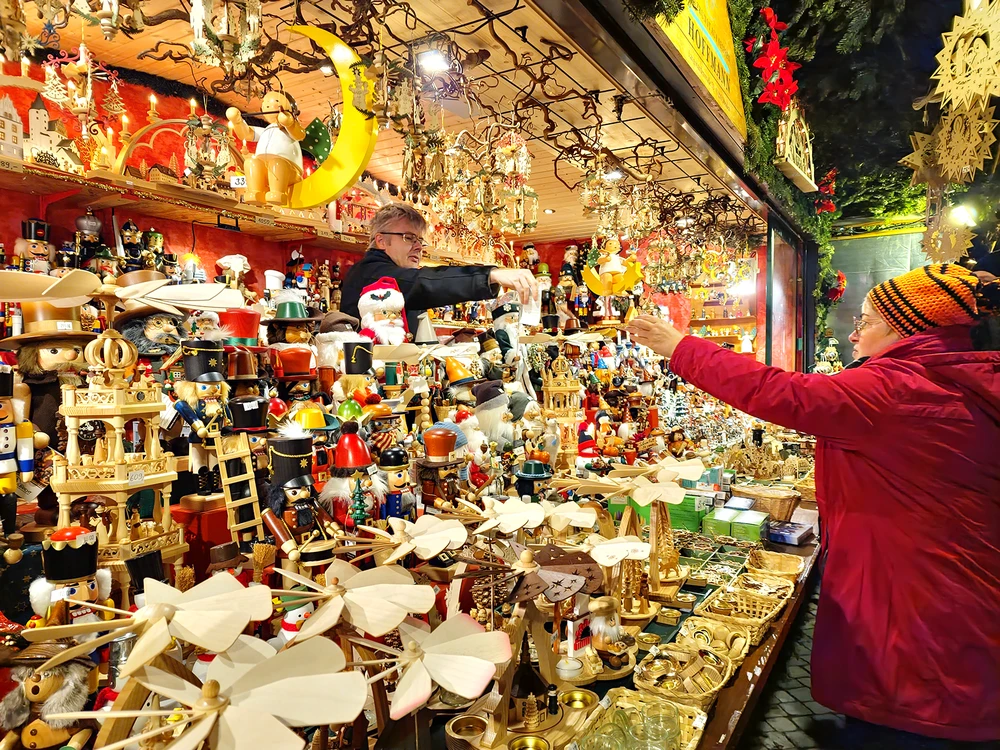
Dresden, the fourth largest city in Germany by area and the twelfth by population, is particularly attractive to tourists from all over the world because of its Striezelmarkt Christmas market, the oldest in Europe – this year marking its 589th anniversary.
The history of the Striezelmarkt Christmas market dates back to the end of October 1434, with a market selling meat and food to the local people for the year-end holidays. By the 16th century, more stalls selling Christmas decorations from the Erzgebirge mountains, as well as stalls selling pastries, candies, candles, spices, and handicrafts, gradually appeared.
On November 29th, the Mayor of Dresden, Dirk Hilbert, declared the market open, and about 600 lights on a giant Christmas tree lit up. People strolled through the market, watched plays and performances, let children play games, met each other, and enjoyed cups of mulled wine (Glühwein) with their fragrant cinnamon and cloves, or warm fruit spirits served in earthenware cups. They also ate honey-coated nuts, chocolate-covered berries, sugar-coated apples, and Lebkuchen cakes. They bought Stollen Christmas cookies to take home and enjoy with family, and gifts for relatives and friends. They went to the market to observe people and to be observed themselves.
The Striezelmarkt market not only holds the record for its age but also holds the 1999 world record for the six-story Pyramide wooden tower. The tower, 14.62 meters tall, features wooden figurines of snowmen, Santa Claus, fairies, priests, and more, topped with a giant wooden windmill whose axis rotates like a traditional lantern. From the top, you can see the entire city center. This wooden tower is priceless, but visitors can purchase much smaller towers as Christmas gifts, ranging in price from 80 EUR to thousands of EUR, all entirely handmade and painted with non-toxic paint.
This year, there are 214 stalls with 1,900 artisans and artists participating over 26 days (from November 29th to the afternoon of December 24th), with an expected revenue of approximately 42 million EUR. Many people are familiar with Stollen cakes during the European Christmas season, especially in German-speaking countries, but they may not know that the most famous Stollen cakes come from Dresden and the surrounding area, and have their own name: Dresdener Stollen.
The Stollenfest usually takes place on the second Saturday after the market opens. A giant Stollen loaf, weighing nearly 2 tons (the largest in Europe), is ceremoniously carried on a three-horse carriage through the city center and then divided into smaller pieces for sale to raise funds for charity after the parade. This year, a 500g piece is expected to sell for 10 EUR. Dresdner Stollen is made with flour, yeast, milk, sugar, fresh butter, candied fruit, lemon zest, orange zest, rum-soaked raisins, almond flour, almonds, lemon zest powder mixed with salt, powdered sugar, and baking spices. These ingredients are what give the loaf its unique flavor.
Visitors can also visit the medieval Christmas market in the backyard of the Royal Castle. Although much smaller in scale, the atmosphere here is extremely special, like stepping back hundreds of years. Everything in the medieval market must be exactly as it was... the Middle Ages, illuminated by torches, wax candles, and oil lamps. Ticket collectors and vendors are dressed in medieval style with coarse cloth shirts, wide leather belts, and prices are also written in ancient Taler coins. Of course, customers still pay in EUR, with an exchange rate of 1€ = 1 Taler. The goods, food, and games in the market are also from the Middle Ages, carrying an ancient flavor. Music from the stages scattered throughout the Christmas markets creates excitement. The music from the Ferris wheels, the lively chatter from the wooden stalls selling warm wine, and the hugs of family and friends chase away the cold of the European winter. Even late at night, market-goers still want to linger and not leave.
TOET DANG, from the Federal Republic of Germany
Source
![[Photo] Prime Minister Pham Minh Chinh receives the Chinese Ambassador to Vietnam](https://vphoto.vietnam.vn/thumb/1200x675/vietnam/resource/IMAGE/2026/04/05/1775397481797_ndo_br_dsc-5512-jpg.webp)

















































































Comment (0)