

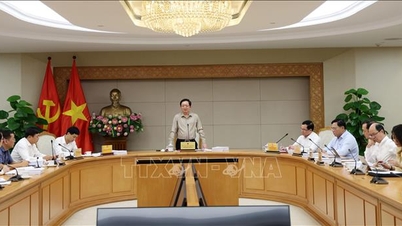
TPO - On the afternoon of January 3rd, Deputy Prime Minister Le Thanh Long - Chairman of the Mekong Delta Regional Coordination Council - chaired the 5th online meeting of the Coordination Council.
TPO - On the afternoon of January 3rd, Deputy Prime Minister Le Thanh Long - Chairman of the Mekong Delta Regional Coordination Council - chaired the 5th online meeting of the Coordination Council.
Reporting at the conference, Mr. Nguyen Chi Dung, Minister of Planning and Investment , stated that the regional economic growth rate (GRDP) of the Mekong Delta in 2024 reached 7.3%, higher than the national average (approximately 7%), ranking 4th out of 6 economic regions. Several localities achieved significant growth, with Tra Vinh having the highest rate at 10%. Many key projects and works in the region are being implemented, and the progress of major road projects is being accelerated.
 |
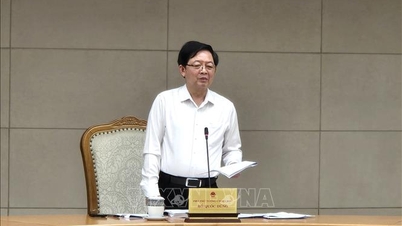
A view of the conference at the Government headquarters. Photo: Duc Tuan. |
However, according to Minister Nguyen Chi Dung, the socio-economic situation of the Mekong Delta still faces many difficulties and limitations. The region's economic scale is still small, accounting for only 12% of the national total; 12 out of 13 localities in the region have not yet achieved self-sufficiency in budget revenue and expenditure. Climate change , land subsidence, landslides, flooding, drought, saltwater intrusion, and water shortages are pressing issues in the Mekong Delta.
Three factors are strongly impacting the Mekong Delta: upstream development of the Mekong River; climate change and sea level rise; and subsidence and lowering of the riverbed. The consequences include increased saltwater intrusion, erosion, freshwater scarcity, flooding, and poor drainage.
Concluding the conference, Deputy Prime Minister Le Thanh Long stated that since its establishment (in 2020), the Mekong Delta Regional Coordination Council has been on the right track in overcoming difficulties and achieving many important results. All 13 provinces/cities in the region have had their provincial planning approved by the Prime Minister; and 5 out of 13 localities have had their provincial planning implementation plans approved.
Localities in the region have proactively implemented linkages and connections. Many key projects in the region are being actively implemented and urgently completed, striving to have 600 km of expressways in the Mekong Delta by 2025.
Besides the positive results, the Deputy Prime Minister noted that the Mekong Delta still faces difficulties and challenges such as: slow growth in some localities; weak linkages between farmers and businesses; failure to optimally exploit agricultural value chains; small-scale production; lack of connectivity in infrastructure, especially transportation infrastructure; slow administrative reform; profound impacts from climate change; and scarcity of resources for construction materials in the context of an increasing number of large-scale construction projects.
Regarding future tasks, Deputy Prime Minister Le Thanh Long noted that in 2025, provinces and cities must focus on simultaneously implementing three tasks: striving for high growth; organizing Party congresses at all levels leading up to the 14th National Party Congress; and reorganizing the organizational structure. A clear understanding is needed to develop feasible tasks and solutions, and especially to demonstrate strong determination to implement them.
The Deputy Prime Minister requested the Ministry of Agriculture and Rural Development to develop a comprehensive hub in Can Tho; to build and develop key raw material areas, focusing on ensuring long-term and sustainable supply for agricultural and aquatic product processing facilities.
The Deputy Prime Minister proposed studying and selecting important and urgent projects in accordance with the Politburo's resolutions and regional planning to prioritize funding allocation in the 2026-2030 medium-term plan. Appropriate funding should be allocated for investment preparation in 2025.
Source: https://tienphong.vn/pho-thu-tuong-chon-cac-du-an-quan-trong-cap-bach-cho-dbscl-post1706550.tpo




























































































Comment (0)