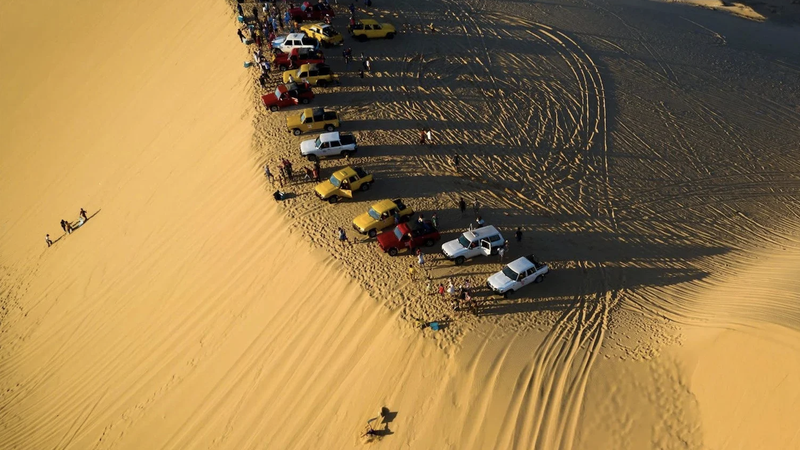
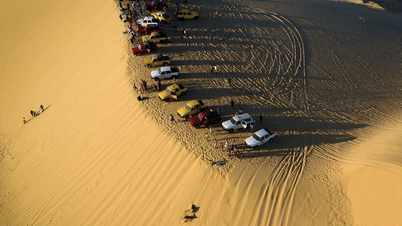
My village, Cay Gang hamlet, is a fishing village. We live peacefully in a coastal area. Here you'll find Ke Ga headland, Hon Mot, Hon Lan... where we once played under the year-round shady coconut groves and towering white sand dunes, where on moonlit nights, climbing the dunes, we thought we could reach the moon!
Simple and quiet.
For years, the villagers toiled in the sea, catching fish and shrimp. This seemingly inexhaustible gift from nature sustained generations. But in 1947, due to the Franco-Vietnamese War, my villagers abandoned the sea and moved to the forest. Since then, long periods of hardship and poverty have plagued them. They eked out a living by clearing forests, burning fields, cultivating crops, and gathering food to survive, constantly changing their living quarters to avoid being hunted by the French.

We were a group of about a dozen big, lanky kids, but we didn't feel ashamed to bathe in the rain naked. We'd chase each other around, teasing and challenging each other, "Who can bathe in the rain the longest without shivering?" The girls would stand there, giggling, showing off their gap teeth. Every day we'd wander through the forest catching birds, picking fruit, and turning over buffalo dung in the fields to find crickets to fight with.
Then, on some days, the soldiers passed through the village. We were surprised and asked them what they were doing, only to find out they were fighting the French. When we asked where they were fighting, they said, "Wherever there are French soldiers, we fight!" Then they practiced playing musical instruments and singing, and they asked if we children knew how to read and write. We replied, "Nobody taught us, so how would we know?"


Late 1948. One early spring day, we heard a loudspeaker blaring… “Children, you must go to school…” With a feeling of both strangeness and fear, we hesitantly went to school. Calling it school was an exaggeration; in reality, the learning space consisted of rows of desks and chairs woven from bamboo and other scraps of wood, without a roof, only sheltered from the sun by the branches of ancient trees. We went to school on sunny days and stayed home on rainy days.
Our first teacher was Uncle Mười Bầu. Although he was a teacher, no one in the village called him "teacher," not even us. Uncle Mười Bầu, a familiar and endearing name, meant no one questioned him about his education, hometown, or background… we only knew that he lived in the Cò-Ke swamp (a revolutionary secret zone in Tân Thành commune, Hàm Thuận Nam district, Bình Thuận province) since before we were born. (I used to herd buffalo into the Cò-Ke swamp, picking Cò-Ke fruit to use as ammunition for slingshots – a type of gun made from bamboo tubes – firing the Cò-Ke fruit by thrusting it, hearing a popping sound. Sometimes, when we were in formation, hitting the "enemy" was quite painful!)
Uncle Mười Bầu went to teach wearing only a single, faded black traditional Vietnamese outfit! He said there were two enemies that had to be eradicated: ignorance and the French. The adults would take care of the French, but the children had to focus on eradicating ignorance. Later, we learned that he was the teacher who had taught our older classmates who had "graduated" and gone to fight the French!
One day, after the whole class had gathered, the teacher said he was about to go away. When asked where he was going, he smiled and didn't say. Ten days before he left, he said that since the children now knew how to read and write, he would write down the poem "The Ant" for them. He emphasized that they must memorize it, and that when they grew up, they would see the patriotism in that poem.
More than half a century has passed, yet I still remember the poem "The Ant" vividly: "You've probably often noticed / Tiny little ants scurrying along the wall / Don't underestimate them, these melancholic ants / They are like people, they also have a homeland / They are like people, they have a beloved country / And they know how to die with a fighting spirit / The land of ants: A tree stump by the hedge / A high, sturdy mound of earth where ants build a fortress / With high ramparts and wide moats built around it / Even soldiers patrolling on all four sides / Patrolling soldiers strictly / Anyone passing by is thoroughly questioned / The country is prosperous and the people are everywhere / Bustling with work / And vehicles and laborers crowd the land / Life is peaceful and the world is tranquil / Suddenly one day a mischievous child / Arrogantly stepped into the hedge / The alarm sounded throughout the peaceful city / The siren blared, the general mobilization order / Laborers, soldiers, and laborers / Ready to die for the country / The boy's foot was like an atomic bomb / Falling on the city walls "Trampling countless people/ The entire corner of the country's city, the tiny ant colony/ Has been shattered under the brutal foot/ The nation is humiliated, the people are bloodthirsty/ They rush at the little boy who attacks/ The boy, in pain, becomes furiously enraged/ He grabs a broom and smashes the ant nest to pieces/ The next day, I invite you to return here/ To this very place, by the hedge under the tree/ The fire ants are peacefully building their nest/ You brave one, try stepping inside/ Despite the brutal foot of yesterday/ Despite the foot that has trampled down the land/ The fire ants are still ready to fight/ Don't think they are gentle and small/ Don't despise them and bring your brutal strength/ It's not easy to conquer a land/ A nation that has been victorious for a thousand generations" (Ngoc Cung - Pre-war poet).
We memorized the poem "The Ant," then said goodbye to our teacher, leaving the school where we learned to read and write, and teacher and students went their separate ways during the war, a time of separation and death.

After 1975, with peace restored, I returned to my hometown, Van My commune, Cay Gang hamlet (now Tan Thanh commune, Ham Thuan Nam district, Binh Thuan province). I went to look for Uncle Muoi Bau, but most of the people who lived during his time had passed away, and some were lost due to the war. Only a few vaguely remembered that Uncle Muoi Bau had died after the 1954 ceasefire.
I respectfully light these incense sticks in remembrance of my uncle, my first teacher, and express my gratitude to the poet Ngoc Cung for instilling patriotism in us through his poem "The Ant" from the days when the resistance war broke out.
Source