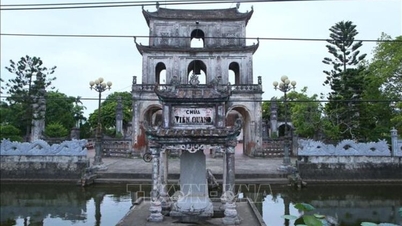
Located within the Yen Tu - Vinh Nghiem - Con Son complex of historical and scenic sites, Kiet Bac is currently being nominated for UNESCO World Heritage status and comprises dozens of large and small temples belonging to the Truc Lam Buddhist sect. These temples have distinct locations and roles, revealing many interesting aspects through research. Hoa Yen Pagoda is located within the Long Dong - Hoa Yen pagoda complex, built on a mountain at an altitude of approximately 500m above sea level.
The system of pagodas and stupas belonging to the Truc Lam Buddhist sect, stretching across the Yen Tu mountain range in the provinces of Quang Ninh , Hai Duong, and Bac Giang, was mainly built during the Tran and Le Trung Hung dynasties. The pagodas built during the Tran dynasty are associated with the Three Patriarchs of Truc Lam (Tran Nhan Tong, Phap Loa, and Huyen Quang), while the pagodas and stupas of the Le Trung Hung period are linked to the revival of Truc Lam Buddhism in the 17th and 18th centuries. Recent studies, particularly archaeological findings, have discovered and identified dozens of pagoda and stupa sites, mainly distributed on the southern slopes of the Yen Tu range, from Con Son (Hai Duong) to Uong Bi (Quang Ninh), and concentrated into six clusters: Long Dong - Hoa Yen, Ngoa Van - Ho Thien, Quynh Lam, Bac Ma, Thanh Mai, and Con Son. On the northwestern slopes of the Yen Tu range (Bac Giang province), there are a few pagoda and stupa sites, smaller in scale, lower in density, and not forming a chain like those on the southern slopes. In reality, the temples are often situated on mountain slopes but at varying altitudes. This also reflects the different roles and functions of the Yen Tu temple system. Specifically, the group of temples located in low hills or at the foot of mountains, usually at an average altitude not exceeding 100m above sea level, includes Quynh Lam, Bac Ma (Quang Ninh), and Con Son (Hai Duong). These areas are also relatively close to residential areas, with relatively flat terrain and fertile land. The scale of these temples is usually large, with some structures covering thousands of square meters. Quynh Lam Pagoda belongs to a group of pagodas located in a low hill area, covering a large area, and was once mentioned in the folk song "The courtyard of Muong Pagoda, the rice fields of Quynh Pagoda".
The second group of temples are built on medium-altitude mountains, approximately 200-250 meters above sea level, often with wide valleys in front, abundant water sources, and fertile land. Typical examples include temples such as Ba Vang, Am Hoa, Trai Cap, Ba Bac, Giang Kinh, and Thong Tan in Quang Ninh province. The third group consists of temples and pagodas built on high mountains, averaging about 500 meters above sea level. Pagodas and stupas are often situated on the saddle-shaped slopes of mountains, typical examples being Hoa Yen, Van Tieu, Am Duoc, Ho Thien, Ngoa Van, and Da Chong. Research shows that during the Tran Dynasty, the period of formation and development of Truc Lam Buddhism, pagodas at the foot of mountains were more convenient for construction and were therefore not considered. Pagodas on the mountainside and at higher altitudes, with more complex terrain, were usually arranged and positioned to blend in with the natural landscape, with smaller constructions, clearly demonstrating a philosophy of harmony with nature and minimizing intervention and alteration of the natural terrain. However, during the Le Trung Hung period, a period of strong revival of Truc Lam Buddhism, these pagodas underwent leveling, construction, and site preparation similar to those in the plains, with many large-scale renovations, such as Hoa Yen, Am Hoa, Ho Thien, Ngoa Van, and Da Chong. Thus, during this period, the philosophy of harmony and reliance on nature gradually declined, replaced by the transformation of natural terrain and the creation of flat surfaces for construction. Archaeological excavations from the Le Trung Hung period at Dong Bao Dai Pagoda (Uong Bi City) are believed to potentially mark the eastern boundary of the Yen Tu area.
Vietnam encourages US businesses to expand investment in high technology.On the morning of June 26th, at the Government Headquarters, Deputy Prime Minister Ho Quoc Dung received Mr. Jeff Place, Supply Chain Director of Coherent Group (USA). During the meeting, the Deputy Prime Minister affirmed that Vietnam encourages US businesses to expand investment, especially in high-tech, innovation, and semiconductor industries.
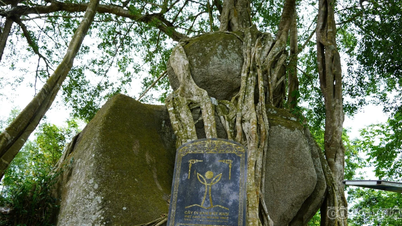
In terms of function, temples also differ. As mentioned above, temples located in lower areas and on mountain slopes have larger areas, closer to the secular world, and are more favorable for propagating Buddhism. These areas have valleys and more fertile land, so besides studying and practicing Buddhism, these temples also undertake production and mobilize resources, mainly food supplies for temples in the high mountains. Meanwhile, temples in the high mountains mainly focus on studying and practicing Buddhism. The presence of meditation halls in these temples is a distinct characteristic, with the meditation halls usually located high up, behind the main hall. During the Tran dynasty, most of the meditation halls were constructed with natural rock roofs or very simply in the style of thatched huts. During the Le Trung Hung period, meditation retreats were built solidly with sturdy structures and surrounding walls, typical examples being the Ham Long hermitage in Ho Thien and the meditation retreat at Da Chong… During the Le Trung Hung and Nguyen dynasties, some stone roofs that were originally meditation retreats were converted into places of worship. As space required expansion, artificial roofs were added to the stone roofs, the most notable example being the One-Roof Pagoda in Yen Tu…


 Việt Nam•07/08/2024






![[Image] National conference summarizing one year of operation of the overall organizational model of the political system, the three-tiered government model.](https://vphoto.vietnam.vn/thumb/1200x675/vietnam/resource/IMAGE/2026/07/01/1782882811691_ndo_br_1-jpg.webp)