


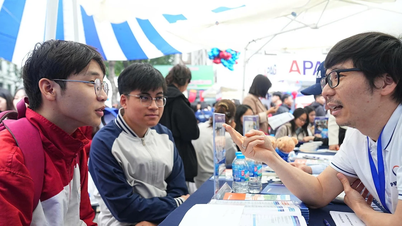
Lecturers are not just transmitters of knowledge, but keepers of the flame for a decent academic environment - Photo: illustration
Circular 26 of the Ministry of Education and Training on professional standards for university lecturers, at first glance, appears to be a technical document: stipulating criteria, standardizing the workforce, and classifying job titles. It also sends a strong message: Vietnamese universities are entering a phase where they must truly professionalize, not only in the system, but in each individual teaching staff member.
From a lecturer's perspective, I believe the most noteworthy aspect of this circular lies not in the number of publications or research topics, but in the way it redefines the "lecturing profession".
Academic ethics: foundation or slogan?
Circular 26 places "ethics" first among the three sets of standards. This is not new, but this time it is emphasized more specifically: lecturers must maintain scientific integrity and be honest in their research, publications, and teaching. In the current context, this is not superfluous.
It's not difficult to see worrying signs: a pursuit of publication volume and international recognition at all costs; formal "co-authoring"; and even plagiarism and improper citations. These phenomena aren't widespread enough to cause systemic alarm, but they are sufficient to erode academic trust if left unaddressed.
The problem is: ethics cannot simply be "regulated." A lecturer might meet all the criteria regarding qualifications, publications, and research topics, but still lack integrity in their research. Conversely, there are those who conduct serious scientific work but fail to "meet the standards" due to a lack of publications.
If we only focus on criteria, we risk turning scientific integrity into a mere slogan. What is more essential is building a transparent academic ecosystem: a rigorous peer review process, effective plagiarism detection mechanisms, and most importantly, a culture of respect for truth. Then, ethics will no longer be something to be "reminded" of, but will become a natural norm.
Circular 26 clearly stipulates the requirements for scientific research: from senior lecturers, there must be international publications, to high-level lecturers, there must be a certain number of publications, along with research topics and specialized books. In principle, this is the right step. Universities cannot just teach without conducting research.
A lecturer who doesn't do scientific research will find it difficult to update their knowledge and guide students. But in reality, the story isn't that simple.
In many educational institutions, especially private or application-oriented schools, research conditions are limited: lack of funding, lack of research groups, and lack of time due to high teaching pressure.
In this context, the demand for "standardization" easily turns into formal pressure. What is the consequence? The proliferation of papers written simply to meet standards, topics undertaken for approval rather than to solve practical problems.
An academic system cannot develop sustainably if it is dominated by a "doing it for the sake of doing it" mentality. Therefore, a more flexible approach is needed. Faculty members should not be evaluated solely by the number of publications, but rather by their quality, impact, and applicability. For specialized fields, alternative products such as technology transfer, innovations, or contributions to the community may be acceptable. Standardization is necessary, but it must be appropriate to reality.
A key new feature of the circular is its application to all lecturers, both in public and private institutions. This helps create a common standard and avoids the situation of having "two standards" within the same system.
However, the differences in conditions between these types of schools are significant. Large public universities have a strong research tradition, a robust faculty, and ample resources. Meanwhile, many private universities focus on applied training, serving the needs of the labor market, with a more flexible operating model.
If a rigid set of criteria is applied, the risk is to reduce the diversity of the university system. Universities may be forced to "follow the standard" instead of developing their own strengths.
The solution is not to lower standards but to stratify them. Different sets of criteria can be established, corresponding to research orientations, applications, or professional practices. A healthy university system is not a homogeneous system, but a diverse system with common standards.
From "qualified" to "right role"
Circular 26 also sets requirements for foreign languages, information technology, and innovation. These are indispensable competencies in the context of the strong digital transformation of higher education . But a question needs to be asked: are we training lecturers as "doers of all kinds," or as "experts in their fields"?
A good faculty member doesn't necessarily have to be good at everything. What's important is that they excel in their respective roles: teaching, research, or connecting with practice. Therefore, instead of requiring all faculty members to meet the same comprehensive set of criteria, specialization should be encouraged. Some may be strong in research, others in teaching, and still others in connecting with businesses. When each individual leverages their strengths, the collective becomes stronger.
In order for Circular 26 to truly be implemented, I believe three main approaches are needed:
First, we need to build a multi-dimensional evaluation mechanism. It shouldn't rely solely on rigid data, but should include qualitative feedback from students, colleagues, and stakeholders.
Secondly, invest in the research environment. If faculty members are required to conduct scientific research, the necessary conditions must be created: research funding, time, international connections, and especially a reduction in administrative burdens.
Thirdly, fostering an academic culture is crucial, yet the most challenging, element. An environment that respects knowledge, encourages debate, and values honesty will naturally produce "standard" lecturers in the deepest sense of the word.
Ultimately, Circular 26 isn't just about numbers; it's about what we want Vietnamese universities to become. If we only focus on meeting standards, we'll have a faculty that meets requirements on paper. But if we go further, aiming for "the right profession," we can build a truly in-depth higher education system. In that system, lecturers are not just transmitters of knowledge, but keepers of the flame for a decent academic environment.
Source: https://tuoitre.vn/chuan-hoa-giang-vien-dai-hoc-2026041212544883.htm












































































Comment (0)