

|
Given the market's increasing demands for quality, food safety, traceability, and product stability, reorganizing tea growing areas in a synchronized, standardized manner, closely linked to processing and consumption, has become an urgent requirement. |

Reorganize production
Tea plants hold a special place in the rural economic life of Thai Nguyen province. The province currently has nearly 24,000 hectares of tea plantations, with a projected fresh tea leaf production of over 280,000 tons by 2025; encompassing many renowned tea-growing regions such as Tan Cuong, La Bang, Trai Cai, Khe Coc, and Bang Phuc... These figures confirm that tea is a key industry and a significant advantage for the locality.
However, significant advantages have not been fully translated into competitiveness. Household farming still accounts for the majority of production, with small-scale and scattered operations; linkages between farmers, cooperatives, and businesses are not strong; and the quality of raw materials varies significantly between regions, and even within the same region. Meanwhile, the market demands uniform, safe products with transparent processes and traceable origins.
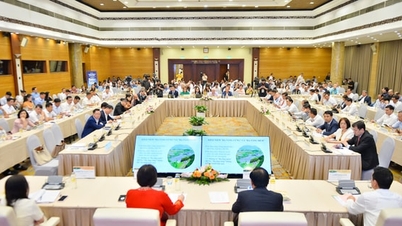
Mr. Duong Son Ha, Deputy Director of the Department of Agriculture and Environment, assessed: Tea cultivation area has grown well in recent years, but small-scale production remains prevalent and labor-intensive. Therefore, priority solutions should focus on planning raw material areas, promoting production linkages, applying technology, digital transformation, and supporting mechanization in production and processing.
|
Reorganizing the raw material areas in a modern, transparent manner, closely linked to the market, will contribute to increasing the value of Thai Nguyen tea products. |

Along with expanding the cultivated area, the question arises as to how much of that area will be organized into truly sustainable raw material zones. If the raw materials continue to come from thousands of scattered production households, each with its own methods and processes, it will be very difficult to establish a consistent quality standard.
When quality is inconsistent, further processing, building sustainable brands, expanding markets, and increasing value will face many obstacles.
Resolution No. 11-NQ/TU of the Provincial Party Committee clearly defines the requirement to shift from extensive to intensive development; from small-scale production to standardized production; and from natural advantages to competitive advantages based on science, technology, innovation, and digital transformation. In this process, organized raw material areas play a fundamental role.
Establish common standards
A tea growing area is not simply a large area of tea plantations, but must be planned, managed, and operated according to a unified set of standards. From seeds and input materials to cultivation, harvesting, processing, quality control, and traceability, everything needs to be organized in a unified manner.
|
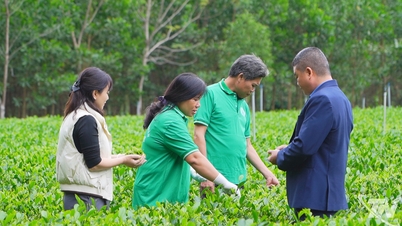
The tea-growing areas of the cooperatives are also popular destinations attracting many domestic and international tourists. |

In accordance with Resolution No. 11-NQ/TU, the province will review the current land situation and the advantages of each locality to establish and plan tea production areas according to GAP and organic standards, creating a source of quality raw materials for processing; at the same time, digitize the planned production areas for management and apply standardized processes. When the raw material areas are clearly established and managed using standards and data, product quality will be more stable.
Alongside planning, production needs to be reorganized. Tea growers need to participate in various forms of linkages such as cooperatives, cooperative groups, cooperative unions, and supply chains with businesses. Cooperatives play a central role in organizing production, providing technical guidance, monitoring processes, aggregating output, and connecting to markets. Businesses need to participate from the stage of establishing raw material areas, setting quality requirements, and linking production with processing and consumption needs.
Mr. To Ha Phuong, Permanent Vice Chairman of the People's Committee of La Bang commune, said: As a famous tea-growing area of the province, the locality focuses on managing and planning concentrated tea production areas, encouraging the conversion of inefficient agricultural and forestry land to tea cultivation.
|
Using unmanned aerial vehicles (UAVs) for irrigation in the tea plantations of Hao Dat Tea Cooperative (Tan Cuong commune). |

The reality from tea cooperatives also shows the urgent need for the formation of concentrated raw material areas. At Hao Dat Tea Cooperative, the unit currently has nearly 70 hectares of raw material area in Tan Cuong commune, but many areas are still small and fragmented, interspersed between residential and agricultural land.
According to Ms. Dao Thanh Hao, Director of the Cooperative, the unit has proposed building a concentrated production area project of 20-30 hectares. If implemented, this will create conditions for the synchronized application of technological advancements, reducing labor, and improving productivity and product quality.
Raw material areas are only effective when they become organized, interconnected, standardized production areas capable of consistently meeting the demands of processing, consumption, and export.
Completing the tea value chain
A well-organized raw material supply area will create a uniform input, thereby encouraging businesses to invest in technology, expand deep processing, and develop high-value product lines. This relationship is crucial for the future of Thai Nguyen tea industry.
|
Tea growers need to shift from individual production to participating in collaborative forms such as cooperatives, cooperative groups, cooperative unions, and supply chains linked with businesses. |

Resolution No. 11-NQ/TU sets the goal that by 2030, 70% of the province's tea growing area will be certified as producing according to GAP and organic standards; 70% of the area will be granted planting area codes; 100% of businesses and cooperatives with raw material areas will apply digital technology in cultivation, supply chain management, and traceability; and 100% of tea and tea-related products will be listed on e-commerce platforms. These are concrete measures of the standardization and modernization process of the raw material areas.
When raw material areas are standardized, businesses and cooperatives will have the conditions to invest in processing plants in concentrated tea-growing areas, develop deeply processed products, and expand the high-value segment.
The production process is managed according to unified standards, the coordinating role of organizations is enhanced, and tea growers are more committed to safe practices, linkage contracts, and long-term markets. With planting area codes, traceability, and digital data, tea products better meet the requirements of modern distribution systems and export markets.
|
Thai Nguyen aims to have approximately 24,500 hectares of tea plantations by 2030, with a fresh tea leaf production of over 300,000 tons and a revenue of around 25 trillion VND. |

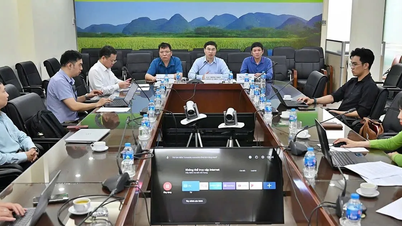
Ms. Uong Thi Lan, Director of Nguyen Viet Safe Tea Cooperative, believes that: When tea growing areas are developed into planned production zones, managed and operated according to common standards, cooperatives and tea growers will have the conditions to innovate production and business processes.
According to Mr. Vu Van Phan, Chairman of the Thai Nguyen Tea Association, organizing the raw material area well will promote restructuring, enhance the tea value chain, and create more impetus for the province's tea products to expand their market.
Reorganizing the raw material area is the starting point of the entire value chain of Thai Nguyen tea. When the raw material area is rationally planned, tightly organized, with effective linkages between farmers, cooperatives and businesses, uniformly applied standards, digitized and transparently traceable, the province's tea industry will continue to consolidate its position, while opening up great potential for value growth and sustainable development.
Development goals for the tea industry in Thai Nguyen province by 2030: - Total tea growing area in the province: Approximately 24,500 hectares; fresh tea leaf production: Over 300,000 tons. - 70% of tea growing areas meet GAP and organic standards; 70% of areas have been granted planting area codes. - 100% of tea businesses and cooperatives with raw material areas apply digital technology. - 100% of tea and tea-related products are listed on e-commerce platforms. - At least 250 tea products will achieve OCOP 3-5 star ratings, including at least 6 products that achieve OCOP 5 star rating. |
Source: https://baothainguyen.vn/kinh-te/202603/chuan-hoa-vung-che-nguyen-lieu-6d90b56/

![[Photo] General Secretary and President To Lam meets with National Assembly delegates from ethnic minorities.](https://vphoto.vietnam.vn/thumb/1200x675/vietnam/resource/IMAGE/2026/04/20/1776696701056_a1-bnd-8331-3342-jpg.webp)


![[Image] National Assembly discusses the implementation of the socio-economic development plan.](https://vphoto.vietnam.vn/thumb/1200x675/vietnam/resource/IMAGE/2026/04/20/1776696707422_ndo_br_img-20260420-185419-jpg.webp)












































































Comment (0)