

 |
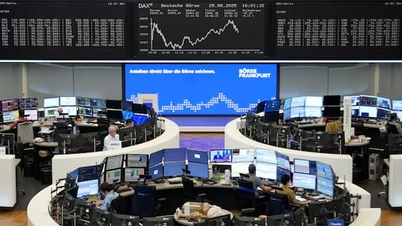
| The US stock market rose slightly following positive signals from the economy. |
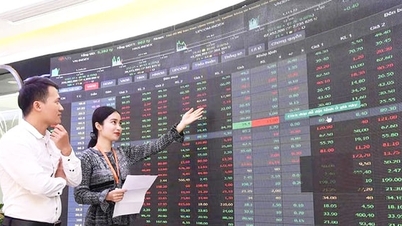
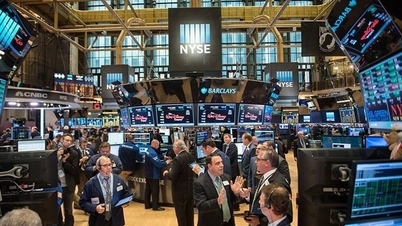
The US stock market closed the trading session on February 2nd (early morning of February 3rd in Vietnam time) in positive territory, signaling a notable recovery after recent volatile sessions. After facing pressure from concerns about monetary policy and the global economic situation, the main US stock market indices made positive moves, offering hope for a stable trading week.
Specifically, the S&P 500 index rose 0.5% to 6,976.44 points, just a short distance from its recent all-time high. This is a sign that investors are gradually returning to the market after a three-day losing streak. The Dow Jones Industrial Average surged 1.1%, or 515.19 points, closing the day at 49,407.66 points. The Nasdaq Composite, with a focus on technology stocks, also recorded a 0.6% increase, closing at 23,592.11 points.
Not only large-cap indices, but also small-cap stocks like the Russell 2000 saw significant growth, with a 1% increase, indicating widespread positive sentiment across the market. These indices suggest a strong recovery, bolstered by positive data on the US economy, including manufacturing and future employment expectations.
However, this recovery also occurred amidst significant volatility in global markets. Asian stocks opened in the red, while European indices recorded a rebound. In the US, investor sentiment was considered positive due to expectations of upcoming economic data and the stability of interest rate policies.
Analysts believe the rise in US stocks primarily reflects a "buy-the-dip" sentiment. Investors are awaiting information on manufacturing and employment reports, as well as expectations of unchanged interest rates in the near future. This has driven a strong shift of capital from technology stocks to cyclical, industrial, financial, and consumer-grade stocks, thereby creating differentiation within sectors.
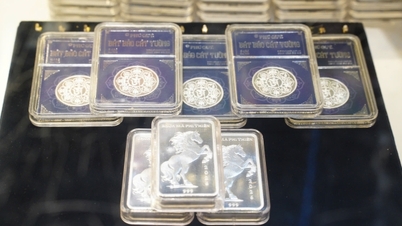
Meanwhile, commodity markets also saw significant volatility. Gold and silver prices fluctuated sharply, with silver falling as much as 9% before partially recovering, indicating that money is flowing out of safe-haven assets and into stocks in anticipation of higher returns. Oil prices fell slightly, while US government bond yields rose after better-than-expected US manufacturing data boosted confidence in the economy.
Despite the strong rally in the US stock market, investors remain cautious. Market volatility (VIX) has not decreased significantly, reflecting a balance between buying pressure and profit-taking. Furthermore, liquidity on February 2nd was higher than average, indicating active participation in the market after the previous sharp correction.
One of the key factors investors need to pay attention to in the coming days is the economic reports to be released this week, especially employment figures and inflation reports. These are crucial indicators for determining the direction of the Federal Reserve's interest rate policy, directly impacting the stock market in the first quarter of 2026.
According to market strategists, the Fed's monetary policy remains a key factor influencing stock valuations, especially as the market is near its historical peaks. Many believe that if the Fed maintains stable interest rates and economic data continues to be positive, the US stock market could continue its short-term recovery. However, risks from inflationary pressures and changes in monetary policy remain factors that need to be closely monitored.
Thus, the February 2nd trading session on the US stock market reflected a recovery after a period of significant volatility, with clear positive performance across major indices and divergence among sectors. However, investors should remain cautious ahead of upcoming key economic data and potential changes in the Fed's interest rate policy. The current US stock market is both promising and challenging, facing unpredictable factors in the near future.
Source: https://thoibaonganhang.vn/chung-khoan-my-phuc-hoi-tich-cuc-177411.html




![[Photo] General Secretary and President visit the China-ASEAN AI Application Cooperation Center](https://vphoto.vietnam.vn/thumb/1200x675/vietnam/resource/IMAGE/2026/04/17/1776404277677_vna-potal-tong-bi-thu-chu-tich-nuoc-tham-trung-tam-hop-tac-ung-dung-ai-trung-quoc-asean-8706616-2286-jpg.webp)





















![[Photo] National Assembly Chairman Tran Thanh Man attends the policy seminar to promote Vietnam-Türkiye cooperation.](https://vphoto.vietnam.vn/thumb/1200x675/vietnam/resource/IMAGE/2026/04/16/1776351415367_vna-potal-chu-tich-quoc-hoi-tran-thanh-man-du-toa-dam-chinh-sach-thuc-day-hop-tac-viet-nam-tho-nhi-ky-8705791-jpg.webp)





































































Comment (0)