

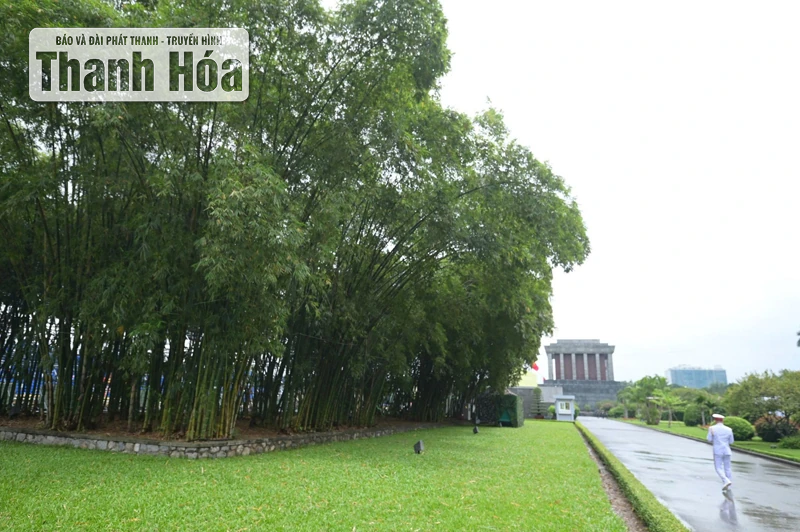
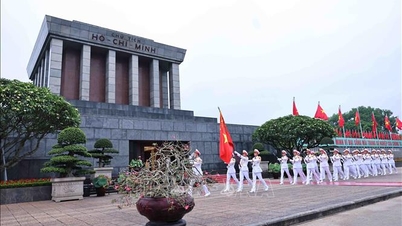
One of the two rows of bamboo originating from Thanh Hoa province, planted in the grounds of the Ho Chi Minh Mausoleum and Ba Dinh Square ( Hanoi ), remains lush and green all year round.
The story of the precious stones and bamboo from Thanh Hoa that were honored to be contributed to the construction and planting at the Ho Chi Minh Mausoleum is well-known through anecdotes. However, the exact origin of these bamboo clumps is less known. In 2019, during a business trip to Tan Phuc commune, a mountainous area in the former Lang Chanh district, when introduced by the commune leaders to a typical bamboo-growing household in the area, we were surprised to hear the story of the bamboo clumps from Son Thuy village that were once used for planting at the Mausoleum. Further investigation with local authorities and historical documents revealed that Thanh Hoa contributed 5,000 peony clumps from the former Ha Trung district and 100 bamboo clumps from the former Ngoc Lac and Lang Chanh districts to be planted around the Mausoleum. Mr. Ha Viet Hoi from Tan Phuc commune (formerly a district official) was appointed by the then Lang Chanh district to be the team leader responsible for selecting and caring for the bamboo clumps intended for the Mausoleum. Along with Mr. Hoi, Mr. Ha Van Nong also participated in the seedling group to carry out the task. At that time, the Lang Chanh bamboo was mainly sourced from Tan Phuc commune and partly from the former Tam Van commune in 1974.
During our research, we met two witnesses – former provincial officials: Mr. Le Quang Muu, former secretary of the Provincial Administrative Committee, and Mr. Trinh Ngoc Tich, an official of the Thanh Hoa forestry sector living in Thanh Hoa City and the former Hoang Hoa district. They recounted in detail their memories from nearly half a century ago. Mr. Muu was assigned by the Standing Committee of the Provincial Administrative Committee to organize the planting of trees at the Ho Chi Minh Mausoleum. Mr. Tich and another witness, Mr. Thieu Sy Tuoc, from the former Dong Tien commune, also an official of the Thanh Hoa forestry sector, were assigned to go to the districts to select, transplant, and cultivate the required number and quality of trees. The accounts of the provincial witnesses at that time completely matched the information we gathered in the former Tan Phuc commune. 100 clumps of bamboo – a characteristic tree species of Thanh Hoa – expressed the reverence and gratitude of the people of Thanh Hoa to their beloved President Ho Chi Minh.
On September 2, 1969, President Ho Chi Minh passed away, leaving behind immense grief for his people and nation. Due to wartime conditions, his remains were preserved in the Da Chong mountain area, Ba Vi (Hanoi) and some nearby locations for the next six years. Before the inauguration of the Ho Chi Minh Mausoleum on August 29, 1975, his remains were brought back to Ba Dinh Square for final rest and preservation. To express their reverence for him, people from all over the country sent hundreds of types of trees characteristic of their regions to be planted in the Mausoleum grounds and the Presidential Palace gardens. Bamboo from Thanh Hoa province was honored to be planted in two rows along both sides of the Mausoleum, right in front of the central area of Ba Dinh Square.
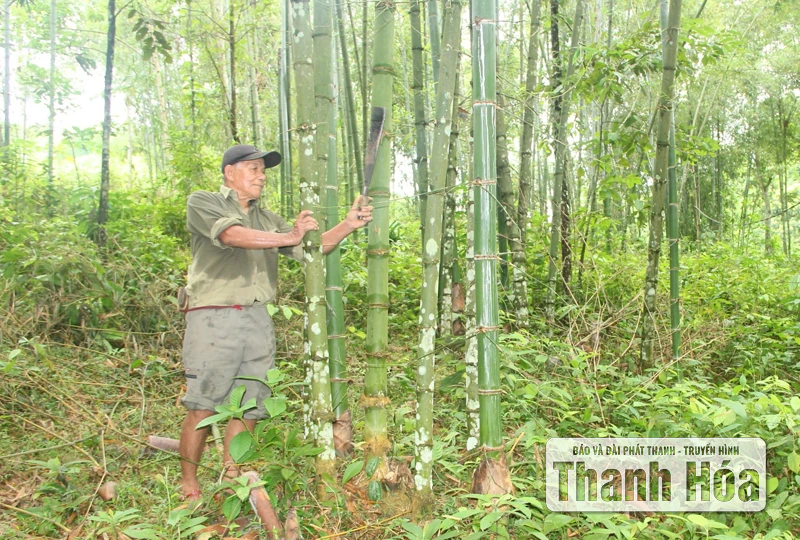
Mr. Le Ngoc Yen, from Son Thuy village, Dong Luong commune, tends to his family's bamboo garden, which contains 20 clumps that were once planted around President Ho Chi Minh's mausoleum.
By 2011 and 2012, many bamboo clumps planted in the grounds of the Ho Chi Minh Mausoleum showed signs of aging, overgrowth leading to nutrient deficiencies, some plants were attacked by purple stripe disease and aphids resulting in stunted growth, and a few suffered from cyclical wilting leading to gradual death. Due to the importance and sensitive nature of renovating the two bamboo gardens near the Ho Chi Minh Mausoleum, the lead unit of the project, the Management Board of the Ho Chi Minh Mausoleum, and the research team of scientists from the University of Forestry organized two scientific workshops and one conference to approve the renovation plan. The Management Board of the Ho Chi Minh Mausoleum submitted a proposal to the Prime Minister to replace and renovate the two bamboo gardens with new clumps taken from Lang Chanh district (formerly), Thanh Hoa province, which is also where the bamboo seedlings were sourced nearly 40 years ago.
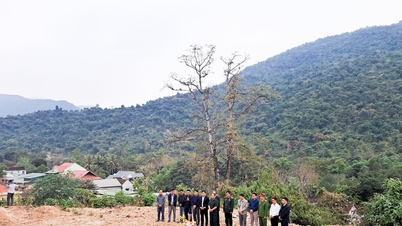
In Son Thuy village, Dong Luong commune, Mr. Le Ngoc Yen expressed immense pride when mentioning how the bamboo clumps he personally cared for and cultivated were uprooted and replanted in the grounds of President Ho Chi Minh's mausoleum in 2013. At 79 years old, the veteran who participated in the resistance war against the US is still robust and strong. Dressed in worn-out work clothes, he quickly grabbed a machete and rode his motorbike to his family's bamboo hill. He even pointed out the specific locations where some of the bamboo clumps had been uprooted with indescribable pride.
“I am a disabled veteran (category 3/4), fortunate enough to return from the war, so I deeply cherish the patriotic spirit and reverence for President Ho Chi Minh. My family's bamboo forest has been passed down through generations; my ancestors contributed bamboo to the Ho Chi Minh Mausoleum, and nearly 40 years later, I never expected to be able to contribute another 20 clumps of bamboo to replace them,” Mr. Yen shared. In the same period, in Son Thuy village, two other households contributed bamboo to the Ho Chi Minh Mausoleum in 2013, totaling 50 clumps. The bamboo selected was young, about 3 years old, still vibrant and healthy, and had to be at least 5 meters tall to meet the technical requirements.
If Thanh Hoa is the bamboo capital of the country with 50% of its area, then the bamboo from the old Lang Chanh region is considered the "king of bamboo" in Thanh Hoa. Lang Chanh bamboo has long been famous, known as "Chau Lang bamboo," for its high quality, thick flesh, and ability to withstand storms, making it less prone to breakage than bamboo from many other regions. Perhaps this is why the bamboo from this area was chosen for planting around the Mausoleum of President Ho Chi Minh on both occasions.
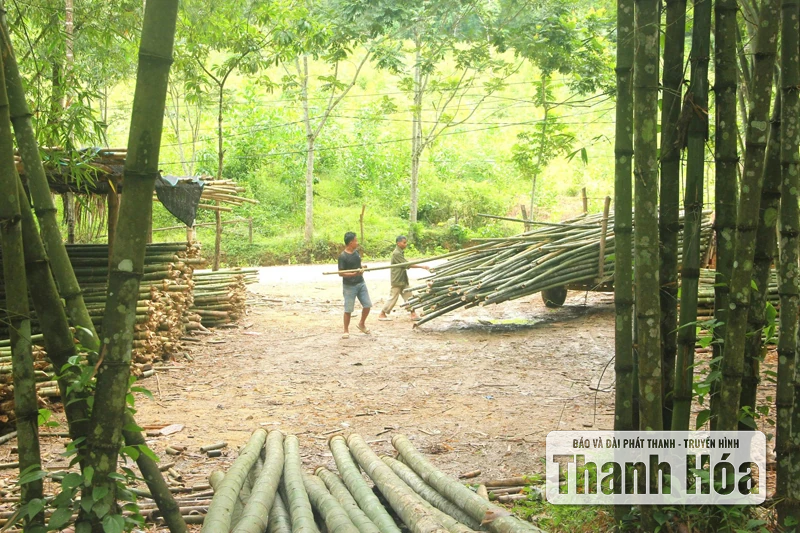
Bamboo is a native crop of the mountainous region of Thanh Hoa province, providing a livelihood for tens of thousands of households in the province's mountainous areas.
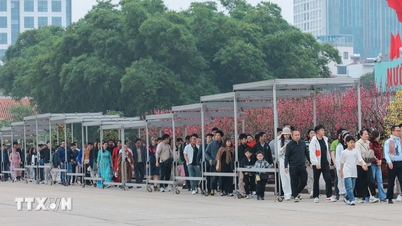
During the days when Hanoi was bustling with activities celebrating the 80th anniversary of the founding of the nation, we had the opportunity to return to the historic Ba Dinh Square. From afar, it was easy to see two rows of bamboo planted along both sides of the front of the Mausoleum, each row stretching for hundreds of meters. These bamboo clumps were planted in two small, bordered courtyards, raised above the grassy surface of Ba Dinh Square and the gardens behind. These two bamboo groves embody the national spirit and are quite fitting with the overall architecture of the Mausoleum grounds and the Square. Every day, visitors and people from all over the country who come to visit the Mausoleum are guided to line up and walk along these rows of bamboo.
Ms. Le Thi Mai, a resident of Linh Dam urban area (Hanoi), expressed: “My family are all from Thanh Hoa province and live and work in Hanoi. Occasionally, I take my grandchildren to visit the Ho Chi Minh Mausoleum, or on summer evenings, we often stroll in Ba Dinh Square under these bamboo groves. Now that I know they originate from my hometown, this is wonderful news that has moved and filled me with pride...”
Text and photos: Le Dong
Source: https://baothanhhoa.vn/chuyen-cay-luong-thanh-hoa-ra-lang-bac-260330.htm

![[Photo] General Secretary and President visit the China-ASEAN AI Application Cooperation Center](https://vphoto.vietnam.vn/thumb/1200x675/vietnam/resource/IMAGE/2026/04/17/1776404277677_vna-potal-tong-bi-thu-chu-tich-nuoc-tham-trung-tam-hop-tac-ung-dung-ai-trung-quoc-asean-8706616-2286-jpg.webp)


![[E-Magazine]: Thanh Hoa Newspaper and Radio & Television "debut" in television drama with "The Happy Tea Shop"](https://vphoto.vietnam.vn/thumb/402x226/vietnam/resource/IMAGE/2026/02/03/1770081918370_e-magazine-bao-w1200t0-di2605d272d2001433t11920l1-cover9.webp)












![[Photo] National Assembly Chairman Tran Thanh Man attends the policy seminar to promote Vietnam-Türkiye cooperation.](https://vphoto.vietnam.vn/thumb/1200x675/vietnam/resource/IMAGE/2026/04/16/1776351415367_vna-potal-chu-tich-quoc-hoi-tran-thanh-man-du-toa-dam-chinh-sach-thuc-day-hop-tac-viet-nam-tho-nhi-ky-8705791-jpg.webp)














































Comment (0)