Without embellishment or ostentation, this hardship has quietly passed through generations, leaving the marks of time on the gray stone and the simple yet resilient human values of the people of this challenging land.
Calluses on the blue stone
In early May, the Thất Sơn region (An Giang province) was scorching hot. In the middle of Cô Tô rocky beach, at midday, the heat seemed to intensify, reflected from the massive rocks and the dust of rocks suspended in the air. Along provincial road 943, the sounds of cutting machines and hammers mingled incessantly, creating the characteristic rhythm of the laborers who silently "splitting rocks for profit" day after day.
With calloused hands and sun-tanned faces, the stonemasons here diligently carve massive blocks of stone into sturdy pillars for construction projects throughout the Mekong Delta and the Southeast region of Vietnam. It's a job that demands a combination of physical strength and meticulous skill, where the line between safety and accident is sometimes as thin as a single misstep with a hammer…
Wearing only plastic safety glasses and tattered cloth gloves that exposed all ten fingertips, Mr. Anh Phan Van Duy (44 years old), residing in Thoi Son ward (An Giang province), still worked nimbly while chatting with the reporter. According to Mr. Duy, the stone-splitting profession here is not for the faint-hearted or impatient. It is a combination of muscular strength and the keen eye of a professional. A skilled worker not only needs strong hands to wield the hammer, but also must know how to "read the grain." Stone, like wood, has layers and textures. Just placing the chisel in the wrong position or cutting in the wrong direction can cause a ton-heavy rock to break in half, rendering all the hard work "wasted."

"I've been working as a stone splitter in Co To for over 20 years. Although it's hard work, the income is quite stable, earning 400,000 to 500,000 VND per day, enough to support my family," Mr. Duy shared.
At just after noon, under a faded tarpaulin covered in dust accumulated over the years, Mr. Duy exerted himself to turn over a large boulder to mark its position, preparing to cut it into smaller stone pillars. With the skill of a seasoned craftsman, his right hand holding a large iron hammer (larger than his fist), his left hand gripping a chisel the size of two fingers, he meticulously carved each edge of the stone to make it as smooth as possible to meet the construction needs of his customers.
The tools of the trade for the stonemasons here are quite simple, consisting only of a saw, a few hammers, and a bunch of iron nails...
According to Mr. Duy, to create a finished stone pillar, the quarry owners purchase raw stone blocks from mining companies in the mountains, some weighing up to tons. After the stones are transported to the storage yard by truck, the workers will split them into smaller pillars about 10-15 cm wide and 1-3 m long, then carve them to make them square and flat.



Mr. Duy said that at the nearly 2-kilometer-long Co To stone quarry, wages are calculated per product. Depending on the length (from 1-3 meters), each finished stone pillar earns the worker between 7,000 and 15,000 VND. Therefore, everyone tries their best, with almost no concept of fixed rest times; as long as it's daylight, they work, and if they get tired, they rest briefly in the shade before continuing their "battle" with the stones.

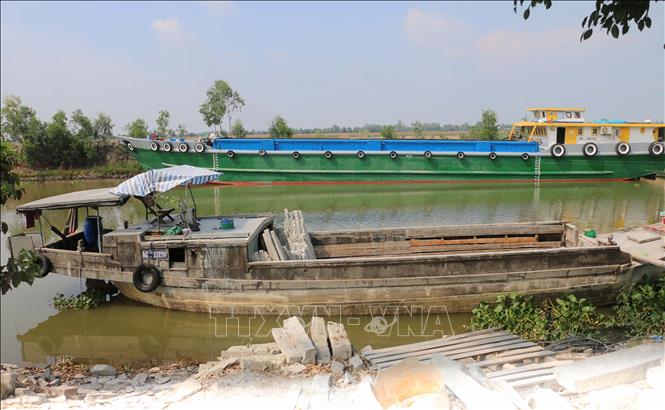
In the sweltering midday heat of summer, each "construction site" on the Co To rocky beach is only covered by a few faded, tattered tarpaulins, with large and small rocks scattered underneath. Down at the Co To canal, dozens of ships are waiting to load cargo to be delivered throughout the Mekong Delta and the Southeast region.
Happiness after the hammer blows
Behind each smooth stone pillar lies a story of sharing and patience. The craftsmen often worked in pairs, one sawing, the other chiseling, relying on each other to split the wages equally for each completed product.
Ms. Nguyen Thi Thi (residing in Thoai Son commune, An Giang province) said that nowadays, although machinery has somewhat replaced human labor in the strenuous stages, the exquisite detail and soul of the stone still depend on the hands and sensitivity of skilled craftsmen. They understand the stone as well as they understand the temperament of their loved ones, knowing where to place the wedges and how much force to apply with the hammer to break the stone exactly as intended.
According to Ms. Thi, the job of splitting stones in Co To Island doesn't discriminate by age or gender; as long as you're healthy and hardworking, you can do it. Cutting stones is dangerous, dusty, and requires a lot of strength and experience in assessing the stone, so it's usually done by men. Women's work mainly involves using iron wedges to separate smaller stone pillars from pre-cut blocks. Although it's less strenuous than sawing, getting your hands or feet crushed, or being hit by a hammer, is a "common occurrence."
"It hurts so much! It's my flesh and blood, how can I bear having rocks embedded in it? But I have to try to get through it," Thi confided.
Despite the hardships, this profession offers the stonecutters here a certain freedom. Mr. Tran Ngoc Tam (Thi's husband), who has been working at the Co To stone quarry for over 30 years, believes that this job is "paying as much as you work," is stress-free, and allows time to care for his family.
However, Mr. Tam could not hide his concern as he witnessed the quarry becoming increasingly deserted. The supply of stone from the mines was gradually becoming scarce, while the younger generation was no longer interested in the arduous and risky job of quarrying, choosing instead to go to the city to work as factory workers for a more stable life.
“About 10 years ago, the Co To quarry was bustling with activity. At its peak, hundreds of quarry workers were working together, filling the entire road with the roar of chainsaws, hammers, and clouds of dust. But now, the quarries are less active, so the work has decreased, and the quarry workers have also stopped working,” Mr. Tam shared.


Stone splitting is usually done in teams of two, one sawing and the other chiseling to flatten the stone. The wages are split equally based on the work done. Besides the men, there are also a number of women working at the quarry, mostly wives of the stone splitters. They participate in almost all stages: from carrying and splitting stones to chiseling. Even when the men have gone to rest, the women are still diligently collecting chisels, cleaning machinery for the next day's work, and so on.
According to Mr. Nguyen Van, Chairman of the People's Committee of Co To commune (An Giang province), currently, there are about four operating stone quarries in Co To with more than 60 workers. Every day, ships still wait busily at the Co To canal dock to transport stone pillars, piles, and paving stones for sale throughout the Mekong Delta and Southeast Vietnam.

Local authorities are studying and replanning this area to ensure environmental protection and move towards establishing an official craft village, contributing to preventing the traditional stone-splitting craft in That Son from disappearing, so that the sweat of the craftsmen today will crystallize into the sustainability of future constructions.
Source: https://baotintuc.vn/xa-hoi/chuyen-doi-tho-da-that-son-20260512091008030.htm