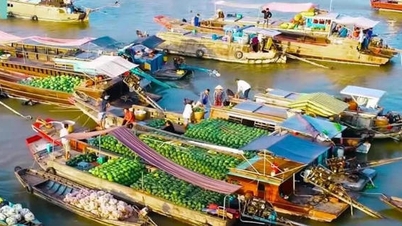
Cai Rang Floating Market, dating back over 120 years, is located on the Can Tho River - Xang Xa No Canal waterway, facilitating trade with other localities in the Mekong Delta. The market is approximately 400 meters from Cai Rang Bridge, with an operating area 100-120 meters wide and 1.3-1.5 kilometers long. For decades, it has been a hub for boats and barges trading agricultural products and goods, playing a vital role in the lives of local residents. In 2016, Cai Rang Floating Market was recognized as a national intangible cultural heritage.
However, the floating market has not been as bustling for many years. In 2016, Can Tho approved a project to preserve and develop the Cai Rang floating market, investing 63 billion VND in items such as garbage collection boats, relocating floating rafts, providing capital support to households to develop tourism products, and organizing boats to sell souvenirs, fruits, and food on the river. Subsequently, Can Tho invested an additional 35 billion VND to build piers, rest stops, parking lots, and cargo terminals in the area.
However, trading activity has decreased, and many small traders have left. Tourism at the floating market is considered to lack proper organization, offer monotonous products, fail to fully exploit its reputation and cultural value, and lack unique experiences.



Once again, Can Tho is currently developing a project to preserve the cultural identity of the floating market traders, zone water-based activities, and develop tourism at Cai Rang floating market. The project aims to preserve the trading practices on the river, the life of the traders, and the image of the floating market as a "living heritage" of the Mekong Delta; to create a unique tourist destination, and to generate additional livelihoods for traders, local people, and related services.
The project's scope encompasses the entire current state of the floating market, the landscape on both sides of the river, and seven bridges in the area. The water surface will be divided into functional zones such as a core conservation area for large-tonnage merchant boats to anchor and trade; a buffer zone for tourism services with passenger ships, floating amenity clusters, and rest stops for food, sightseeing, and experiencing riverine culture… The project development team is also said to be studying several domestic and international models such as Hoi An Ancient Town and floating markets.
Damnoen Saduak in Thailand and Notting Hill in England are examples of conservation, spatial organization, and tourism development. The project is expected to take approximately 3 years to develop and will cost nearly 30 billion VND.
According to data from the Can Tho Department of Culture, Sports and Tourism, in the first six months of the year, the city welcomed over 7.5 million visitors, with total tourism revenue reaching approximately 6,600 billion VND. If Cai Rang floating market could fully realize its potential and value, the number of tourists and revenue could have exceeded these figures. Therefore, reviving the heritage of Can Tho floating market is essential, but learning from previous projects, it is crucial to conduct thorough surveys and gather opinions from residents, tourists, businesses, experts, researchers, media outlets, and local authorities. If implemented, the new project must have practical and effective cultural and economic benefits, creating livelihoods for residents, providing tourists with memorable experiences, and contributing to the local development.



Source: https://baophapluat.vn/danh-thuc-di-san-cho-noi-cai-rang.html