

 |
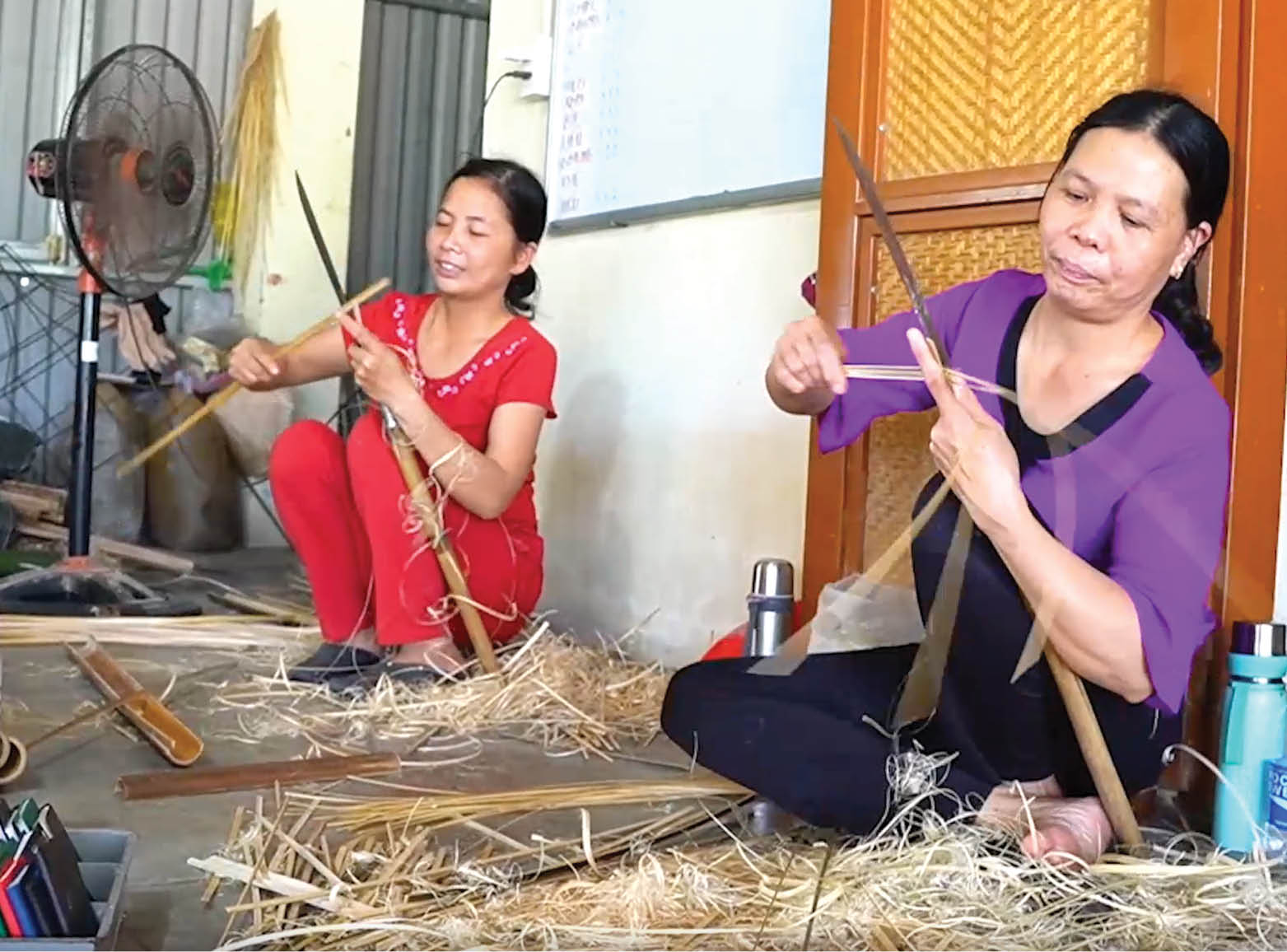
| Women in Quang Dien commune meticulously weave handicrafts to support their livelihoods. |
Innovate the way things are done.
In A Luoi 1 commune, the emulation movement to build new rural areas was "inspired" by the A Nor community tourism model. From previously small-scale activities, the Pa Co people have registered to compete in "upgrading tourism standards" by investing in homestays, expanding experiential services, and preserving the local landscape and culture. Household groups reported significant income improvement since the cooperative launched the movement: homestay groups compete to maintain clean and beautiful spaces; performing arts groups compete to prepare outstanding performances; and culinary groups compete to preserve traditional dishes, creating a ripple effect of competition within each household.
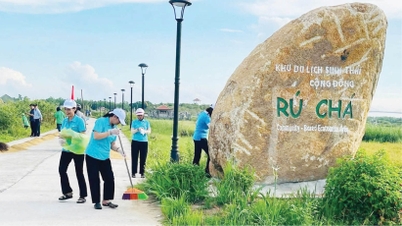
According to Mr. Hoang Thanh Duy, Director of the A Nor Community Ecotourism Cooperative, the driving force behind this success lies not in the number of services, but in the shared spirit: competing to protect the forest, preserve water sources, and maintain the cultural traditions of the Pa Co people, viewing them as shared assets to be preserved together. Many families shared that since the introduction of community tourism, they voluntarily clean the path to the waterfall and tend to their gardens every weekend because "the influx of tourists is thanks to the collective efforts of the entire village."
Mr. Nguyen Van Hai, Chairman of the People's Committee of A Luoi 1 commune, said that the commune is continuing to launch emulation campaigns to improve service standards, open training courses on customer service skills, and support households participating in tourism in order to fulfill the income - culture - environment criteria in the set of criteria for new rural areas in the highlands.
In Quang Dien commune, the movement to apply technology is becoming a spearhead in building new rural areas. Building on the smart control room completed in the previous phase, the commune has deployed a security monitoring system, interconnected digital reporting, and environmental monitoring equipment to serve disaster warning. According to Mr. Tran Kim, Vice Chairman of the Commune People's Committee, the digital transformation emulation not only shortens the time for processing documents but also enhances the transparency and efficiency of leadership, direction, and management.
Quang Tho II Cooperative chose to register for the "digitalization of production - market expansion" emulation campaign. According to the cooperative's director, Mr. Nguyen Luong Tri, bringing their OCOP-certified centella tea product to e-commerce platforms and applying 3D and AR simulations in product promotion has opened up new approaches for farmers, aligning with the emulation movement for developing digital rural areas.
In the environmental criteria – one of the key requirements of advanced new rural development – many localities in the city have launched emulation campaigns for waste sorting at source, building safe food markets, and implementing household wastewater treatment models.
Shifting from "movement" to "substance"
Following the administrative reorganization, the scale of communes within the city has expanded, the population has increased, and the workload has become greater, thus requiring a more direct and flexible management mechanism. In Quang Dien commune, the emulation movement started with the staff: clear assignment of responsibilities, prioritizing the completion of production area planning, upgrading schools, health stations, transportation, and irrigation to meet the increasingly high demands of the people. "Emulation must start from within; if the staff do well, the movement will spread to the people," Mr. Tran Kim emphasized.
In Khe Tre commune, the emulation movement focuses on mobilizing people to participate in building new rural areas, with each household having a suitable task to contribute to the common achievement. Mr. Tran Van Quang, Vice Chairman of the Commune People's Committee, shared: "Each village and each household contributes through their own work. The people are the key to the success of the new rural area movement."
Furthermore, digital transformation is becoming a highlight in the emulation movement in many localities. Communes that have undergone restructuring are proactively incorporating digital transformation into their emulation tasks, focusing on administrative procedure reform, disaster monitoring, and transparency in operational processes. Local authorities assess that digital transformation has made the emulation movement more substantive and better served the people.
Mr. Le Thanh Nam, Deputy Chief of the Office for Coordinating the National Target Program for Building New Rural Areas in the city, said that in the coming period, the city will continue to prioritize infrastructure investment, promote digital transformation, develop ecological agriculture, and expand the smart commune model in accordance with Resolution 19-NQ/TW of the Central Committee on agriculture, farmers, and rural areas in the new period. "The important thing is to avoid gaps in management and ensure that each commune makes strong and sustainable progress," Mr. Nam emphasized.
From community-based tourism models, technology applications, and grassroots emulation movements, it is evident that the construction of new rural areas in Hue city is shifting from a "movement" to a "substantive" effort. Each commune has its own approach, each community its own initiative, and each citizen its own role… creating new vitality for Hue's rural areas in the context of effective operation of the two-tiered local government. Emulation has become an important driving force, contributing to improving people's lives and shaping a green, smart, ecological, and modern Hue countryside in this new development phase.
Source: https://huengaynay.vn/kinh-te/nong-nghiep-nong-thon/chuyen-dong-moi-tu-cac-phong-trao-thi-dua-160524.html
![[Photo] National Assembly Chairman Tran Thanh Man attends the policy seminar to promote Vietnam-Türkiye cooperation.](https://vphoto.vietnam.vn/thumb/1200x675/vietnam/resource/IMAGE/2026/04/16/1776351415367_vna-potal-chu-tich-quoc-hoi-tran-thanh-man-du-toa-dam-chinh-sach-thuc-day-hop-tac-viet-nam-tho-nhi-ky-8705791-jpg.webp)
















![[Image] Bridges and roads connecting the eastern part of Ho Chi Minh City](https://vphoto.vietnam.vn/thumb/1200x675/vietnam/resource/IMAGE/2026/04/16/1776328595108_ndo_br_bh-vt5-jpg.webp)
























![[Infographic] Details of the Hanoi-Quang Ninh High-Speed Railway Project](https://vphoto.vietnam.vn/thumb/402x226/vietnam/resource/IMAGE/2026/04/16/1776338188424_anh-man-hinh-2026-04-16-luc-18-16-10.png)

![[Photo] National Assembly Chairman Tran Thanh Man meets with the Speaker of the Georgian Parliament](https://vphoto.vietnam.vn/thumb/402x226/vietnam/resource/IMAGE/2026/04/16/1776338494029_anh-man-hinh-2026-04-16-luc-18-21-21.png)












Comment (0)