 |
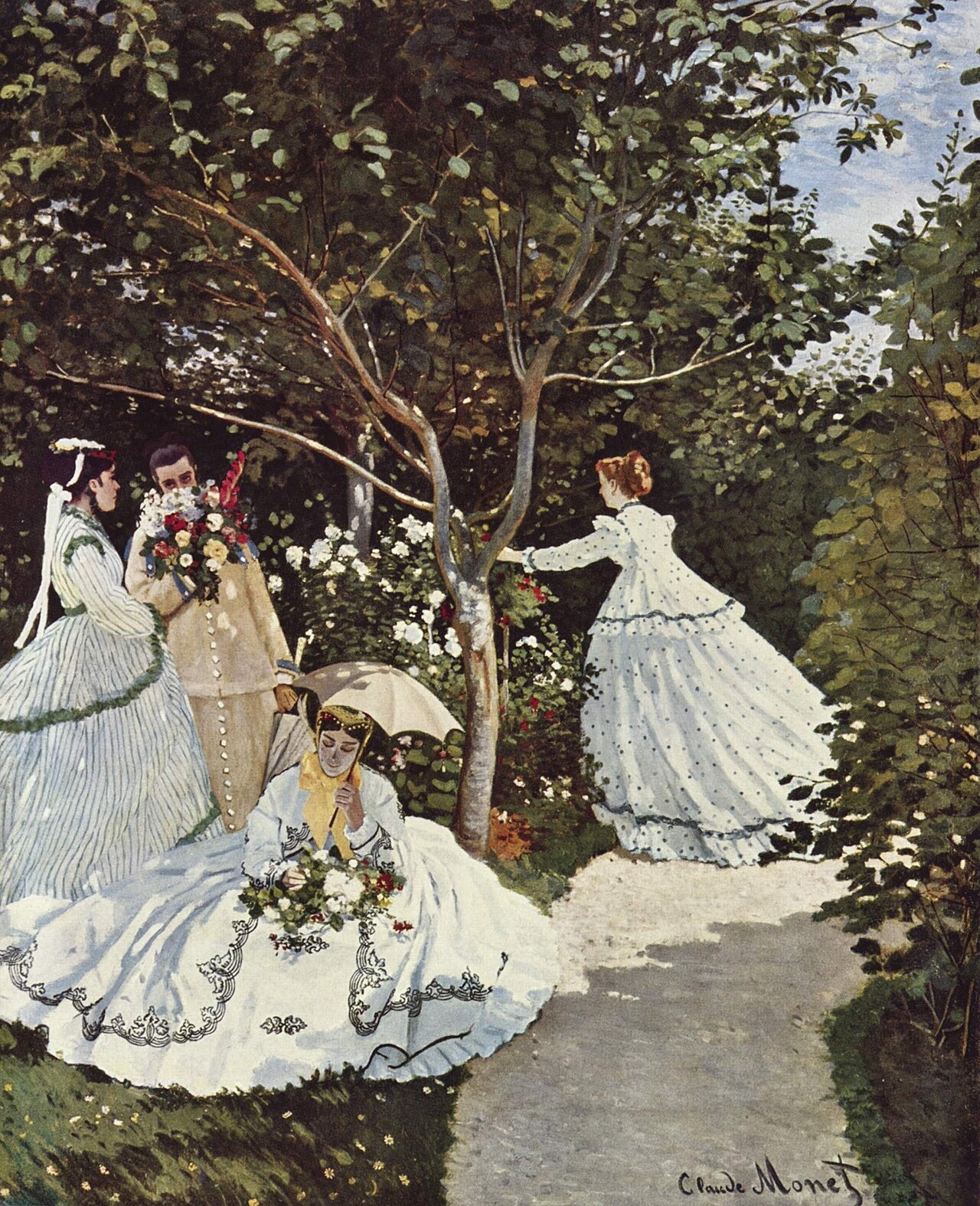
The painting "Girls in the Garden" was painted by the renowned artist Claude Monet. Photo: Wikipedia |
The Manifesto of a New Realism
In 1866, having started this work at a relatively young age, Claude Monet set himself a double challenge: to paint outdoors and on a large canvas.
In his garden at Ville d'Avray, he arranged four young girls to give the scene a natural, graceful feel, while ensuring the work had the coherence and logic characteristic of narrative painting.
New ambitions and unconventional methods



To accomplish this, Monet devised a highly ingenious device: he attached the large canvas to a pulley and dug a trench beneath it. By doing so, he could lower or raise the painted section while maintaining perspective. At the same time, he could capture changes in light, ensuring the harmony of the figures, whether static or dynamic, with the unchanging and evocative natural world.
Around the central axis formed by the pathway and tree trunks, Monet places his four figures in the lower part of the painting. Although beautifully rendered, the main figures retain a certain air of mystery, their faces either partially visible and gazing into the distance, or obscured by the colors of a bouquet of flowers or the faint light under the shadow of an umbrella.
The key lies not there, but in the colorful sunlight reflected on their clothing, seemingly reflecting every nuance of joyful nature. Only the path to the right evokes the vast blue of large clouds, but it is in the details of the flowers and clothing in the scene that the viewer perceives, almost touches, the movement of air and light.
Use the ambiguous to clarify the tangible.
Quietly sheltered under an umbrella in the sunlight, the young woman sat on the grass beneath a tree, her wide skirt forming a shimmering circle that seemed to ripple around her; oblivious to the artist's presence, she focused her attention on the bouquet in her hand. Behind her, two other women silently gazed at a second bouquet.
Finally, on the right, drawn into the shadows and interrupting the fragile stillness of the scene, the fourth young woman, with her hurried footsteps, dispels the melancholic dreaminess created by her companions. On her attire, the handling of light creates gradients and shades, contrasting with the contrast of light and dark areas—a distinctive feature of her friend's attire in the foreground.



Notable details
The young woman seated in the foreground is none other than Monet's partner, Camille. However, upon closer inspection of the painting, it appears she also served as a model for the other characters. A model with the costumes (rented for the occasion) and various poses were intended to create the effect of a group of characters formed from a single subject.
Source: https://znews.vn/thu-thach-kep-cua-monet-tao-kiet-tac-hoi-hoa-post1664798.html