


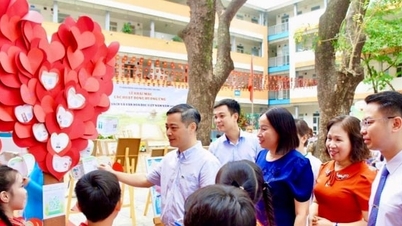
Teachers and students of Huynh Thuc Khang Secondary School, Ninh Kieu Ward, view an exhibition of novels by writer Ho Bieu Chanh.
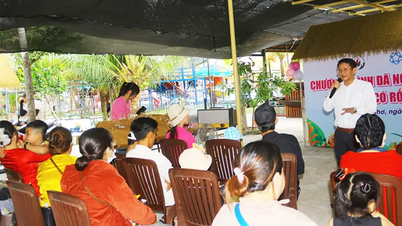
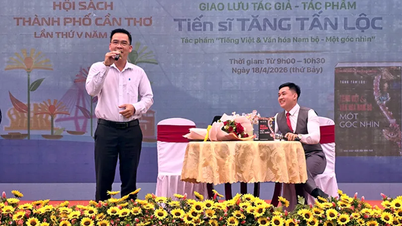
At the recent Spring Book Park event in Can Tho City in 2026, organized by the Department of Culture, Sports and Tourism at Tao Dan Park (Ninh Kieu Ward), in addition to new book stalls and author-book introductions and interactions, there was also an interesting activity: displaying valuable book collections from private collectors.
The first thing that impresses visitors is the collection of ancient palm leaf books belonging to Venerable Ly Hung, the abbot of Pitu Khosa Rangsay Pagoda (Ninh Kieu Ward). Venerable Ly Hung has made a significant contribution to preserving and conserving the pagoda's rare collection of ancient books. The bookshelf contains over 4,000 books, many of which are hundreds of years old, meticulously carved on palm and cypress leaves. The content of these palm leaf books records scriptures, customs, rituals, and moral education . The unique cypress leaf pieces are displayed respectfully, attracting many people to admire them.
Collector Dang Duy Khoi (An Binh ward) brought to display a collection of 50 novels by writer Ho Bieu Chanh, mostly published within the last half-century. Classic works by the author such as "Who Can Do It?", "The Bitter Taste of Life", "The Poor Man's Son", "The Grass Blown by the Wind", "Living and Dying with Love"... printed on pages stained with the passage of time, with distinctive hand-painted covers. Because many of Ho Bieu Chanh's novels have been adapted into films, visitors were very interested in seeing the original literary works firsthand.
Ms. Nguyen Thi Kieu Tien, a visitor, shared: "When I was a student, I often read novels by Ho Bieu Chanh, but this is the first time I've seen so many of his books, and especially, they are all old books."
Collector Nguyen Van Chuon (Tan An ward) contributed publications over a century old to the exhibition, all carefully preserved. These include the "Dai Nam Quoc Am Tu Vi" (Great Vietnam National Language Dictionary) by Huynh Tinh Paulus Cua, published in 1895-1896, and the "Luan Ly Giao Khoa Thu" (Moral Education Textbook), published in 1925, opening up a space of ancient scholarship and reflecting the development of Vietnamese education and language in the early modern period. The publications of collector Trinh Quoc Gia (Ninh Kieu ward) are also valuable books, nearly a hundred years old, encompassing various aspects of culture and cultural transformation.
The collection of Dinh Hoai Thuong (Long Tuyen ward) focuses on authors who have had a profound influence on the spiritual life of the Vietnamese people, such as Bao Dinh Giang, Nguyen Hien Le, and Nguyen Duy Can. From folk songs and patriotic literature of Southern Vietnam to works on "learning to be a good person," "self-study," and "how to conduct oneself," these books have quietly accompanied many generations of Vietnamese readers and are now cherished as part of the spiritual heritage. Mr. Dinh Hoai Thuong said: "Having a love for books since my school days, I have consciously bought and collected books, and today my family's bookshelf has quite a large number. This is also a joy for me."
Like Mr. Thuong, most of the collectors participating in the exhibition have quite extensive family bookshelves, serving both their reading needs and their pursuit of knowledge, as well as being a fascinating hobby. These bookshelves weren't built overnight, but accumulated over many years. The collections displayed at the Spring Book Park not only possess material value but also represent the spirit of preserving and conserving old and antique books. These are private bookshelves, formed from personal passion and a conscious effort to preserve cultural memories for the community. Notably, many of these collectors belong to the 80s and 90s generations, who view books as a way to anchor their cultural identity amidst a digitized world. This "undercurrent" has been and continues to nurture a sustainable reading movement, where books are not only for reading but also for preserving and passing on to future generations.
Text and photos: DANG HUYNH
Source: https://baocantho.com.vn/co-mot-mach-ngam-van-hoa-doc-o-can-tho-a198525.html










![[Photo] “Red Journey” 2026: Vietnamese Youth Continue Building the Bridge of Friendship Between Vietnam and China](https://vphoto.vietnam.vn/thumb/1200x675/vietnam/resource/IMAGE/2026/04/20/1776629730866_4055880775670638308-9618-4200-jpg.webp)









































Comment (0)