

Journalists and relatives of fallen journalists across the country will never forget that sacred July of the Year of the Rat, when the national media system almost simultaneously reported, published articles and photos of the grand memorial service at Da Pagoda (Vinh City, Nghe An province) for over 500 fallen journalists, including 6 journalists from Nghe An who sacrificed their lives in the resistance wars against France and the US, defending the Fatherland, and volunteering for noble international missions with the Land of a Million Elephants and the Land of the Golden Pagodas.
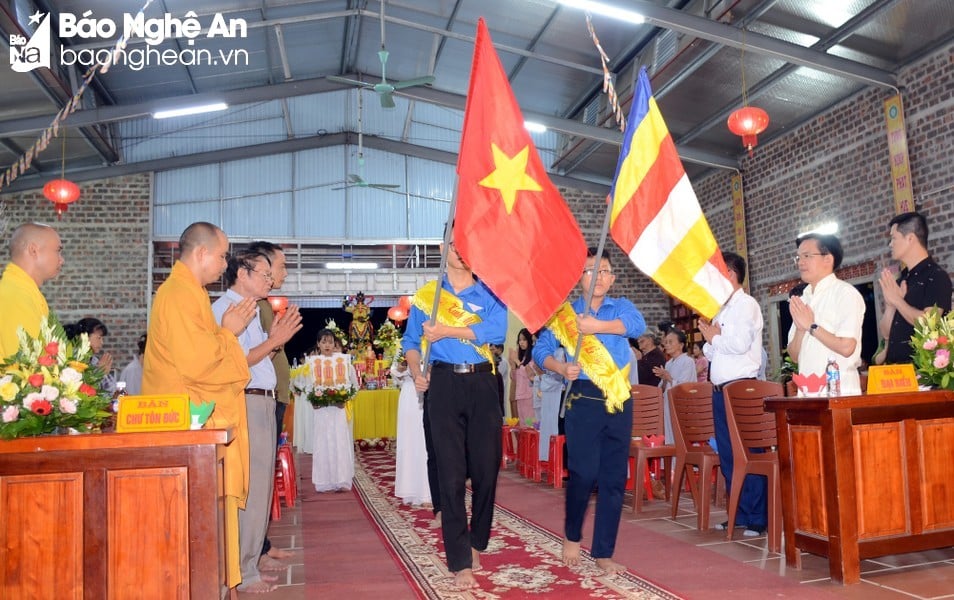
The event, deeply rooted in the age-old Vietnamese national moral values of "Drinking water, remember the source" and "Eating fruit, be grateful to the tree planter," was solemnly held at Au Lac Pagoda (Da Pagoda), a nearly 400-year-old temple located in Hoa Tien hamlet, Hung Loc commune, Vinh city, Nghe An province on July 27, 2020, leaving an indelible mark. In the seventh lunar month, on the full moon day, people still deeply cherish the moral principle of remembering and showing gratitude to their ancestors and deceased relatives.
The temple's humane idea was happily shared by the Vietnam Buddhist Association of Nghe An province, both in content and form, according to rituals suitable to the feelings and aspirations of many central and local press agencies and Buddhists around Vinh City. The very name , "Ceremony to pray for the souls of revolutionary martyred journalists," already signifies the enthusiastic and responsible participation of representatives from the Provincial People's Committee Office, Vinh City, Nghe An Newspaper, the Nghe An Journalists Association, representatives of the Party Committee, government, and mass organizations of Hung Loc commune, the people of Hoa Tien hamlet, the Director of Saigon Eye Hospital and a large number of doctors from Saigon Eye Hospital, Nghe An Radio and Television Station, etc. Press agencies sent their most capable and dedicated reporters to the "Ceremony to pray for the souls of revolutionary martyred journalists," working quickly to publish the most impactful and moving articles about an activity honoring the glorious generation of journalists who fought bravely during the difficult and brutal wartime.
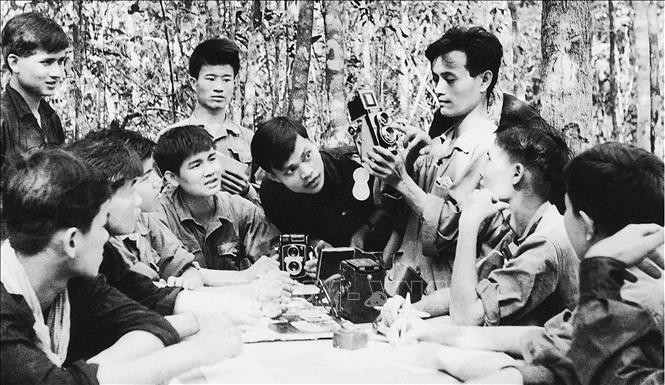
The first martyr in the resistance against the French was journalist Tran Kim Xuyen, who died on March 3, 1947. Tran Kim Xuyen was born in 1921 in Huong Son, Ha Tinh province , and was the former Deputy Director of the Vietnam Information Agency, now the Vietnam News Agency. The last martyr in the resistance against the Americans was journalist Nguyen Duc Hoang, born on April 8, 1942, in Tan Yen, Ha Bac province, and the head of the Loc Ninh branch of the Vietnam News Agency, who died on August 6, 1974. The only journalist to die in February 1978 in the volunteer army helping the Cambodian people fight the Pol Pot genocide was Vu Hien, from Thuy Nguyen, Hai Phong, a reporter for the Naval Service newspaper. A journalist who died in February 1979 defending the Northern border was reporter Bui Nguyen Khiet of the Hoang Lien Son newspaper. Another journalist, Nguyen Nhu Dat, worked at the People's Army Film Studio. To obtain a news item, a report, a photograph, or a war film clip, a reporter has to pay with their life.
From 1960 to 1975, the Vietnam News Agency (VNA) lost nearly three hundred journalists across various battlefields, the most intense being the Central Highlands, Zone 5, the Southeast, the Cu Chi Iron Land, Quang Tri , Thua Thien Hue, and the 81-day and night defense of Quang Tri Citadel. VNA reporter Luong Nghia Dung, later posthumously awarded the title of Hero of the Armed Forces by the Party, State, and National Assembly, sacrificed his life defending Quang Tri Citadel. Journalist Luong Nghia Dung fell bravely, like more than three thousand officers and soldiers of the 320th Division, 304th Division, 48th Regiment, and 27th Regiment named after Trieu Hai, most of whom were from Nghe An province.
Before 81 days and nights of fierce fighting with the enemy, fighting for every inch of land blackened by bomb smoke and bullets, two Liberation Army film reporters, Le Viet The and Nguyen Nhu Dung, sacrificed themselves simultaneously on the turret of a tank of Brigade 203 during the attack to liberate the Hai Lang sub-district. The strip of land, the heartland of Central Vietnam from Duc Pho (Quang Ngai) to Dong Ha (Quang Tri), was soaked with the blood and bones of 15 journalist martyrs throughout the years of the liberation war. Among those courageous faces was writer and journalist Duong Thi Xuan Quy, a young mother who heartbreakingly left her two-year-old child, Duong Huong Ly, behind in the rear, crossing the Truong Son Mountains into the arduous and fierce Zone 5. The only remaining relic of the martyred journalist Duong Thi Xuan Quy is a hair clip found where she "rests in the blessed land of Duy Xuyen," Quang Nam (from the poem "Song of Happiness" by poet Bui Minh Quoc, in memory of his beloved wife Duong Thi Xuan Quy).
Journalist Le Doan, former Editorial Secretary of the Vietnam Women's Newspaper, suppressed her deep regrets and longing, reluctantly leaving behind her two young children, the oldest 6 years old and the youngest 4 years old, before returning to her hometown of Ben Tre via a liaison route at sea. She took on the important responsibility of Vice President of the Women's Liberation Association and concurrently Editor-in-Chief of the Women's Liberation Newspaper of Southern Vietnam. Journalist Le Doan died in My Tho after a carpet bombing raid. Her resting place was disfigured by artillery fire and bombs. After liberation, her relatives and comrades could not find her remains. Her two children cried and searched through the black, crumbling earth, only to find a piece of a Hue-colored woolen sweater that their mother had brought with her to the South in 1966 when she left Hanoi. Journalist Pham Thi Ngoc Hue died on the battlefield in Laos. After many years of searching, only a penicillin vial containing a faded piece of paper bearing the name Pham Thi Ngoc Hue, Truong Son Newspaper, was found at the former battlefield, Ang Kham Valley, Forward Command Post of Regiment 559.
The immense suffering of war did not only befall the frail and vulnerable lives of Le Doan and Duong Thi Xuan Quy, but also the female journalists, editors, and telegraph operators who were martyrs, sacrificing their lives on the battlefields of Southeast Vietnam, Thua Thien Hue, Dong Thap Muoi, Zone 8, Zone 9, and the Central Highlands. They included journalists Pham Thi De, Tran Thi Gam, Nguyen Thi Kim Huong, Nguyen Thi Moi, Truong Thi Mai, Le Thi Nang, Pham Thi Kim Oanh, Ngo Thi Phuoc, Nguyen Thi Thuy, Doan Thi Viet Thuy, Nguyen Thi Mai, Le Kim Phuong, Nguyen Thi Nhuong, Nguyen Phuong Duy… all of whose graves and remains have never been found.
The exact moments of their sacrifice may have varied, but their burial places were always on the hot battlefields, under the relentless barrage of bombs and bullets. Le Van Luyen, a reporter for the Central Vietnam Liberation News Agency from Nghi Trung, Nghi Loc, Nghe An, died on the Que Son front (Quang Nam) in 1970. His remains were laid at the foot of Liet Kiem mountain, nearly two thousand meters from the front lines, seemingly safe, but after several carpet bombing raids by B52s, the cemetery was riddled with bomb craters. His son, Le Van Son, graduated from university and volunteered to teach in Que Son (Quang Nam), hoping to find his father's remains. For four years, he searched countless cemeteries throughout Quang Nam, but to no avail. Le Van Son could only console his mother and siblings, knowing his father had become one with the soil of their homeland.
For thirty years, the Vietnamese revolutionary press steadfastly and resiliently stood alongside the nation in defeating French colonialism, American invaders, and the puppet regime of Saigon; assisting Laos in achieving independence in 1973; helping the Cambodian people escape genocide; and defeating the northern invasion. The Vietnamese revolutionary press suffered the loss of over 500 journalists. In Nghe An province alone, there were the following journalist martyrs: Dang Loan and Tran Van Thong from the Western Nghe An Newspaper; Nguyen Con from the Army Film Studio; Le Duy Que and Le Van Luyen from the Liberation News Agency; Nguyen Khac Thang from the Southeast Liberation Army Film Studio; and Ho Tuong Phung from the Voice of Vietnam Radio.
The Vietnam News Agency lost over 200 journalists. The People's Army Film Studio suffered nearly 40 casualties.
The Voice of Vietnam, the Voice of the People's Revolutionary Liberation Radio, lost more than 50 editors, reporters, broadcasters, and technical staff.
They were outstanding journalists, brilliant and creative technical specialists, well-trained in the vast rear area of the North and tempered and refined on the battlefield, steadfastly holding their ground even on the vast waters of the Dong Thap Muoi region. Overcoming harsh hardships, and repeatedly being bombed and shelled at their base, they consistently broadcast the voice of the National Liberation Front of South Vietnam, patriotic and progressive organizations and forces fighting for independence and freedom, calling on the whole world to oppose aggression and unjust wars, and appealing to progressive humanity to support Vietnam in its struggle for independence, national reunification, and the protection of peace.
After the victory on April 30, 1975, when the country was reunified, beyond the human losses and casualties, there was a persistent and unceasing haunting memory: the remains of hundreds of journalists who sacrificed their lives scattered across various battlefields could not be found.
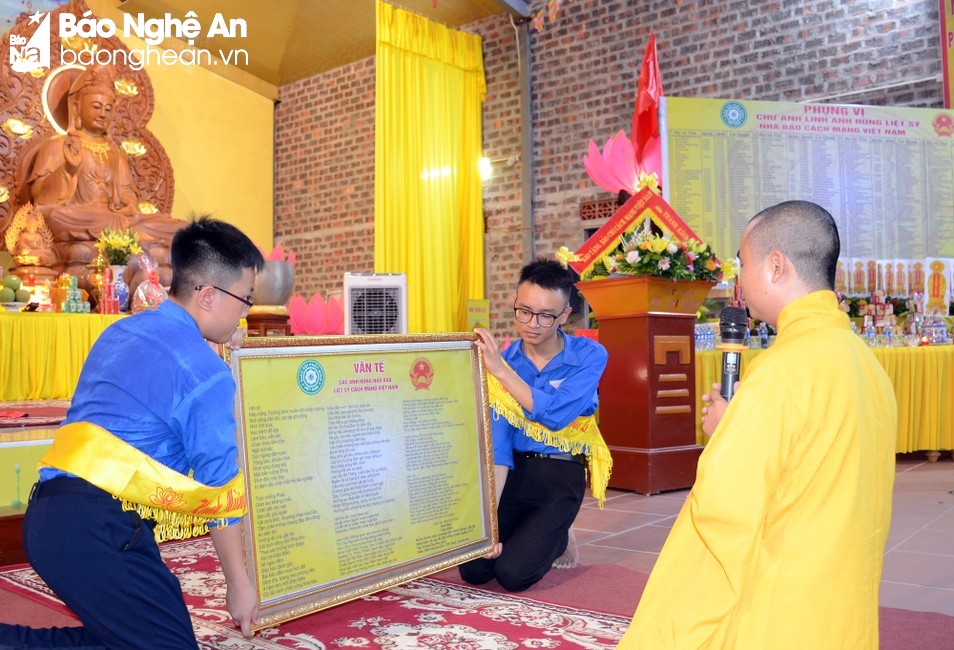
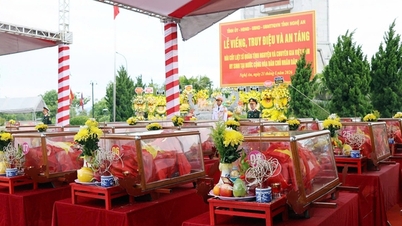
For nearly a century, among the 1.2 million martyrs nationwide, the journalists, both male and female, are like clouds, mist, smoke, the earth, and plants, yet they cannot be considered fairy tales or the past; instead, their radiant presence is enveloped in the hearts and minds of mankind. Then, one day, in the sacred space, amidst the fragrant incense of the Three Jewels of Da Pagoda (Au Lac Pagoda), one of 15,000 pagodas nationwide, including nearly 70 in Nghe An, a grand ceremony was held to pray for the souls of 511 heroic journalists and revolutionary martyrs of Vietnam, a testament to the spirit of "Buddha's light shining everywhere." Venerable Thich Dong Tue, abbot of Au Lac Pagoda, along with Venerable Thich Dong Bao and Thich Dong Tu, solemnly performed the ritual of inviting the spirits of heroic martyrs and journalists to attend the grand memorial service on the occasion of the 73rd anniversary of the Day of War Invalids and Martyrs, expressing the concern, gratitude, and responsibility of the Party, State, and organizations to those who have made great contributions to the Fatherland.
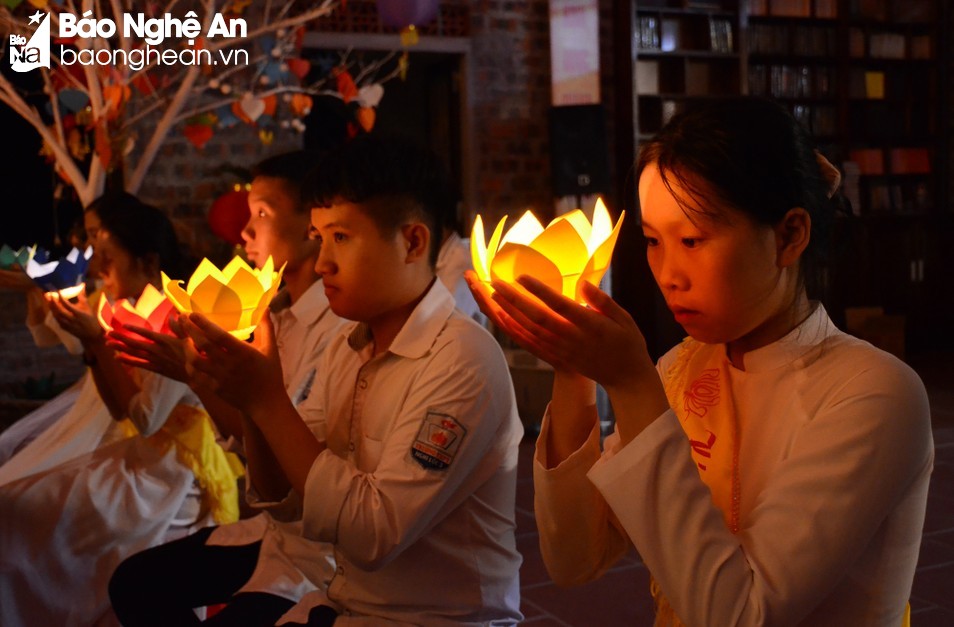
A night of prayer for the deceased. The Au Lac Pagoda was illuminated, shimmering with thousands of candles. Students from universities and colleges, members of the Au Lac Pagoda Club, and Ha Pagoda members, elegantly dressed in their brown robes, respectfully carried the memorial tablets of the national revolutionary journalists and martyrs to the altar, enshrining them in eternal gratitude and offering incense for generations to come.
The fragrant incense burns brightly every day. The bells chime every morning and evening, lulling the spirits of the fallen journalists to find peace in the afterlife.
There is a journalist named Minh Tri, a former war correspondent against the US, who spent nearly 20 years searching for and piecing together information about fallen journalist martyrs across the battlefields from 1947 to the war to defend the Northern border, fulfilling a noble international duty. In 2019, he completed a list of 511 journalist martyrs, which was included in the Museum of Revolutionary Journalism of Vietnam and is commemorated at Da Pagoda (Au Lac Pagoda). After the memorial service in the year of the Rat, every day, regardless of sun, rain, storms, or wind, he quietly and diligently goes to the pagoda to offer incense and pay respects to the heroic journalist martyrs from all over the country.
Source

![[Photo] General Secretary and President To Lam presides over a working session with the Central Policy and Strategy Committee on the development of the materials industry.](https://vphoto.vietnam.vn/thumb/1200x675/vietnam/resource/IMAGE/2026/05/21/1779359935432_a3-bnd-3129-1412-jpg.webp)
![[Photo] National Assembly Chairman Tran Thanh Man working with the Standing Committee of the Law and Justice Committee](https://vphoto.vietnam.vn/thumb/1200x675/vietnam/resource/IMAGE/2026/05/21/1779378929214_ndo_br_1-4610-jpg.webp)


























































Comment (0)