

.jpg)
These sand dunes naturally become a destination for many tourists who enjoy exploring the pristine beauty of mangrove coconut groves and experiencing the simple, peaceful pleasures of river life.
Floating village on a hill
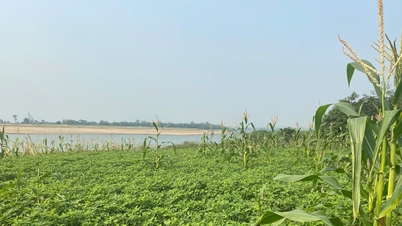
Standing by the railing of Cua Dai Bridge and gazing upstream, one can clearly see numerous sandbanks near the mouth of the Thu Bon River. Perhaps the river's age and history are more profound than the countless sandbanks and islets that rise and fall, a lush green carpet of vegetation amidst the vast expanse of water.
The reason the sandbar is "younger" than the river is because it was formed from the fresh, fertile pink alluvial soil deposited by the Thu Bon River over generations. The mother river, the Thu Bon River, grows from streams on the towering Ngoc Linh peak, winding its way through villages and hamlets for nearly 200 kilometers before splitting into two branches. The area between these two branches is now Go Noi commune.
The story goes that, long ago, an old fisherman and his son swam upstream in search of a place to settle. When they reached a land embraced by two rivers, teeming with fruit trees, they stopped and built a house to live in. Knowing that this wild, fertile land was inhabited by the old fisherman and his son, many people from the north packed their bags and came, eventually forming a small village with scattered thatched houses nestled amidst the green foliage. The land was fertile, attracting people, and gradually, more and more people from other places heard about the rather large mound rising between the two rivers and inquired about finding it. Thus, the place name "Gò Nổi" (Floating Mound) came into being.
For generations, the names of the land and villages in Gò Nổi have been intertwined with the ups and downs of history, producing many famous and heroic figures who have brought glory to this land of sand dunes. The Thu Bồn River splits in two like the two arms of a hardworking mother embracing her beloved child, Gò Nổi, and it is the hand of Mother Thu Bồn River that has nurtured and built up Gò Nổi over the years. Gò Nổi emerged from the womb of nature, a gift bestowed upon humanity.
The Thu Bon River flows downstream, giving rise to dozens of isolated islets and sandbanks, undulating amidst countless playful waves before emptying into Cua Dai estuary. Standing on the breezy Cua Dai bridge and looking down, one sees dozens of large and small islets intertwined, further enhancing the peaceful and poetic beauty of the river and its waters.
For generations, the people of Hoi An and the former eastern Duy Xuyen region have been familiar with the names of the sandbanks at the end of the river, imbued with the rustic character of Quang Nam province: Con Bap, Con Me, Con Dua, Con Tron, Con Noi, Con Thuan Tinh, Con Chai, Con Ba Bon, Con Ong Hoi, Con Ba Xa…
.jpg)
Mutual consent
Once, I visited the Rừng Rẫy field in Thanh Đông, Cẩm Thanh commune (formerly) to see the tomb of Trần Thị Quy, a concubine of King Quang Trung, and the generals of the Tây Sơn dynasty. This ancient burial ground has been classified as a national historical site since 1991.
Here, the elders in Cam Thanh told me a fascinating story related to Thuan Tinh islet. They said that, according to their ancestors, Thuan Tinh islet was once a desolate place, uninhabited, covered with lush green coconut trees, and teeming with fish and shrimp in the river. Although this sandy islet is close to Thanh Chau swiftlet farming village, it was frequently visited by people from Duy Nghia commune on the southern bank who sailed across to fish and cultivate crops. At times, people from Duy Nghia even built temporary shelters to live in for convenience in their work.
Seeing the islet right before their eyes being brazenly occupied by others, the villagers of Thanh Chau held a meeting to discuss how to drive them away and reclaim their territory. Arguments ensued, and finding themselves at a disadvantage, some who had cast their nets, cast their fishing gear, and cultivated crops on the islet had to move towards the southern shore.
To ensure the long-term security of the sandbank, the village elders of Thanh Chau devised a customary law: whenever a young couple truly loved each other and decided to get married, they had to voluntarily pledge to build a house on the sandbank to maintain peace in the territory.
The fertile land and abundant fruit trees provided favorable conditions for young couples to settle on the sand dunes. They established their lives on the isolated dunes, separated from the villages of Thanh Chau, primarily because of their great and undying love for each other. That love overcame all difficulties and challenges to cultivate perseverance and fidelity, built on a foundation of mutual understanding, which is why the villagers of Thanh Chau call it Thuan Tinh (meaning "Duyen Tinh" or "Duyen Tinh").
Peaceful river
With dozens of islets covered in the green of coconut palms and a mix of other vegetation, only one islet bears the name Coconut Islet. Coconut palms are characteristic trees of these islets in the middle of the river. Looking back through history, the rustling shadows of coconut palms on these islets serve as a testament, a symbol of the protective embrace and shelter that coconut trees provided to countless people who braved bombs and bullets during the long struggle to defend the nation.
Coconut trees stretched out their lush green fronds, concealing cadres, guerrillas, security forces, and boats carrying weapons to attack enemy strongholds within the town. From the land, from the villages, from the dense coconut forests of the Cam Thanh, Cam Nam, and Cam Chau rivers, many loyal and indomitable sons and daughters were born, honored as Heroes of the People's Armed Forces, such as Le Van Duc, Tong Van Suong, Tran Minh Luong, Tran Thi Dua, Nguyen Van Viet, Vo Thi Hoa…
The sandbanks at the end of the Thu Bon River still silently conceal countless stories of affection and camaraderie from times of war.
Now, Thuan Tinh is a peaceful islet, only about 2 hectares in size, that has been transformed into a riverine ecotourism area. Since 2021, Thuan Tinh islet has seen the emergence of simple, charming wooden houses that are welcoming and approachable to everyone. Several other islets have also been developed for human benefit, including Bap islet, the largest in this cluster of islets.
Visiting Thuan Tinh is about escaping the hustle and bustle of the city, enjoying the cool sea breeze, and listening to the endless symphony of nature and the waves of Cua Dai, a sight rarely found elsewhere.
Around the beginning of the twelfth lunar month, sardines from the sea usually gather around the sandbanks to feed while waiting for their eggs to grow, providing a significant source of income for the people who live and work along the river. In early spring, schools of sardines with full bellies begin to swim upstream to spawn. The sandbanks at the end of the legendary Thu Bon River are a beautiful landscape of the region.
Source: https://baodanang.vn/con-bai-cuoi-song-me-thu-bon-3327022.html









![[Photo] Chief Justice of the Supreme People's Court commemorates Vietnamese Heroic Mothers and Martyrs.](https://vphoto.vietnam.vn/thumb/402x226/vietnam/resource/IMAGE/2026/02/06/1770349590651_ndo_br_aq-28-jpg.webp)

















































































Comment (0)