

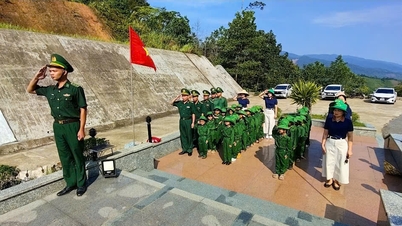
With human strength, using hoes, shovels, and crowbars, our soldiers cleared forests, leveled mountains, and used their physical strength to pull artillery into position – a miracle. This miracle was then immortalized in the Monument to the Hand-Pulled Artillery Road (located in Na Nhan commune, Dien Bien district) on the right bank of the Nam Rom River. The monument depicts the image of the artillery soldiers, "with hearts of gold and iron," gripping the winch ropes firmly, their feet firmly planted on the ground as they pulled artillery across high mountains, dense forests, and deep ravines into position during the Dien Bien Phu Campaign. Seventy years have passed, and that artillery-pulling road has become a legend.
 The monument commemorating the hand-pulled artillery piece is located in Na Nhan commune, Dien Bien district (Dien Bien province), on the right bank of the Nam Rom river, standing majestically against the mountainside, silhouetted against the blue sky of the homeland.
In May, veteran Pham Duc Cu, from the 367th Anti-Aircraft Artillery Regiment, 351st Division – who contributed his blood and sweat to building the legendary artillery hauling route during the Dien Bien Phu Campaign 70 years ago – joined us in revisiting the historical site. This is the cluster of relics of the hand- hauling route used by our soldiers. Although over 90 years old, Mr. Cu still remembers the key dates of the Dien Bien Phu Campaign vividly. He recounted: “In late December 1953, the Politburo decided to choose Dien Bien Phu as the strategic decisive battle point in the 1953-1954 Winter-Spring Campaign. On December 20, 1953, the Command of the 351st Division and the 105mm howitzer and anti-aircraft artillery regiments received orders to march. After a day of urgent preparation, both units set off for battle. Our unit departed from the mountains and forests of Phu Tho to Dien Bien Phu.” In his book "Dien Bien Phu: A Historic Rendezvous," General Vo Nguyen Giap recalled: "I personally assigned the task to the division; the heavy artillery, going into battle for the first time, would face many great difficulties. First and foremost, we must ensure safety and absolute secrecy during the march. Getting the personnel, vehicles, and artillery to their destination safely is considered 60% of the victory... The appearance of artillery and anti-aircraft guns would create a great surprise for the French army on the Dien Bien Phu battlefield."
After 11 days and nights of extraordinary effort, our troops and volunteer youth accomplished a miraculous feat: opening a road for artillery towing from Tuan Giao to Dien Bien Phu. With the road opened, artillery trucks crossed the Pha Din Pass and followed the Tuan Giao - Dien Bien Phu route to a secret assembly point, about 15km from Dien Bien Phu. On January 14, 1954, at the Forward Command Post in Tham Pha cave, the Party Committee and the Campaign Command held a meeting to disseminate the plan to destroy the Dien Bien Phu fortified complex. At the meeting, the Party Committee and the Campaign Command concluded that, for the time being, preparations should be made to apply the motto "attack quickly, win quickly," but if the enemy changed their strategy, we could also apply the motto "attack surely, advance surely." To ensure secrecy, the Command decided to use manpower to tow the artillery from the assembly point to the battlefield, a distance of about 15km. The artillery towing road had to be completely newly constructed. With the spirit of "paving the way to victory," using only human strength, in just 20 hours our troops cleared forests and leveled mountains to complete the artillery hauling road, running from the Na Nhan forest gate, over the 1,150-meter-high Pha Song peak, down to Tau village, along the Dien Bien Phu - Lai Chau road, to Nghiu village. This is the only artillery hauling road ever built by hand, unprecedented in the history of warfare worldwide .
The next task, moving howitzers and anti-aircraft guns into position, was assigned to the 351st and 312th Divisions, expected to be completed in three nights. Using human strength to drag these heavy iron and steel blocks, weighing 2 to 3 tons, over high mountains, dense forests, and deep ravines was a miracle, exceeding the imagination of the French army. A French intelligence report on the enemy's preparations for the battle stated: "Opening the way to bring cannons into Dien Bien Phu is the work of Hercules." Of course, there was no Hercules; only the spirit of unity, the determination, and the "fight to win" of the Vietnamese people transformed into the immense strength to bring the cannons into the Dien Bien Phu battlefield. In the darkness of night, with a sheer cliff on one side and a bottomless ravine on the other, the artillery soldiers, with extraordinary willpower, carried each "giant" cannon over the summit of Pha Song into position.
Upon arriving at the monument commemorating the manual artillery hauling, Mr. Cu was deeply moved. The monument depicts our soldiers pulling a 105mm cannon up the steep mountain pass on the right bank of the Nam Rom River, its imposing presence etched into the mountain landscape against the blue sky. Overwhelmed with emotion, Mr. Cu recounted: “Back then, the road was very narrow, and the rain made the artillery hauling route even more slippery and muddy. Initially, we all had shoes and sandals. Yet, within just one week of hauling the cannon, most of the soldiers' shoes and sandals were torn to shreds. Their feet couldn't touch the ground, and their hands clung tightly to the winch ropes, determined to pull the cannon into position. The 2.4-ton cannon was pulled up and then lowered again, only moving 20 to 30 centimeters after each command of 'one, two, three!'.”
But after seven arduous days and nights, the artillery had not yet reached all the positions, so the planned start date of January 20, 1954, had to be postponed by five days. At this time, the Campaign Command Post had moved from Tham Pua cave to Huoi He cave in Na Tau village. Here, after considering the situation to ensure the strategy of "fighting to win," General Vo Nguyen Giap changed the battle plan from "quick attack, quick victory" to "steady attack, steady advance" and ordered the artillery to be pulled out of the positions. Pulling the artillery into position was difficult, but taking it out was even more challenging. Starting from the evening of January 25, 1954, the pulling of artillery out of the positions in Nghiu, Tau, Na Ten, and Na Hy villages began. At this time, our artillery pulling route was now exposed, and aircraft and artillery bombarded suspected enemy positions day and night. Determined not to abandon the artillery, the soldiers, with their hearts of gold and iron, clung tightly to the winch ropes, their feet firmly planted on the ground, gritting their teeth as they held the cannons steady. In that situation, the song "Cannon Pulling Chant" by composer Hoang Van was born, as if to give the soldiers extra strength to overcome those dangerous moments.
Along the route of transporting artillery, there were many examples of bravery and selflessness in protecting the cannons. Among them was Platoon Leader To Vinh Dien of the 367th Anti-Aircraft Artillery Regiment - a son of Thanh Hoa province who sacrificed himself to save the artillery. Recalling those moments when his comrades defied danger to save the artillery years ago, the eyes of old soldier Pham Duc Cu welled up with tears. “That day, February 1, 1954, the night of the 29th of the Lunar New Year, the Year of the Horse, Company 827, led by To Vinh Dien, pulled the last artillery piece out of the battlefield. At Chuoi Slope, the narrow road, bordered by high mountains and deep ravines, had sections with steep inclines. It was drizzling, pitch black, and enemy artillery was shelling the area around the road. A piece of shrapnel severed the winch cable, causing the artillery piece to plummet down the slope. Determined to prevent the artillery from falling into the ravine, To Vinh Dien used all his strength to steer the artillery piece into the embankment. While struggling with the artillery, he shouted, “Let’s save the artillery piece! We’re not afraid to die!” The artillery piece lunged forward and dragged him under its wheels. The 2.4-ton steel weight pressed down on his chest. Before his death, he managed to ask his comrades, “Is the artillery piece alright, comrades?” His funeral was held quietly in the forest. Because the campaign hadn’t yet begun and secrecy was necessary, not a single incense stick was lit at his grave, and there were no gunshots to bid him farewell,” said Mr. Cu. Recalling that moment, his example of sacrifice gave strength to the soldiers to safely pull the artillery pieces out. By February 5, 1954, the last artillery piece was pulled to the assembly point.
 The 105mm artillery position of Company 806, Regiment 45, Division 351 was secretly positioned on the mountainside of Na Loi village, Thanh Minh commune, Dien Bien City (Dien Bien province).
To deploy the new artillery positions, the Campaign Command decided to select six artillery hauling routes. After just over 20 days of intensive work, all six artillery transport routes, totaling 70km in length, were completed. The construction of the artillery bunkers required considerable effort. Located deep within the mountains, the bunkers had separate firing and concealment positions, spacious enough for artillerymen to operate easily during combat. On the night of March 11, 1954, all our anti-aircraft artillery, howitzer, and other artillery batteries moved into their secret and secure positions, heading towards the Dien Bien Phu fortified complex, effectively blocking the skies over Muong Thanh.
Leaving the cluster of historical sites depicting the hand-pulled artillery, we arrived at Na Loi village, Thanh Minh commune – the location of the 105mm artillery position of Company 806, Regiment 45, Division 351. The artillery position was built in sturdy bunkers along the mountainside, ensuring secrecy during combat. Here, at 1 PM on March 13, 1954, the first 105mm heavy artillery battery was ordered to fire the first rounds at the Him Lam resistance center, marking the beginning of the Dien Bien Phu Campaign. The more than 30-minute artillery barrage helped our infantry forces advance and capture the entire Him Lam resistance center, opening the "steel gate" in the North.
Throughout the Dien Bien Phu Campaign, H6 rocket launchers, 37mm anti-aircraft guns, 75mm mountain guns, 105mm heavy artillery, along with other firepower of the Vietnam People's Army, unleashed thunderous attacks on French soldiers. This created favorable conditions for our troops on multiple fronts to capture strongholds and the headquarters of the Dien Bien Phu fortified complex. At exactly 5:30 PM on May 7, 1954, the "Determined to Fight - Determined to Win" flag fluttered proudly atop General De Catries' bunker, marking the complete victory of the Dien Bien Phu Campaign. When the battle ended, a group of French prisoners of war, walking along the roads used to transport artillery back to the concentration camp, remarked: "Just by building these roads, you have already defeated us!"
Text and photos: Tran Thanh
Source
![[Photo] General Secretary and President To Lam presides over a working session with the Central Policy and Strategy Committee on the development of the materials industry.](https://vphoto.vietnam.vn/thumb/1200x675/vietnam/resource/IMAGE/2026/05/21/1779359935432_a3-bnd-3129-1412-jpg.webp)








































































Comment (0)