

Every dry season, news of drought and salinity intrusion becomes a recurring nightmare in the Mekong Delta. So, is there a way to escape this ordeal? This question, posed in an article by Master's student Nguyen Huu Thien published in Thanh Nien newspaper, reflects the age-old aspiration of the people of the Mekong Delta to "work in harmony with nature."
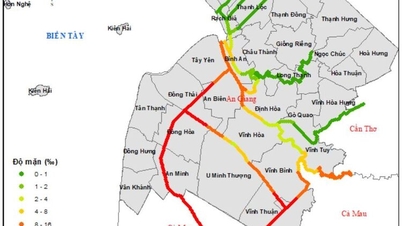
According to Master's student Nguyen Huu Thien, author of the article "To make salinity intrusion no longer a nightmare for the Mekong Delta," there are two options for adapting to salinity intrusion in the Mekong Delta. One is to continue on the old path, continuing to "fight" salinity intrusion with infrastructure projects, which would mean the Mekong Delta would once again struggle against it every dry season. The second is to implement the zoning plan according to the integrated Mekong Delta planning with the spirit of "harmonizing with nature" as outlined in Resolution 120.
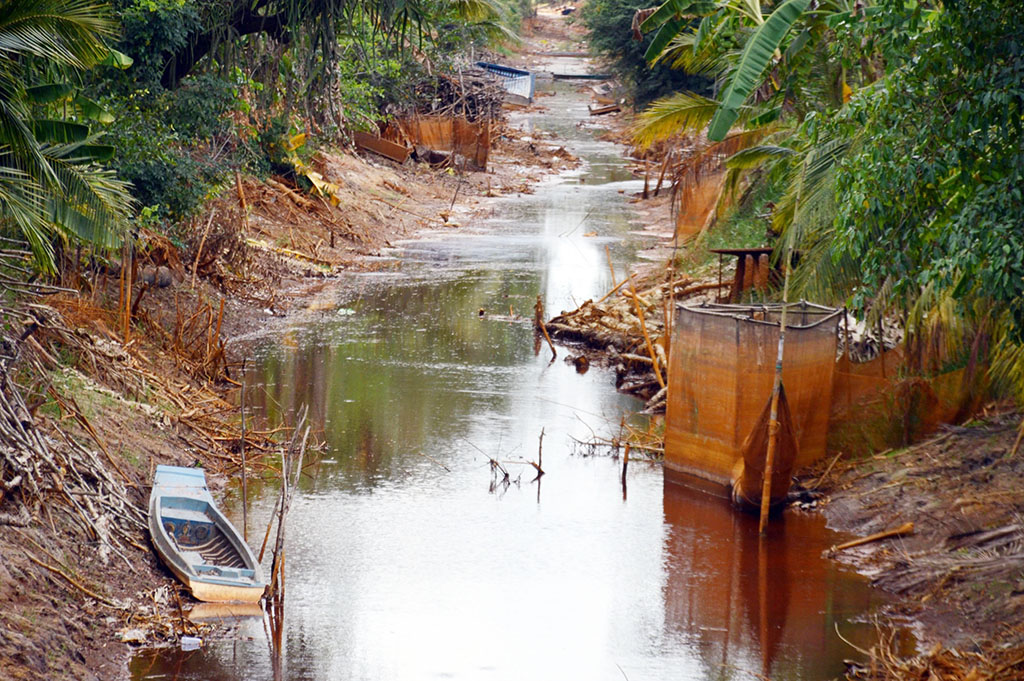
Over 80 canals and ditches in Tran Van Thoi District ( Ca Mau Province ) dried up, with some completely dry during the 2024 dry season.
Specifically, the "harmonious with nature" approach will involve integrated planning that divides the Mekong Delta into three zones. The freshwater core zone in the upstream area is a region that always has freshwater, even in extreme years; this zone prioritizes rice cultivation, fruit trees, and freshwater aquaculture. Next is the brackish water zone with a water cycle: freshwater during the rainy season, suitable for rice cultivation, and brackish/saltwater during the dry season. In this zone, farming systems need to be adapted to the brackish/saltwater conditions during the dry season. The coastal zone, with year-round salinity, will develop farming systems that adapt to the year-round salinity regime.
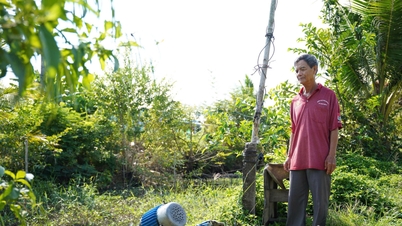
Adapting to saline conditions for production.
Reader Lao Nong Tri Dien expressed: "I completely agree with Master Nguyen Huu Thien. It can be said that saltwater intrusion into inland fields has existed for generations, not just recently. It's time we lived in harmony with nature and adjusted the areas that need freshwater. On the other hand, we ourselves have prevented water from reaching the fields, inadvertently causing desertification, a serious decrease in air humidity, not to mention the pollution of fields due to stagnant water and the lack of essential minerals brought from the sea. I sincerely hope that the relevant authorities will soon implement the spirit of Government Resolution 120."
Supporting the view that "adapting to salinity intrusion is more important than fighting it," commentator Tan Nguyen argues that this is a macro-level issue that is difficult for individual households to implement: "During the dry season, ponds and lakes dry up, small canals run dry, and even saltwater has to be introduced to prevent erosion. Therefore, this serious problem cannot be solved at the household level. In my opinion, the government still needs to build dams on large rivers to prevent salinity intrusion during the dry season to ensure the livelihoods of the people."
The majority of opinions on the issue suggest that two major problems need to be addressed at the macro level: developing "nature-friendly" production methods to adapt to drought and salinity, and securing freshwater for domestic use.
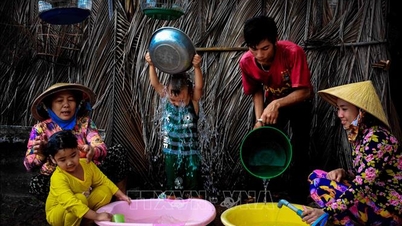
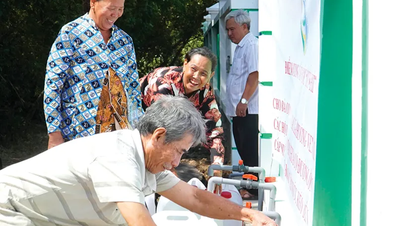
Supplying fresh water for domestic use.
Commenter Madam Phuong Le remarked: "With the current economic potential and scientific and technical level, bringing clean water to people in coastal areas is not difficult, in my opinion. It only requires investing in pipelines from upstream to treat the water for people's use, without wasting agricultural land. Furthermore, having a buffer zone to contain saltwater will certainly reduce saltwater intrusion." "In addition, our people need to build reservoirs to store water during the rainy season. People in the Mekong Delta have been doing this for hundreds of years; now we just need to expand the scale of water storage," added commenter Tuan Truong Anh.
Concurring, Mr. Hoi Quang stated: "I would like to add that if we look back at the period before the dam was built to prevent saltwater intrusion compared to the present, the saltwater has encroached about 50 km further inland. Therefore, those involved in planning should understand the high and low tide regimes in the Mekong Delta. They should plan for freshwater reservoirs in the land that our ancestors have cultivated, and not chase after rice yields at the expense of the living environment... If exploited properly, brackish water areas will yield higher profits than freshwater areas."
Why not build a reservoir upstream like the Dau Tieng reservoir?
Huy Ha
* In my opinion, these analyses are correct and accurate from the beginning of the dry season until now. I hope that the authorities at all levels will recognize this and act in accordance with the spirit of Resolution 120.
Linh Nguyen Vu
The government has already issued Resolution 120 to address these concerns and anxieties. Now we just need to follow that resolution.
Quang
Source link


![[Photo] Prime Minister Pham Minh Chinh receives the Chinese Ambassador to Vietnam](https://vphoto.vietnam.vn/thumb/1200x675/vietnam/resource/IMAGE/2026/04/05/1775397481797_ndo_br_dsc-5512-jpg.webp)











































































Comment (0)