This transformation not only helps improve productivity and increase people's income but also contributes to promoting the growth of the local fisheries industry. However, in the context of complex shrimp diseases, extreme weather conditions, and fluctuating market prices, developing high-tech shrimp farming combined with environmental management and disease prevention is becoming an urgent requirement for sustainable development.
Bringing digital technology into shrimp ponds.
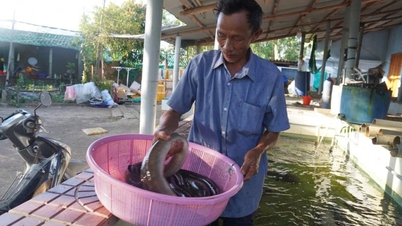
Sitting at home but still able to monitor the activities of his fish ponds via smartphone, Mr. Ngo Van Thoi, from Tan Thanh hamlet, Long Thanh commune, said that the sensor system installed in the ponds continuously updates environmental indicators such as temperature, salinity, pH, and dissolved oxygen content in the water. When the parameters exceed the permissible limits, the system will send a warning signal so that farmers can take timely action.
Previously, his family mainly raised shrimp using an improved extensive farming method with low stocking density and heavily dependent on natural conditions. However, over the past 10 years, they have gradually shifted to industrial farming in earthen ponds, and now they use a high-tech pond-lined model.
On approximately 3 hectares of land, Mr. Thoi's family invested in 4 ponds with a total water surface area of about 5,000 m². All ponds are lined with tarpaulin and equipped with water fans, aeration systems, bottom oxygenation, and automatic environmental monitoring equipment. Each pond is stocked with over 200,000 whiteleg shrimp juveniles, at a density of about 300 shrimp/m², many times higher than traditional farming methods.
Mr. Thoi said that when using traditional earthen ponds, the highest stocking density was only about 40-50 shrimp/m², resulting in low yields. Investing in a comprehensive technical system has helped increase stocking density many times over, while also effectively controlling environmental factors, improving shrimp survival rates, and boosting productivity.
"High-tech farming requires a larger investment, but in return, we can better manage the pond environment. Previously, we relied mainly on experience, but now many indicators are monitored via phone. When there are fluctuations, we know about them early so we can take action and minimize risks," Mr. Thoi shared.

According to Mr. Thoi, the application of technology helps to better control the water environment, improve the survival rate of shrimp, and increase productivity. Mr. Thoi produces three crops a year, with each successful crop yielding approximately 7 tons of commercial shrimp per pond. At times, the selling price of commercial whiteleg shrimp reached nearly 200,000 VND/kg, generating revenue of over 1 billion VND per pond, with a profit margin of about 40%.
The economic benefits of high-tech farming models have encouraged many coastal households to boldly switch to new production methods. Multi-stage farming models, utilizing environmental sensors, automatic feeders, bottom oxygenation systems, and remote management, are becoming increasingly popular in key farming areas.
According to Mr. Chau Huu Tri, Director of the Agricultural Extension Center (Department of Agriculture and Environment of Vinh Long province), many shrimp farming models applying high technology are showing clear effectiveness. Notably, the two-stage whiteleg shrimp farming model applying Industry 4.0 technology with a sensor system continuously monitoring environmental indicators such as dissolved oxygen, temperature, salinity, and pH is a prime example.
Data is transmitted directly to farmers' smartphones, enabling more efficient pond management, reduced labor costs, minimized risks, and increased productivity. This is also a crucial foundation for Vinh Long province to develop modern farming areas that meet the increasingly high demands for traceability and quality standards of the market.
The development of high-tech shrimp farming models is making a significant contribution to the growth of the province's fisheries sector. According to the agricultural sector, from the beginning of the year until now, the total fisheries production has reached over 477,000 tons, an increase of 5.4% compared to the same period last year; in which, brackish water shrimp farming continues to play a leading role with the stocked area reaching over 90% of the annual plan and the harvested production reaching over 50% of the plan.
Notably, the area for intensive high-density whiteleg shrimp farming continued to expand by an additional 566 hectares, bringing the total area for high-tech whiteleg shrimp farming to nearly 6,000 hectares, thereby contributing to increased productivity and production efficiency.

Overcoming challenges for sustainable development.
Despite the positive results, shrimp farmers still face many difficulties, especially diseases and the increasing volatility of the farming environment.

According to Mr. Ngo Van Thoi, in the early years of switching to high-tech farming, environmental conditions were relatively stable, making production easier. However, in recent years, the weather has been erratic, with prolonged heat waves interspersed with unseasonal rains, causing significant fluctuations in the pond environment and creating conditions for disease outbreaks.
In 2025, his family suffered heavy losses in two consecutive shrimp farming cycles across three ponds due to microsporidian disease (EHP) when the shrimp were only 45-75 days old. The total cost of losses, including shrimp fry, feed, electricity, and environmental treatment, amounted to approximately 600 million VND.
In the current farming season, the price of commercial shrimp is only around 120,000 VND/kg, a sharp decrease compared to the favorable period before. In addition, due to the impact of EHP disease from the early stages, the harvest yield has decreased significantly.
"Now shrimp farmers are worried about both disease outbreaks and prices. The difficulties in shrimp farming affect not only the farmers but also local service and trading activities," Mr. Thoi said.
Not only Mr. Thoi's household, but diseases affecting aquatic animals remain a major challenge for the local aquaculture industry. According to statistics from the Fisheries, Fisheries Inspection and Marine Affairs Department, from the beginning of 2026 to the present, the entire province has recorded nearly 530 hectares of aquaculture damaged; of which, tiger shrimp accounted for over 234 hectares, and whiteleg shrimp nearly 296 hectares.
Common diseases include microsporidiosis (EHP), white spot syndrome virus (WSSV), acute hepatopancreatic necrosis disease (AHPND), white feces disease, and diseases related to the rearing environment.
According to Ms. Le Thi Hanh Chuyen, Deputy Head of the Fisheries, Fisheries Inspection and Marine Affairs Sub-Department, monitoring results in aquaculture areas show that many dangerous pathogens are still present in key shrimp farming areas. Meanwhile, extreme weather events are causing rapid changes in the water environment, putting great pressure on disease prevention and control efforts.
In response to this situation, the provincial fisheries sector is strengthening environmental monitoring and warning systems in concentrated aquaculture areas; at the same time, it is stepping up disease surveillance, guiding farmers to adhere to seasonal schedules, use fry of clear origin, and implement effective pond environmental management measures.
The province has organized numerous training courses and workshops to transfer technology, aiming to help people identify dangerous shrimp diseases early, update new technical solutions, and improve their ability to respond to situations arising during production.
Besides disease prevention and control, removing bottlenecks in investment capital and infrastructure is also a requirement for high-tech shrimp farming to continue to be effective and develop sustainably.
According to many shrimp farmers in Tan Thanh hamlet, most farmers now have the ability to access and operate high-tech farming models. However, the biggest obstacle remains the initial investment capital. A complete high-tech farming system requires billions of dong in investment to build ponds, install equipment, and complete the technical infrastructure. Therefore, people hope that credit institutions will pay attention to supporting them with loans at suitable interest rates so that they can invest in and upgrade their production models.

Besides capital, electricity and transportation infrastructure are also crucial factors determining production efficiency. Water pumps, aeration systems, and other continuously operating equipment require a stable, high-capacity power supply. Furthermore, transportation routes must be adequate to facilitate the transport of feed, input materials, and harvested products.



Mr. Ngo Van Hiep, a shrimp farmer in Tan Thanh hamlet, Long Thanh commune, said that in areas with inconvenient transportation, traders often buy commercial shrimp at prices 5,000 VND/kg lower than in farming areas with convenient transportation conditions due to the added transportation costs.
"To develop high-tech aquaculture, people need capital, electricity, and convenient transportation. If they receive good support in terms of credit and infrastructure, more households will be encouraged to invest," Mr. Hiep commented.
According to Ms. Le Thi Hanh Chuyen, the province's fisheries sector is encouraging the widespread adoption of multi-stage shrimp farming models, the application of digital technology in environmental monitoring, the use of biological products, and the strengthening of production linkages along the value chain.
In the context of an increasingly demanding market for product quality, food safety, and traceability, developing high-tech shrimp farming aims not only to increase productivity but also to create uniform products that meet the requirements of processing businesses and export markets.
At the same time, the locality is encouraging farmers to participate in cooperatives and link with purchasing and processing businesses to stabilize output, reduce price risks, and build concentrated raw material areas.
Developing high-tech shrimp farming, coupled with environmental management, disease control, and production linkages, is a crucial solution to improve economic efficiency, build a stable raw material supply area, and move towards sustainable development of Vinh Long's fisheries industry.
Source: https://baotintuc.vn/kinh-te/cong-nghe-cao-tiep-suc-nganh-tom-20260608105750778.htm

































![[Photo] Thousands of people participate in a run to show their support for the campaign "Sharing a common determination to build drug-free communes, wards, and special zones".](https://vphoto.vietnam.vn/thumb/1200x675/vietnam/resource/IMAGE/2026/06/27/1782554475933_0673e2a3df7b5e25076a-8283-jpg.webp)