Many students are concerned that the Information Technology (IT) industry will become increasingly stressful, fiercely competitive, and easily replaced by AI.
Students' anxieties about the "wave" of AI
Despite his passion for technology, Nguyen Minh Khang, a 12th-grade student at Nguyen Huu Huan High School (Thu Duc Ward, Ho Chi Minh City), hesitated to apply for IT programs due to concerns that AI will replace programmers in the future.
The male student said that his biggest concern was choosing a field of study that wouldn't become outdated after graduation. "I like technology, but I'm torn between Software Engineering, Computer Science , and Cybersecurity. I'm afraid that in a few years, if AI develops too rapidly, there won't be many job opportunities left in my field," Khang shared.
Similarly, Tran Khanh Vy, a student at Gia Dinh High School (Thanh My Tay Ward, Ho Chi Minh City), said that the biggest pressure right now is not only choosing a major but also choosing a university.
Vy believes that many students are inclined to enroll in technology-focused universities with high admission scores, such as the Ho Chi Minh City National University system, including the University of Technology, the University of Science, or the University of Information Technology, because they worry that studying in other environments will make it difficult to compete for jobs.
"Many of my peers think that attending a top school is the only way to easily get a job later, so I feel quite pressured," Vy said.
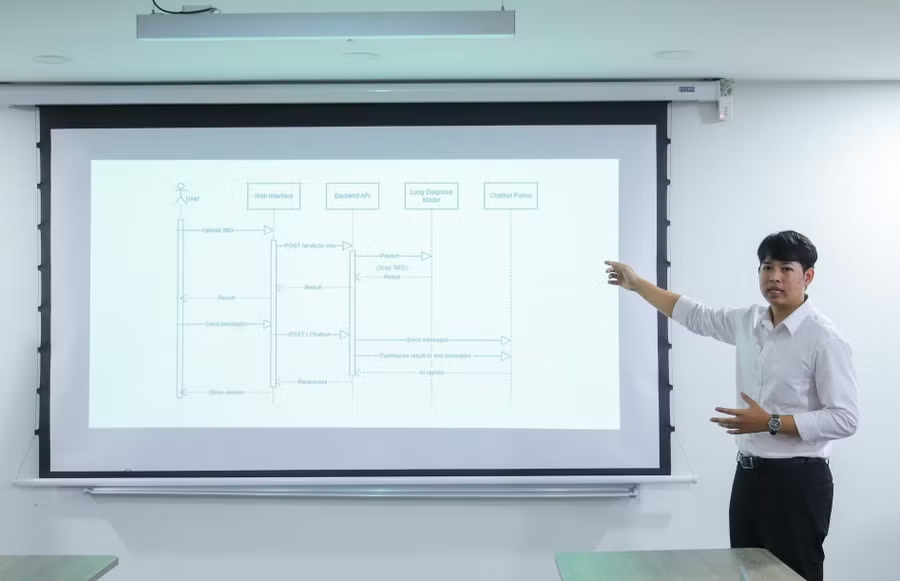
Meanwhile, Le Hoang Nam, a student at Trung Vuong High School (Saigon Ward, Ho Chi Minh City), said that his family initially opposed his desire to enroll in Software Engineering because they believed that AI can now write code very quickly.
"My brother said that many foreign tech companies are cutting staff, so learning software now is quite risky. That's making me quite worried," Nam shared.
Not only university entrance exam candidates, but many students interested in AI, Digital Marketing, or Multimedia Communication who don't have the academic qualifications for university are also worried about career opportunities if they choose to study at a college in the technology field.
Choose the right skills instead of chasing after "hot" fields.
Discussing career trends in the technology field, Ms. Nguyen Thi Dieu Anh, Deputy Head of the Faculty of Information Technology, Van Hien University, said that the rapidly growing skill groups currently include AI, big data, computer networks, cybersecurity, and applied technology capabilities.
According to Ms. Dieu Anh, many positions such as big data specialist, fintech engineer, AI/Machine Learning specialist, software programmer, or security expert are projected to continue strong growth until 2030. However, the important thing is not to choose a "hot" field, but to understand which role in the technology world suits you best.



"If students enjoy building products, websites, applications, or software systems, they can choose Information Technology or Software Engineering. If they are interested in AI, algorithms, and intelligent models, they should consider Computer Science. For those who enjoy data analysis, trend prediction, and decision support, Data Science is a suitable path," shared Ms. Dieu Anh.
Students interested in system security and cyberattack prevention can choose Information Security or Cybersecurity. Meanwhile, those with a creative inclination towards visual arts, games, and multimedia can pursue Digital Design, Game Design, or Multimedia Communications using technology.
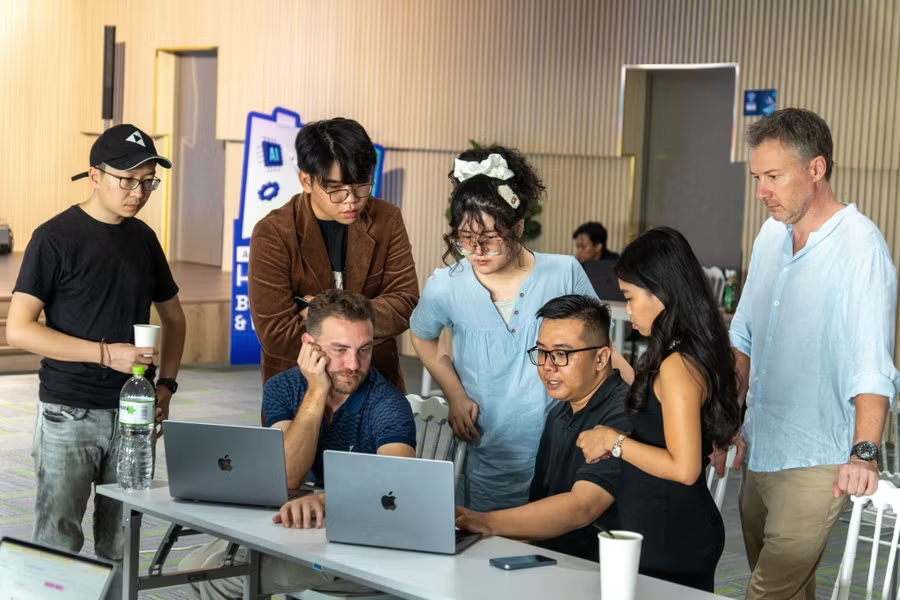
Notably, interdisciplinary technology trends are also thriving in fields such as educational technology, medical technology, and media technology.
"In the age of AI, IT students shouldn't just learn a tool, but must learn the ability to adapt. Tools can change very quickly, but problem-solving skills, systems thinking, the ability to learn new technologies, and working on real-world projects are long-term competencies," emphasized Ms. Dieu Anh.
According to this expert, to increase competitiveness, students need to invest seriously throughout their university studies by building a strong foundation, improving their English skills, participating in clubs and competitions, doing internships early, building a personal portfolio, and continuously updating their knowledge of AI technology.
Regarding concerns that AI will replace programmers, Ms. Dieu Anh stated that AI is only a supporting tool and cannot completely replace the role of software engineers.
"Businesses still need people who can analyze problems, design systems, understand users, control data security, and collaborate in teams. The most valuable people in the future are not those who code the fastest, but those who know how to use AI to solve problems most effectively," Ms. Anh stated.

From the perspective of college-level training, Mr. Nguyen Duy Tien, Head of Admissions and Student Affairs at Ho Chi Minh City College of Technology, stated that in the context of strong digital transformation across most fields, from AI, data science, software technology to cybersecurity, communication, and digital business, these areas continue to attract significant interest from candidates in the 2026 admissions season.
This year, the school is recruiting approximately 3,000 students for college-level programs in engineering, technology, economics, and languages to meet the demand for high-quality human resources in the labor market.
"Digital technology is currently the backbone of the national digital transformation strategy. The demand for human resources in this field is increasing very rapidly and is predicted to continue booming in the coming years," said Mr. Tien.
Instead of focusing solely on specialized knowledge training, many vocational education institutions are now shifting strongly towards practical training, closely linked to the actual needs of businesses.
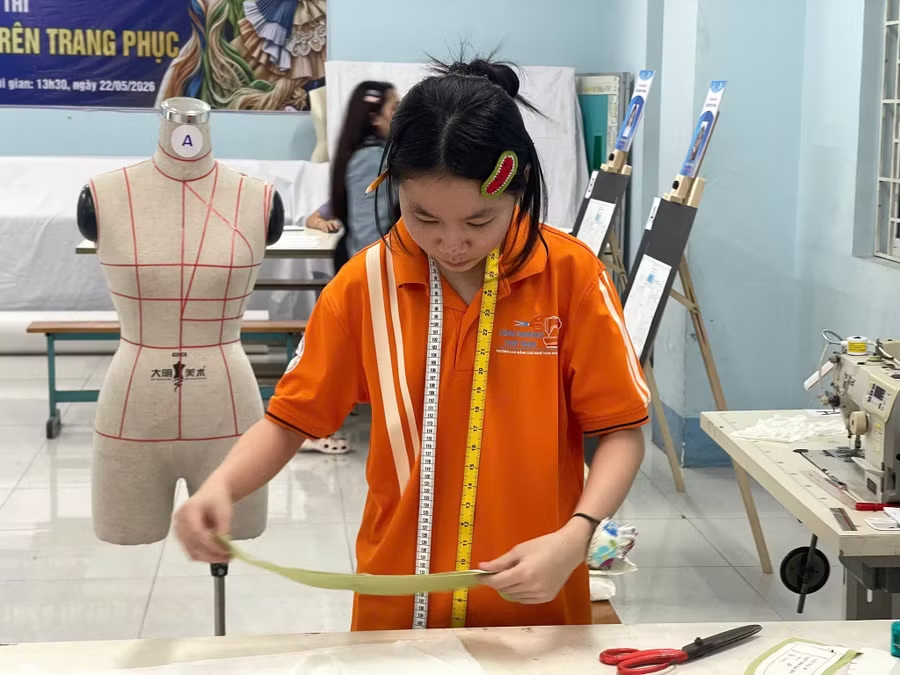



At Ho Chi Minh City College of Technology, the "dual training" model is being implemented in many technology fields. Accordingly, students not only study at the college but also participate in a business internship semester as part of their main curriculum.
During this semester, students directly learn at businesses and receive guidance from technical staff on practical professional skills. "After the business internship semester, many students are offered employment by businesses even before graduation," Mr. Tien shared.
According to school representatives, the university currently has over 150 partner businesses participating in training and recruitment in technology, engineering, and economics fields. This is considered one of the advantages that helps students increase their job opportunities after graduation.
Besides job prospects, the short training duration is also a point of interest for many students. According to Mr. Tien, the current college program lasts about two years, helping students to enter the labor market sooner.
Addressing concerns about not attending a top university and the potential for competition, Ms. Dieu Anh argues that the university's name isn't the only factor determining the success of technology students. While some universities excel in academic research and in-depth algorithms, many others focus on practical applications, real-world scenarios, and adaptability to businesses. Students gain early exposure to real-world projects, professional skills, AI, data, application programming, and cybersecurity.
"Many students who didn't attend top universities still become excellent programmers, AI engineers, or cybersecurity experts because they are very proactive learners and work on many projects from an early age," Ms. Anh said.
Source: https://giaoducthoidai.vn/cong-nghe-so-dung-so-ai-hay-hieu-minh-post782610.html





![[Photo] Strengthening character and expertise: Intense training for artillery soldiers.](https://vphoto.vietnam.vn/thumb/1200x675/vietnam/resource/IMAGE/2026/06/30/1782815602541_lu-368-1875-4571-jpg.webp)