

 |
| Faced with the market's increasing demands for product quality and information transparency, Thai Nguyen's agricultural sector has chosen technology as the "key" to expanding its output. In the photo: A model of clean tea production, adhering to organic standards, contributes to improving product quality and value. Photo: Provided. |
Restructuring production along the value chain.
From characteristic agricultural products such as tea, fruit trees, rice, and vegetables to livestock and forestry, Thai Nguyen is entering a phase of agricultural restructuring with science and technology and digital transformation playing a pivotal role. Agriculture is gradually shifting from a focus on quantity to organizing production according to modern value chains, in which technology leads the entire process from production to consumption.
Implementing the Project for the Development of Key Agricultural Products for the period 2021-2025, with a vision to 2030, and Resolution No. 10-NQ/TU, the province is promoting data digitalization and reorganizing production to meet market demands. The province currently has 804 cooperatives, including 625 agricultural cooperatives; nearly 70% operate effectively, 37.6% apply high technology, and over 70% participate in value chain linkages, creating a foundation for sustainable development.
 |
| Free-range chicken products from Tan Khanh commune are being promoted and sold through digital platforms. |
Digital transformation also promotes the standardization of production. Currently, over 8,100 hectares of crops meet VietGAP standards, with tea cultivation alone reaching over 6,440 hectares. By 2025, the province will grant new VietGAP certifications to 44 tea-growing establishments and 26 livestock farms, contributing to enhancing the reputation of Thai Nguyen agricultural products in the market.
According to Mr. Bui Phuong Thao, Vice Chairman of the People's Committee of Vo Tranh commune, with over 2,500 hectares of tea plantations and an annual production of over 30,000 tons, the locality has identified tea development for export as a long-term strategy. The commune focuses on deep processing, building raw material areas that meet VietGAP standards and organic farming practices, strengthening food safety control and traceability, and promoting linkages with businesses and cooperatives to gradually bring Vo Tranh tea to the international market.
From the cooperative's perspective, Mr. Do Van Thao, representative of Phu Thinh Agricultural Cooperative (Phu Dinh commune), said: The cooperative currently has 19 members, linked with 26 households, cultivating 10 hectares of tea with the main product being hook-shaped tea. We organize production according to VietGAP standards, use organic fertilizers, control irrigation water sources, and ensure food safety. In the future, the cooperative plans to expand the area to 45 hectares, forming a stable raw material area, creating a foundation for export, including to the South Korean market.
 |
| Water-saving automatic irrigation systems are being used in many tea-growing areas in the province, contributing to reduced labor and increased production efficiency. Photo: Provided. |
Along with production standardization, Thai Nguyen currently manages 151 planting area codes, of which tea accounts for 106 codes with an area of over 871 hectares and a production of nearly 11,000 tons. All production areas are closely monitored regarding processes, food safety, and traceability, meeting the requirements of both domestic and international markets.
In the digital transformation process, QR codes for traceability are considered a "passport" that helps agricultural products from Thai Nguyen enter modern distribution systems, increase value, and affirm their brand. According to Ms. Le Thi Huong, Director of BK Food Cooperative, digitizing information and participating in e-commerce helps products increase credibility, expand markets, and create room for sustainable growth.
Simultaneously, the province is strengthening the construction of technical barriers to protect the reputation of agricultural products. In 2025, functional agencies inspected 140 establishments, collected 226 samples; maintained a testing laboratory that meets ISO/IEC 17025:2017 standards and operated a digital platform to serve quality management.
 |
| Consumers can easily find and purchase specialty products from Thai Nguyen on Shopee with just a few simple steps on their phones or computers. Photo: TL |
Agricultural production linked to the market.
The agricultural market in Thai Nguyen is being reshaped by technology. Digital transformation is becoming the driving force behind the reorganization of production, distribution, and consumption according to the logic of a modern market economy. The province's pioneering initiative to build a shared agricultural product store on an e-commerce platform clearly demonstrates a shift from a mindset of "doing agriculture" to "doing agricultural economics," with the market as the benchmark and technology as the lever for increasing value.
Based on that orientation, a digital ecosystem has gradually been formed and is operating synchronously, including: the Industry and Trade Department's website, the province's e-commerce platform, a traceability system using QR codes, "Thai Nguyen Products" and "Viet-Thai Nguyen" booths on major platforms, along with a series of livestream programs such as "Thai Nguyen OCOP Market Fair 2025"... The consumption space is expanded towards direct, transparent, and sustainable connections between producers and consumers.
 |
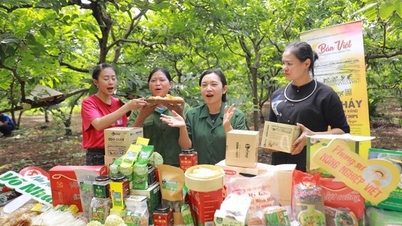
| Viettel Post Thai Nguyen is partnering with local people to promote and sell agricultural products and OCOP (One Commune One Product) products on digital platforms. Photo: Provided. |
Mr. Nguyen Huy Hoang, Deputy Director of the Department of Industry and Trade, informed: Digital markets and livestream sales programs have created a strong ripple effect for local agricultural products. For example, the "Digital Custard Apple and Thai Nguyen Agricultural Products" program, held in Vo Nhai and La Hien communes, reached over 10 million people and closed nearly 1,500 orders within 5 hours of broadcasting; the livestream promoting Tan Khanh hill chicken recorded approximately 12,000 interactions.
These results show that e-commerce is becoming an effective connecting channel, shortening the distance between production areas and consumer markets.
Value added from innovative approaches
Digital transformation has yielded tangible results. Currently, nearly 190,000 households, businesses, and cooperatives in the province participate in digital platforms; over 1,800 agricultural products and OCOP (One Commune One Product) products are traded online. Many OCOP entities have recorded revenue increases of 20-50%, with digital channels contributing approximately 30%, confirming that the digital economy is a new growth driver for agriculture in Thai Nguyen.
Practical experience at the grassroots level demonstrates the clear effectiveness of technology application. According to Ms. Ly Thi Quyen, Director of Thien An Cooperative (Phu Thong commune), 9 of the cooperative's OCOP products have been sold on major e-commerce platforms, and they have also applied modern goods management software and connected to logistics services. As a result, revenue in 2025 is expected to exceed 3 billion VND, a significant increase compared to the period before technology was implemented.
 |
| The model of growing tangerines according to organic standards by Mr. Do Van Luan's family in Na Meo village (Phuc Loc commune) has brought high economic efficiency. |
More importantly, technology has contributed to elevating the brand image of Thai Nguyen's agricultural products. The province currently has 598 products that have achieved OCOP certification from 3 to 5 stars, including 10 5-star products; the economic value has increased by an average of over 20% after being recognized. The fact that 100% of businesses and cooperatives with OCOP products of 3 stars or higher participate in digital platforms shows that digital transformation has gone into depth, becoming a key driving force of modern and integrated agriculture.
In implementing Plan No. 36-KH/TU of 2026, Thai Nguyen province identifies science and technology, innovation, and digital transformation as the driving forces for the development of ecological agriculture and modern rural areas. The province aims for a 4% growth rate in agriculture, forestry, and fisheries; an average income of 126 million VND/hectare; a food production output of over 590,000 tons; a fresh tea leaf output of over 277,000 tons; and a tea value exceeding 16.8 trillion VND.
Building on that foundation, Thai Nguyen continues to develop the OCOP program in depth, linking it with technology and digital transformation; striving to add at least 20 OCOP products with 3 stars or higher, expanding production according to GAP and organic standards, granting planting area codes, building raw material areas and value chains, thereby expanding markets and enhancing the brand of local agricultural products.
The province currently has 804 cooperatives (including 625 agricultural cooperatives); over 8,100 hectares of crops meet VietGAP standards, with tea alone accounting for over 6,440 hectares; and 151 registered cultivation areas. Over 1,800 products are traded online; 598 OCOP products have achieved 3-5 stars, with their value increasing by over 20% after recognition. |
Source: https://baothainguyen.vn/nghi-quyet-57/202602/cong-nghe-so-mo-loi-tieu-thunong-san-cc11413/








































































Comment (0)