

In the early morning of August 19th (Vietnam time, or noon on August 18th Eastern Time, USA), US President Joe Biden, along with Japanese Prime Minister Fumio Kishida and South Korean President Yoon Suk Yeol, held a summit at Camp David (Maryland, USA). Prior to that, on the evening of August 18th (Vietnam time), President Biden also had two separate meetings with Prime Minister Kishida and President Yoon.
Comprehensive cooperation framework
Following the summit, the joint communiqué stated that the three countries had agreed to coordinate on a number of issues. First, the US, Japan, and South Korea agreed to maintain an annual trilateral summit, along with other trilateral meetings at various levels to consult on a range of issues.
Regarding regional security and geopolitics , the three countries agreed on an approach to the Indo-Pacific region, including the central role of ASEAN and promoting cooperation with countries in the South Pacific, while committing to coordinating efforts to promote security and peace in the Indo-Pacific. The communiqué also criticized China's actions in the South China Sea, declaring support for international law, including freedom of navigation and overflight, as reflected in the United Nations Convention on the Law of the Sea (UNCLOS). The joint communiqué further affirmed "the importance of peace and stability in the Taiwan Strait as an indispensable element for security and prosperity in the international community."
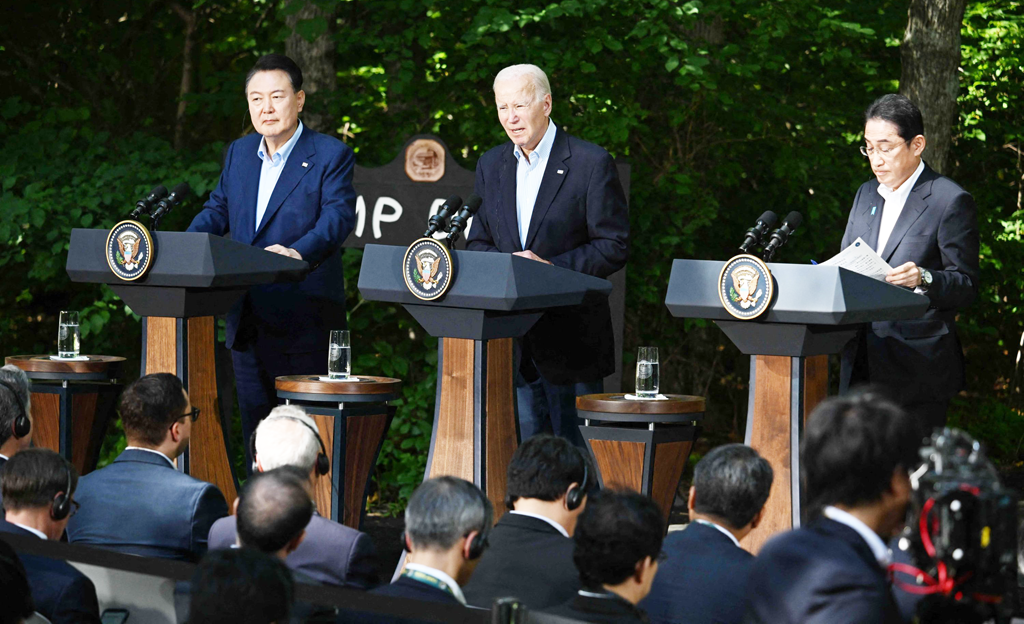
From left to right: President Joon, President Biden, and Prime Minister Kishida at a joint press conference at Camp David on August 18.
Regarding the Korean Peninsula issue, the statement said: "We strongly condemn the unprecedented number of ballistic missile launches by the Democratic People's Republic of Korea, including multiple launches of intercontinental ballistic missiles (ICBMs) and conventional military actions that pose a serious threat to peace and security on the Korean Peninsula and beyond."
However, the three countries also affirmed: "Japan, South Korea, and the United States remain committed to re-establishing dialogue with North Korea without preconditions." This commitment can be seen as a move to pave the way for resuming dialogue with North Korea without imposing any conditions that Pyongyang must fulfill before dialogue can begin.
Nevertheless, Washington, Tokyo, and Seoul have agreed to strengthen joint exercises on missile defense and anti-submarine warfare. In particular, the three countries are coordinating a sea-based ballistic missile defense warning system to share real-time data in order to respond to "missile and nuclear threats" from North Korea.
In addition, the statement reaffirmed support for Ukraine and condemned Russia.
Economically, the statement indicated that the US, Japan, and South Korea will cooperate to improve supply chains, particularly in the semiconductor sector. In addition, the three countries will "strengthen cooperation on technology protection measures to prevent the illegal export or theft of advanced technologies we develop abroad." According to observers, these cooperative relationships represent a significant counterweight to China.
Opportunity for cooperation
Within these framework agreements, economic cooperation, such as strengthening supply chains, particularly in semiconductor components and technology in general, has been actively pursued by all three countries. Washington, Tokyo, and Seoul have also promoted numerous cooperation programs under these agreements.
However, the most notable initiative is the real-time information-sharing system for North Korean missile launches. Such cooperation, combined with joint exercises, could closely monitor and enhance military deterrence capabilities in Northeast Asia – a region experiencing the rapid rise of China.
In an interview with Thanh Nien newspaper on August 19th, Dr. Satoru Nagao (Hudson Institute, USA) commented: "At the trilateral summit, the US, Japan, and South Korea agreed on many security issues, especially a real-time information sharing system to counter North Korean missile launches. Although Pyongyang's missile launches are not a new issue in recent years, this is the first time Washington, Tokyo, and Seoul have agreed on this system."
According to Mr. Nagao, this agreement points to two things. First and foremost, it indicates that the security situation in Northeast Asia has deteriorated. In particular, China has rapidly increased its military spending and is nearing the same level as the United States. Simultaneously, China is believed to be planning an attack on Taiwan. Also in the region, North Korea, a close ally of China, is testing several sophisticated missiles. Therefore, one cannot ignore the risk scenario that if China attacks Taiwan, North Korea could attack South Korea and Japan. In such a situation, US military resources would be divided between two fronts.
Since launching its military campaign against Ukraine, Russia has been subjected to Western sanctions and has become somewhat dependent on China. Chinese and Russian warships and bombers have conducted numerous joint exercises. China and Russia also oppose any strong sanctions against North Korea. Therefore, given this China-Russia-North Korea relationship, the US, Japan, and South Korea understand the need for deeper cooperation.
"Secondly, this agreement was reached due to South Korea's internal politics. Previously, some South Korean administrations pursued different foreign policies, but the policy gradually changed under President Yoon, who chose to strengthen relations with both the US and Japan. Thanks to this, the three countries were able to reach this agreement," Dr. Nagao analyzed.
Continuity Challenge
The US-Japan-South Korea summit marks the latest phase in rebuilding trust between Tokyo and Seoul and strengthening trilateral cooperation with Washington to bolster the rules-based order amid China's rise in the Indo-Pacific, the Ukraine conflict, and tensions on the Korean Peninsula.
The agreement reached at Camp David established a framework for deeper trilateral cooperation in the areas of security, economics, and diplomacy. However, the continuity of the agreement will depend on whether these initiatives translate into domestic political support for President Yoon and whether the cooperation is institutionalized to be maintained under subsequent administrations. Whether Seoul maintains South Korea's strategic convergence policy with Japan and the U.S. is a matter of concern for all parties.
Professor Stephen Robert Nagy (International Christian University - Japan, scholar at the Japan Institute for International Studies)
Source link


![[Image] Hanoi's urban life under the challenge of a "scorching hot" environment](https://vphoto.vietnam.vn/thumb/1200x675/vietnam/resource/IMAGE/2026/05/25/1779706979265_nang-nong-t5-2026-minh-duy-7-4636-jpg.webp)


![[Image] Close-up view of the interchange connecting the two expressways and Long Thanh Airport.](https://vphoto.vietnam.vn/thumb/1200x675/vietnam/resource/IMAGE/2026/05/25/1779703378210_ndo_br_z7863716673926-224453a31600126cce10622af6290afd-4549-jpg.webp)














































































Comment (0)