

From March 1, 2026, the Artificial Intelligence (AI) Law will officially come into effect, placing Vietnam among the pioneering countries in the world with a comprehensive AI law.
Promoting innovation
According to the Vietnam AI Economy 2025 report, recently published by the National Innovation Center (NIC), the Japan International Cooperation Agency (JICA), and Boston Consulting Group (BCG), Vietnam is currently leading Southeast Asia in digital transformation, with an impressive annual growth rate of 20%, further solidifying its position as the fastest-growing and most dynamic digital economy in the region. BCG estimates that by 2040, AI will become a core element in Vietnam's economic growth, contributing between $120 and $130 billion.
In the context of AI being identified as a new growth driver, the enactment of the AI Law is a crucial step towards perfecting the legal framework, ensuring innovation goes hand in hand with risk control. The law stipulates many notable provisions such as: Mandatory labeling and warnings for AI-generated content, clear identification of prohibited behaviors, classification of AI systems according to risk levels, handling of liability and compensation for damages, in order to ensure human rights, privacy rights, national interests, public interests, and national security. Specifically, Article 7 prohibits the misuse or appropriation of AI systems to violate the law; the use of technology to falsify or simulate real people or events to deceive or manipulate; and the collection and processing of data in violation of regulations on personal data protection, intellectual property, and cybersecurity for the development and operation of AI. Article 11 stipulates that audio, image, and video content created or edited by AI to simulate real people or events must be clearly labeled; Or, according to Article 9, AI systems are classified into three risk levels: low, medium, and high, in order to apply corresponding regulatory obligations…
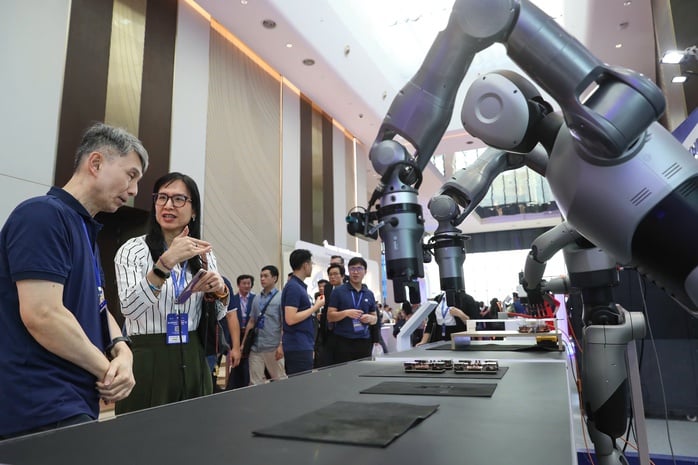
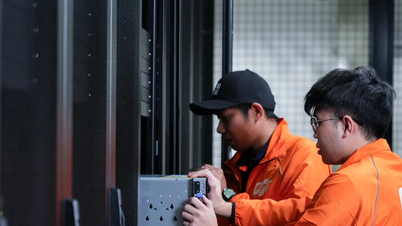
Vietnamese vendors explore ways to apply AI in their businesses. Photo: HOANG TRIEU
Regarding the AI Law, which officially came into effect on March 1st, the State Bank of Vietnam has just issued a draft Circular detailing the requirements for safety, risk management, and deployment conditions for AI applications in the banking sector. In recent years, AI has been widely applied in the banking industry for applications such as credit scoring, loan appraisal, fraud detection, chatbot consulting, and eKYC. However, these deployments also pose risks to system security, data inaccuracies, and customer privacy violations. Therefore, the circular is expected to establish a minimum framework for safety and risk management, ensuring consistent, safe, and effective AI deployment.
Prioritize human resource development.
Dr. Sreenivas Tirumala, Senior Lecturer in Information Technology and Cybersecurity at RMIT University Vietnam, believes that the enactment of the AI Law will boost investor confidence in data processing and legal responsibilities related to the use of AI in Vietnam, especially in the context of increasing foreign investment. The law also puts Vietnam ahead of other ASEAN countries in terms of legislation.
More than just a legal milestone, the AI Law demonstrates Vietnam's determination to become a leading nation in AI. Through its regulatory framework and innovation incentives, Vietnam is laying the foundation for a competitive AI ecosystem, aiming for sustainable development. Experts believe that in the long term, the law could create a strategic breakthrough, helping Vietnam shift from a technology consumer to a value creator. The law contributes to removing institutional, infrastructure, data, and financial bottlenecks; and protecting citizens' rights from ethical risks caused by AI...
However, Dr. Tirumala also noted the compliance challenges when the law takes effect. Many systems in the healthcare, education, and finance sectors were launched before this time, while the preparation period was insufficient for small and medium-sized enterprises (SMEs), and also posed a challenge for businesses using high-risk AI systems. He suggested that raising awareness of AI among businesses and providing a simplified compliance process are necessary. Developing human resources is also a major priority. The law requires integrating basic AI knowledge into the general education curriculum and encourages universities to expand AI-related programs to build a highly competitive workforce. "Universities need to integrate fundamental principles of AI and AI ethics into the curricula of all disciplines, not just technology. It's crucial to guide students on how to apply AI responsibly based on social and cultural norms, as well as current regulations and laws. Universities need to build partnerships with organizations and businesses to implement practical learning projects and internship programs. This will be key to creating a workforce ready to apply AI. This approach ensures graduates can meet compliance requirements while fostering innovation," Dr. Tirumala suggested.
The development of AI is not just a domestic story but is closely linked to trends of competition and cooperation on a regional scale. AI is also reshaping the field of cybersecurity. AI-powered systems are capable of automatically scanning infrastructure, detecting vulnerabilities, and analyzing context, significantly reducing manual workload. Vladislav Tushkanov, Head of Research and Development at Kaspersky, believes that when AI is managed and used securely, it will be crucial for the future of cybersecurity in the digital age.
Creating two growth drivers
According to the Vietnam AI Economy 2025 report, AI will create two main growth drivers: increased consumer revenue, generating between $45 billion and $55 billion through consumer demand for AI-powered products and services; and cost savings of $60-75 billion due to increased productivity through automation, predictive analytics, and improved efficiency thanks to the use of AI technology.
These figures highlight the powerful transformative potential of AI and the compelling opportunities it opens up for businesses, startups, and policymakers in Vietnam.
Source: https://nld.com.vn/cu-hich-cho-ai-viet-nam-but-pha-196260228200637953.htm

![[Image] Bridges and roads connecting the eastern part of Ho Chi Minh City](https://vphoto.vietnam.vn/thumb/1200x675/vietnam/resource/IMAGE/2026/04/16/1776328595108_ndo_br_bh-vt5-jpg.webp)



















































































Comment (0)