

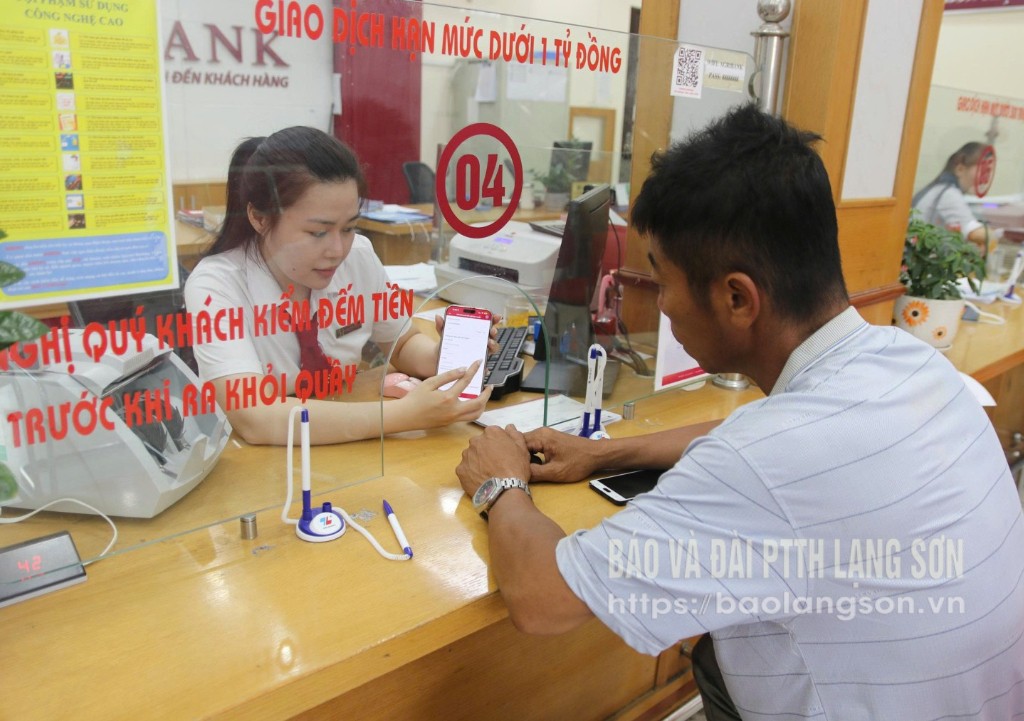
Cashless payments are an inevitable trend in the development of global trade. In recent times, with the active coordination of all levels and sectors, cashless payment activities in the province have achieved many positive results. This has gradually changed the behavior and habits of the people, contributing to the successful development of the digital economy and digital society in the future.
Implementation efforts
To promote cashless payments, the Prime Minister issued Decision No. 1813 dated October 28, 2021, approving the Scheme for Cashless Payments in Vietnam for the period 2021-2025. To effectively implement the scheme, the Provincial People's Committee issued Plan No. 100 dated April 28, 2022, on the implementation of the Prime Minister's Decision No. 1813. Accordingly, the Provincial People's Committee has set specific targets, solutions, and tasks for departments, agencies, and units, aiming to ensure that citizens and businesses have access to and use payment products and services that suit their needs and are reasonably priced; and simultaneously directed the integration of the Scheme's content into the province's annual socio-economic development tasks and plans.
In addition, to promote cashless payment activities in the province and effectively implement the Government's plan, the Provincial People's Committee has also issued many plans and directives for implementation. Specifically, these include: Plan No. 90 dated April 14, 2022, to promote digital transformation and cashless payments in schools, educational institutions, hospitals, and medical facilities in the province during the 2022-2025 period; Official Letter No. 1485 dated December 10, 2022, to promote digital transformation in cashless social security payments in the province; and Official Letter No. 1821 dated August 19, 2025, on implementing Prime Minister's Directive No. 124 dated July 30, 2025, on promoting cashless payments.
Under the decisive direction of the province, departments, agencies, and related units have actively implemented many solutions to promote cashless payments. These units have intensified information and communication efforts, while also supporting and guiding people in using electronic payment methods for transactions, shopping, and online public services.
Mr. Le Quang Huy, Director of the State Bank of Vietnam Region 5, stated: To effectively implement the cashless payment scheme, the State Bank of Vietnam's Lang Son Provincial Branch (now the State Bank of Vietnam Region 5) has closely followed the directives of the Government, the State Bank of Vietnam, and the Provincial People's Committee. It has directed commercial banks in the area to focus on developing digital infrastructure, applying modern technology, digitizing customer data, connecting and sharing with the national population database, and deploying 24/7 payment services and electronic and online payment methods through Internet banking, Mobile banking, ATMs, POS, QR code payments, e-wallets, and card payments to save time and transaction costs, and enhance customer convenience and experience. Simultaneously, it has strengthened the dissemination of information on the Party's viewpoints and policies, and the State's laws and regulations on cashless payments. Solutions to ensure security, safety, and confidentiality in cashless and electronic payments for service users.
At Lang Son Water Supply and Drainage Joint Stock Company, over the years, the unit has implemented many solutions to promote and guide customers to make cashless payments for water services. Mr. Tran Quang Huy, Deputy General Director of the company, said: Following the policy of the Government and the province, since 2022, the company has been promoting cashless water bill payments to customers. However, at that time, it was mainly company employees and young customers who used the service. By 2024, the company had taken more decisive measures to promote cashless payments. Accordingly, the company issued a notice to customers using water supply services to stop collecting cash at home, and widely disseminated information to customers through electronic information websites and mass media. The company also signed contracts with several commercial banks in the area and e-wallets to provide cashless water bill payment services. To date, the percentage of individual customers paying their water bills using cashless methods has reached 95%.
With close guidance from the province and the coordinated efforts of all levels, sectors, and relevant units, cashless payment activities in the province have achieved many remarkable results, contributing to the realization of the Project's objectives and effectively implementing the Government's policy.
Significant change
The effective implementation of the government's cashless payment scheme has contributed to a shift in cashless payments within the province, facilitating transactions for customers.
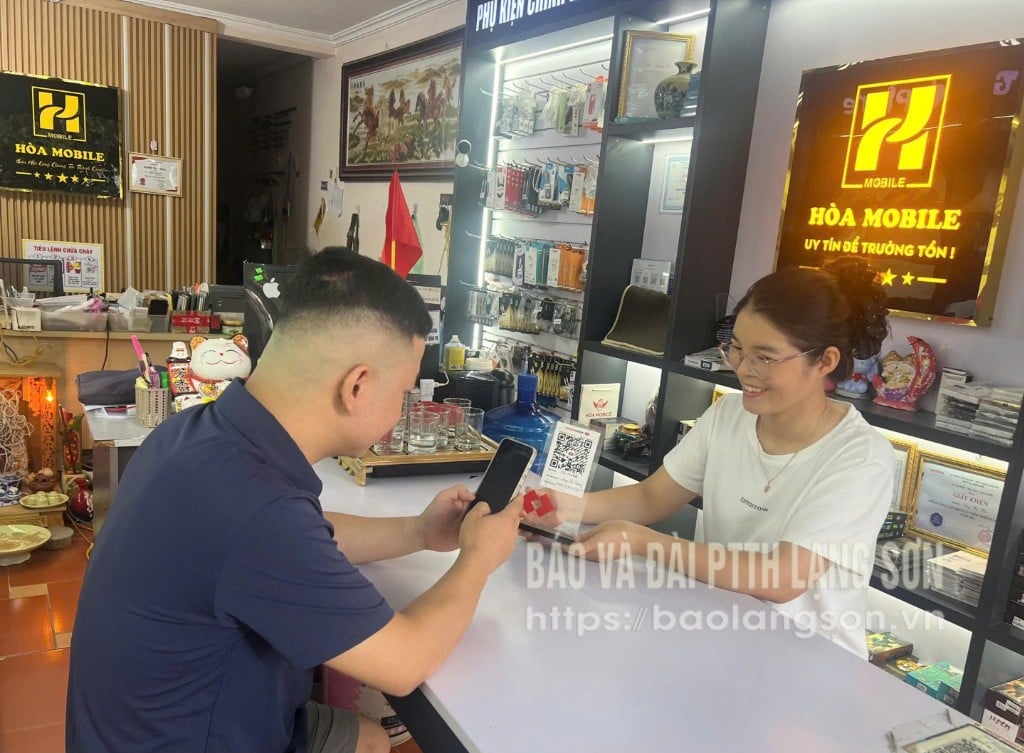
Currently, many supermarkets, stores, pharmacies, and even small eateries have equipped themselves with QR codes for convenient customer payments. Mr. Nong Van Hoa, owner of Hoa Mobile phone store in Ky Lua ward, shared: "In today's 4.0 era, customers mainly pay online instead of using cash as before. Understanding this trend, the store has proactively equipped itself with QR codes from many banks to make transactions easier for customers. On average, the store has 15-20 customers per day, with up to 90% paying cashless. I find this payment method very convenient, fast, and secure."
Not only businesses, but consumers have also been changing their payment habits, prioritizing electronic payment methods. With just a smartphone and a bank account, customers can make payments and conduct transactions anytime, anywhere.
Ms. Hoang Hai Yen from Tam Thanh ward said: "Previously, when going to the market or buying things, I had to check if I had cash in my wallet, which was very inconvenient. Since stores started accepting payments via e-wallets or QR codes, I hardly use cash anymore. Even when going for breakfast, coffee, or buying vegetables at the market, I use my phone to pay. This payment method is fast and convenient; I don't have to worry about losing my wallet or preparing small change to buy things."
To facilitate customers, commercial banks in the province have actively organized campaigns to educate and guide people on installing and using banking applications; and instructed shops and businesses to use QR codes for payment. As a result, the number of bank accounts opened for people aged 15 and above has reached over 789,000, accounting for 89.5% of the population; the number of transactions via Mobile Banking accounts for 72.4% of total cashless payments in the economy; banks in the province have provided over 50,000 QR codes to shops and businesses to support payment activities; and over 92% of fixed business locations offer electronic payment services via QR codes.
Regarding cashless payment activities in public services, public service providers have proactively coordinated with payment service providers and payment intermediaries in the area to complete the connection of electronic payment infrastructure to serve the requirements of coordinating the collection and expenditure of state budget funds through cashless payment methods; encouraging schools, hospitals, electricity, water, sanitation, telecommunications, and postal companies in the area to cooperate with the banking sector in collecting tuition fees, hospital fees, and electricity bills. To date, the percentage of educational institutions in the province accepting tuition fee payments through cashless methods has reached 100%; 15 out of 15 public medical examination and treatment facilities in the area accept cashless payments, accounting for 100%; the percentage of people receiving pensions, social insurance benefits, and unemployment benefits paid through cashless payment methods has reached over 74.8%...
To ensure the safety of cashless payment operations, relevant departments, agencies, and units have strengthened coordination to promptly detect, prevent, investigate, and handle violations of the law in payment activities. At the same time, they have promptly coordinated and exchanged information on the situation, methods, and tactics of criminals in payment activities to warn and advise payment service providers, intermediary payment service providers, and service users to prevent and deter the risk of exploiting payment activities for illegal purposes.
Promoting cashless payments is not only an essential requirement in the process of modern development but also a crucial driving force for building a sustainable digital economy and digital society. With the decisive involvement of all levels, sectors, and relevant units, along with the positive response from people and businesses, cashless payments are gradually becoming part of daily life, contributing to improved management efficiency, increased transparency, and greater convenience in people's transactions.
Source: https://baolangson.vn/cu-hich-cho-kinh-te-so-5059212.html




![[Photo] The General Secretary and the Prime Minister attend the groundbreaking ceremony for multiple-level boarding schools in border areas.](https://vphoto.vietnam.vn/thumb/1200x675/vietnam/resource/IMAGE/2026/03/19/1773888999705_vna-potal-tong-bi-thu-va-thu-tuong-du-le-khoi-cong-dong-tho-dong-loat-cac-truong-noi-tru-lien-cap-bien-gioi-8649904-3885-jpg.webp)








































































Comment (0)