

Unlike the Kinh people, whose vegetarian offerings are often associated with Buddhism and ascetic practices, the Tay and Nung people's vegetarian offerings in the province originate from indigenous folk beliefs and exhibit a clear stratification. In the Tay and Nung people's beliefs, the spiritual world is not only connected to direct ancestors but also extends to sacred entities related to land, villages, occupations, and community origins. This belief is reflected in the arrangement of the worship space in each family. Besides the ancestral altar placed in the most prominent position in the house, many families also have additional altars for Buddha, the Holy Mother, the patron saint of their profession, and general protective deities. These altars are usually smaller but placed high, mainly on the left side when viewed from the outside; or arranged as a separate worship room on a hill behind the house, facing the same direction as the main house. This arrangement not only reflects spiritual order but also shows the clear distinction between everyday living space and sacred space in the lives of the Tay and Nung people.
According to Dr. Hoang Van Pao, Chairman of the Provincial Cultural Heritage Association and a researcher of folk culture in Lang Son province, the higher altars inside the house or the separate altar room behind the house of the Tay and Nung people are usually where they worship Buddha; Mother Hoa, Hoa Vuong Thanh Mau (Me Nang); ancestors of many generations; founders of trades such as shamans, carpenters, and herbalists; founding masters of ethnic groups or people with special spiritual status in the lineage (Dam). Not every family worships all of the above; depending on the lineage tradition, spiritual history, and living conditions, they may worship one or a few deities; the number of incense burners is also arranged flexibly to suit their needs.
In the worship system of the Tay and Nung people, vegetarian offerings hold a special place. On holidays and festivals, offerings to the most sacred altars are all vegetarian, such as grains, fruits, tea, water, etc., with absolutely no animal slaughter. The clear distinction between vegetarian and non-vegetarian offerings is considered an important principle, demonstrating respect for the religious order within the family. According to the Tay and Nung people, the divine beings do not partake in material offerings but witness the sincerity, purity, and solemnity of those offering them.
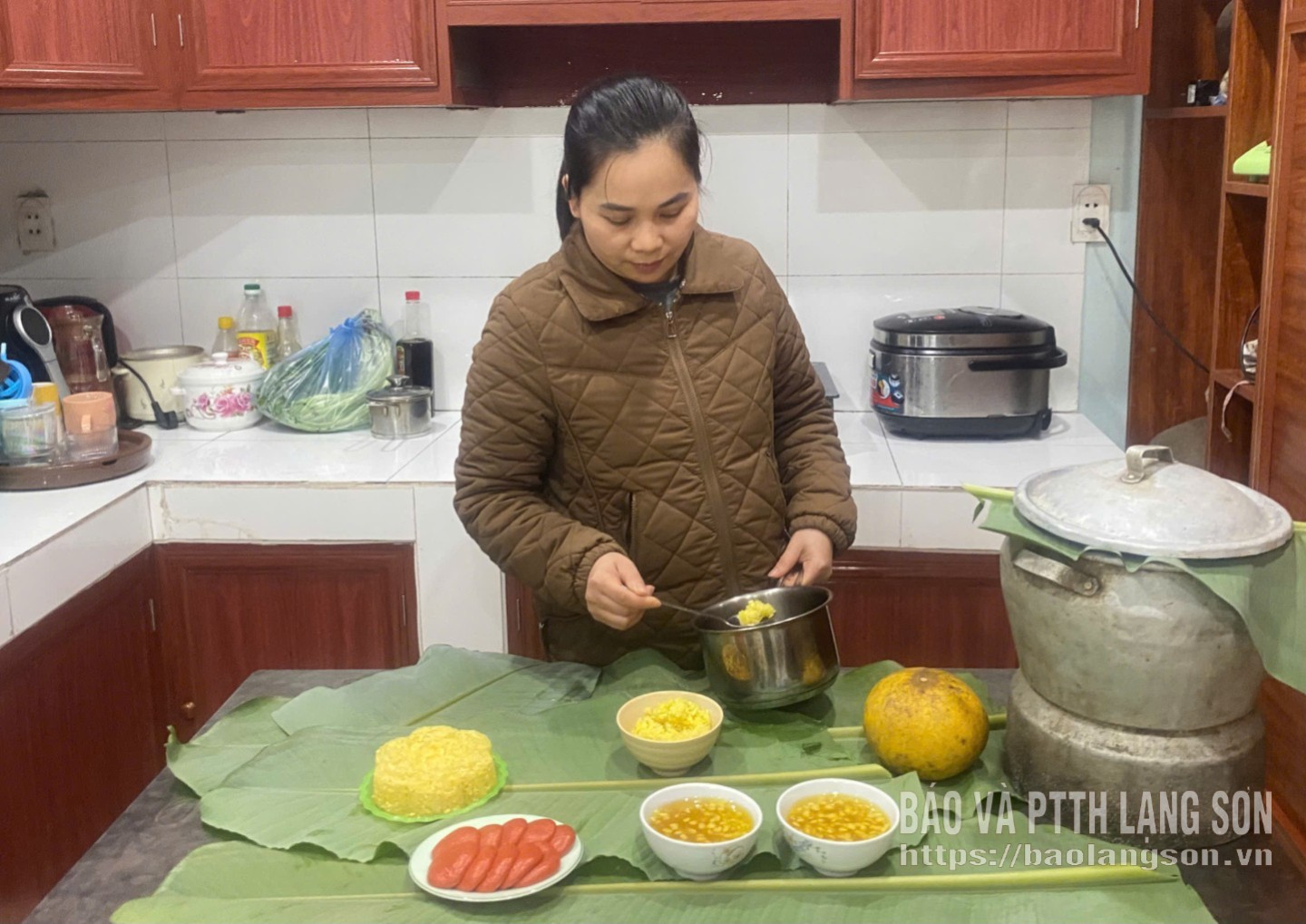
While vegetarian offerings on the 15th and 1st days of the lunar month are usually prepared simply and in a routine manner, vegetarian offerings during the Lunar New Year are more elaborate, meticulous, and solemn, conveying wishes for blessings and peace in the new year. From the afternoon of the 30th day of the lunar month, families prepare offerings with products closely associated with traditional agricultural production such as glutinous rice wine, five-colored sticky rice, vegetarian banh chung (rice cakes), khau sli (rice flour cakes), banh phong (rice puffs), banh khao (rice flour cakes), fruits, etc., to offer on the vegetarian altar. Most of the offerings are prepared by the family themselves, showing their reverence. Each offering carries a profound meaning: grains symbolize abundance and fertility; sticky rice and cakes are the culmination of diligent and skillful labor; tea and water symbolize purity and the harmony of yin and yang, conveying wishes for a peaceful and prosperous new year.
During the Lunar New Year celebrations, before offering meat dishes, families always make vegetarian offerings first. The offerings are not elaborate; some families offer sticky rice with sugar, sweet rice porridge, or sweet soup, while others simply have a small portion of white rice, a plate of vegetables or some boiled root vegetables and fruits, and a pot of hot tea. However, the preparation is always meticulous and clean. This task is usually undertaken by the older women in the family, such as the grandmother, mother, or eldest daughter-in-law. Throughout the preparation process, they constantly remind each other of the old taboos and customs. Therefore, offering vegetarian food is not only a religious ritual but also a way for the Tay and Nung people to teach and preserve their cultural knowledge.
Sharing about this custom, Ms. Le Thi Kim, from Dau Linh village, That Khe commune, said: "Every Lunar New Year, my family always prioritizes preparing vegetarian food to offer to the Buddha altar first. Even though modern life means there's nothing lacking in the market, several families in the neighborhood still get together to make 'banh khao' and 'banh phong' (traditional Vietnamese rice cakes) for the ceremony. Parents and children go to the market together, roast the rice, ferment the dough, mold the cakes, and wrap them... The warm, convivial atmosphere strengthens family bonds."
Ms. Sam Thi Xuan from Binh Chuong village, Dinh Lap commune, shared: "My family has a member who practices sorcery, so in addition to the ancestral altar, we also have a separate altar. As someone involved in preparing for the rituals, from the twelfth lunar month onwards, I remind myself to be more mindful, refrain from killing animals, and avoid places considered unclean such as cemeteries, hospitals, funerals, or houses where someone is sick. No one forces me to do these things, but for me, it's a way to maintain peace of mind and completeness when performing the rituals."
After the Lunar New Year, the vegetarian offerings are usually taken down and distributed to children and grandchildren who live far away, or enjoyed by the whole family together, as a way of sharing the blessings of the new year and sending wishes of good fortune. In modern life, many ancient rituals of the Tay and Nung people have been simplified to suit living conditions, but the custom of offering vegetarian food is still preserved by families. This is not just a custom that formed by chance, but is linked to a tightly organized belief system, showing a clear distinction between family ancestors and higher-ranking deities, between human life and the spiritual world. Through this, it contributes to nurturing humanistic values in the Tay and Nung communities.
Source: https://baolangson.vn/cung-chay-net-dep-trong-ngay-tet-cua-nguoi-tay-nung-5070471.html


![[Image] Bridges and roads connecting the eastern part of Ho Chi Minh City](https://vphoto.vietnam.vn/thumb/1200x675/vietnam/resource/IMAGE/2026/04/16/1776328595108_ndo_br_bh-vt5-jpg.webp)











![[Photo] National Assembly Chairman Tran Thanh Man attends the policy seminar to promote Vietnam-Türkiye cooperation.](https://vphoto.vietnam.vn/thumb/1200x675/vietnam/resource/IMAGE/2026/04/16/1776351415367_vna-potal-chu-tich-quoc-hoi-tran-thanh-man-du-toa-dam-chinh-sach-thuc-day-hop-tac-viet-nam-tho-nhi-ky-8705791-jpg.webp)

























![[Infographic] Details of the Hanoi-Quang Ninh High-Speed Railway Project](https://vphoto.vietnam.vn/thumb/402x226/vietnam/resource/IMAGE/2026/04/16/1776338188424_anh-man-hinh-2026-04-16-luc-18-16-10.png)
![[Photo] National Assembly Chairman Tran Thanh Man meets with the Speaker of the Georgian Parliament](https://vphoto.vietnam.vn/thumb/402x226/vietnam/resource/IMAGE/2026/04/16/1776338494029_anh-man-hinh-2026-04-16-luc-18-21-21.png)















Comment (0)