

Despite creating the "necessary" weapon to end the war, completely destroying two cities, and ushering in a new era, Julius Robert Oppenheimer opposed nuclear proliferation for the rest of his life.
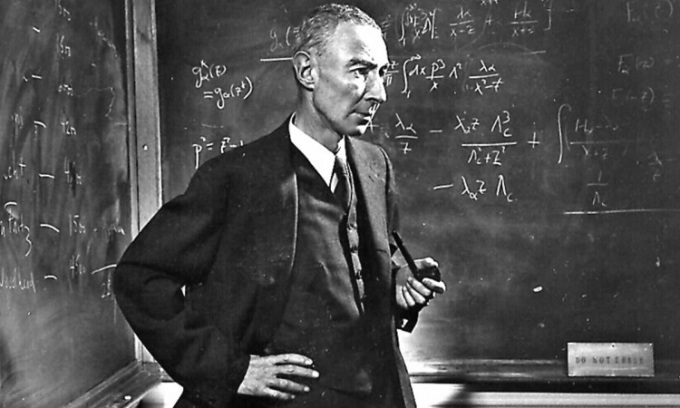
Theoretical physicist Julius Robert Oppenheimer. Photo: The Thomas Jefferson Hour
Born in New York City in 1904, Julius Robert Oppenheimer was the son of a wealthy German-Jewish immigrant who made his fortune trading textiles. He graduated with honors from Harvard University in just three years, and subsequently studied theoretical physics at both Cambridge University in England and the University of Göttingen in Germany, where he earned his doctorate at the age of 23.
The young physicist quickly became close friends with some of the greatest scientists of the time. His academic work advanced quantum theory and predicted everything from neutrons to black holes. He was also a keen learner beyond the scientific fields, studying Sanskrit and pursuing religious studies.
After the United States joined the Allies in 1941, Oppenheimer was invited to participate in the top-secret Manhattan Project to develop nuclear weapons. While the researcher worked to understand what was needed to trigger and sustain a neutron chain reaction to create a nuclear explosion, Oppenheimer's superiors were greatly impressed by his broad knowledge, ambition, work ethic, and ability to inspire other scientists. In 1942, the U.S. military appointed Oppenheimer as head of the secret bomb testing laboratory.
While military authorities searched for a suitable location for the laboratory, Oppenheimer suggested Los Alamos Ranch, a private boys' school near Santa Fe. Soon after, he directed hundreds, then thousands, of personnel at the Los Alamos Laboratory.
Oppenheimer not only assembled the brightest minds of the time, but he also inspired, motivated, organized, and encouraged them to demonstrate their abilities. On July 16, 1945, Oppenheimer and his colleagues gathered at the Trinity test site south of Los Alamos for the world's first nuclear test. It was an incredibly tense moment. The scientists knew the bomb, nicknamed "Gadget," would shape the future of the world. But they also believed it could end World War II. Although the war in Europe had ended, American authorities feared the bloodiest phase of the war was still ahead. They hoped to force Japan to surrender rather than threaten to use the new weapon. The secret test was a success.
On August 6th and 9th, 1945, the United States dropped two bombs, developed with Oppenheimer's help, on Hiroshima and Nagasaki, respectively. At least 110,000 people were killed in the explosions that obliterated both cities on a scale unprecedented before or after. Oppenheimer had served on a scientific council that recommended the War Department deploy bombing raids on Japan as soon as possible. Controversy continues over whether the government should heed the scientists' pleas to drop bombs solely on military targets, or even conduct public testing in an attempt to force Japan's surrender.
The night before the bombing of Hiroshima, Oppenheimer was cheered by a crowd of his fellow scientists at Los Alamos, and declared his only regret was not having completed the bomb in time to fight the German army. But despite their excitement at the achievement, the scientists were horrified by the loss of life in the attack, fearing that nuclear weapons could spark, rather than prevent, future wars. A few weeks after the bombing, Oppenheimer wrote a letter to the Secretary of War warning that "the security of this nation cannot rest entirely or primarily on scientific or technological strength. It can only rest on making future wars impossible."
But Oppenheimer also defended the Manhattan Project and the bomb he was tasked with building, arguing that it was necessary to understand the capabilities of nuclear science. However, Oppenheimer spent much of his life advocating for the prevention of nuclear weapons, opposing the US development of more powerful thermonuclear bombs. He argued that the US should consider using tactical nuclear weapons and pursue other applications of nuclear technology, such as energy production.
Oppenheimer never returned to government service; instead, he founded the World Academy of Arts and Sciences, teaching science until his death in 1967.
An Khang (According to National Geographic )
Source link

























































































Comment (0)