

Border region leader
The Hmong people have settled on the Dong Van karst plateau for hundreds of years. At the beginning of the 20th century, the Happiness Road connecting Ha Giang with Dong Van, a remote and rugged border region, had not yet been built. Above the "gateway to heaven," the people mainly cultivated opium poppies. In this context, Mr. Vuong Chinh Duc in Sa Phin commune emerged as a highly respected leader. He had participated in the Hmong army fighting against the Black Flag Army and was revered by his people as their leader. With his strategic brilliance, martial arts skills, and knowledge of the opium trade, he became one of the wealthiest merchants in Indochina.
|
The King's Mansion, with its unique architectural style, is over 100 years old. |
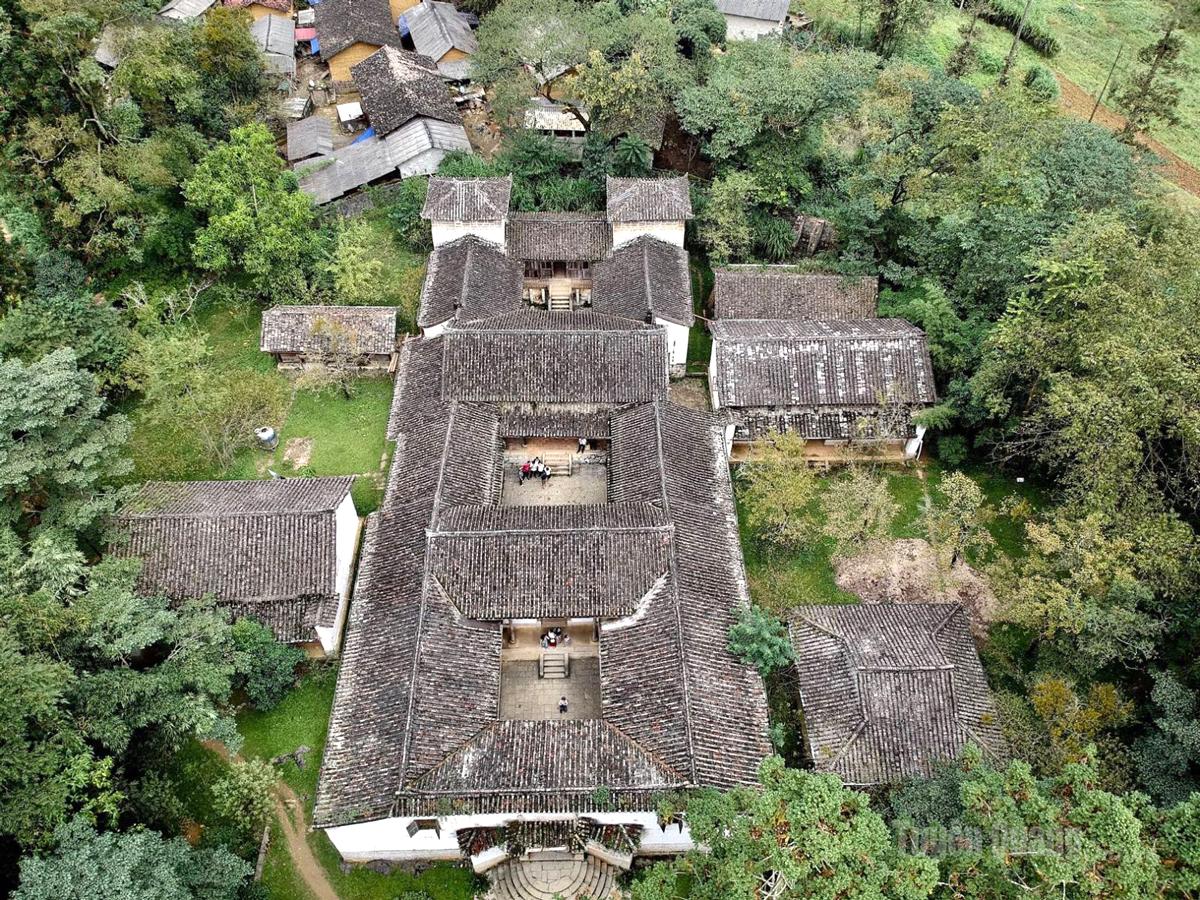
With his vision and resources, Mr. Vuong Chinh Duc built the Vuong family mansion – a unique architectural masterpiece combining the cultural essence of the Mong, Chinese, and French people. This mansion was later classified as a national-level architectural and artistic monument by the Ministry of Culture, Sports and Tourism (in 1993).
Mr. Vuong Duy Bao, former Director of the Department of Grassroots Culture (Ministry of Culture, Sports and Tourism ), a descendant of "King of the Hmong" Vuong Chi Sinh, shared: When the French invaded Vietnam, Mr. Duc's son, Vuong Chi Sinh (born in 1886), rallied the Hmong people to fight back, forcing the French to sign a peace treaty with the Hmong - an unprecedented event.
A historic meeting
In the book "Stories of the Vuong Family, Stories Now Told," published by Hong Duc Publishing House, and many documents currently on display at the Vuong family historical site, details of the historic meeting between President Ho Chi Minh and Mr. Vuong Chi Sinh are recorded. According to these documents, on the eve of the August 1945 General Uprising, recognizing the immense prestige of the Vuong family in the border region, President Ho Chi Minh sent representatives of the Viet Minh to meet with Mr. Vuong Chinh Duc and his son to discuss cooperation in the resistance. Living in a turbulent land, having witnessed the cruelty of the French, Japanese, and Kuomintang forces, Mr. Sinh and his son quickly realized that the path outlined by the Viet Minh – "driving out foreign invaders and bringing prosperity to the nation" – was an ideal that aligned with the aspirations of the Hmong people. Hearing the Viet Minh's propaganda, Mr. Vuong Chinh Duc said: "Throughout history, we Hmong people have fought our enemies without help; now that we have the Viet Minh and President Ho Chi Minh, what more could we ask for!"
According to the Journal of Military History - Vietnam Military History Institute, issue 190, October 2007, after the success of the August Revolution, President Ho Chi Minh invited Mr. Vuong Chinh Duc to Hanoi to discuss national affairs. Due to his advanced age, Mr. Duc sent his son, Vuong Chi Sinh, to meet with President Ho Chi Minh on behalf of the family. That meeting became a historical turning point in Mr. Sinh's life and in the revolutionary process in the rocky plateau region.
At the meeting, President Ho Chi Minh became sworn brothers with Mr. Vuong Chi Sinh, changing his name to Vuong Chi Thanh - sharing the word "Thanh" from President Ho Chi Minh's name (Nguyen Tat Thanh). President Ho Chi Minh entrusted him with the position of Chairman of the Administrative Committee of Dong Van District.
Shortly afterwards, President Ho Chi Minh commissioned the Ministry of National Defense's weapons factory to forge a precious sword for him. The scabbard was engraved with the words written by President Ho Chi Minh: "Utmost loyalty to the nation - Refusal to be enslaved."
It is not only a precious gift but also a sacred message, a guiding light for the Hmong people in the border region.
|
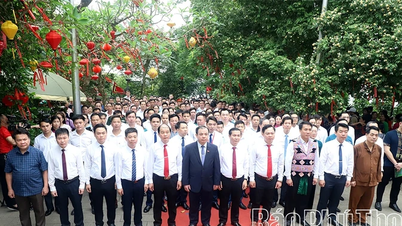
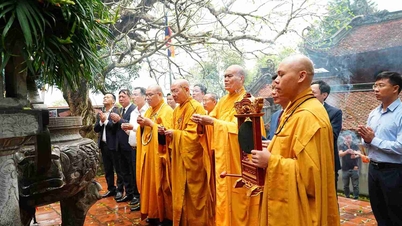
Celebrating the spring festival at the mansion of "King of the Hmong" Vuong Chi Sinh. |

The journey from "King of the Hmong" to Member of Parliament
According to the book "History of the Dong Van District Party Committee (formerly), after returning to Dong Van, Mr. Vuong Chi Sinh actively participated in the "Golden Week" movement, donating much gold, silver, and wealth to the revolution. On January 6, 1946, in the first general election of the Democratic Republic of Vietnam, voters in Dong Van elected him as a representative to the first National Assembly, becoming the first Mong representative of the former Ha Giang province.
As a representative of the people of the highlands, he was both a voice of the people before the National Assembly and a leader of the revolutionary movement in his homeland. He, along with Viet Minh cadres, encouraged the people to abandon opium cultivation and switch to growing corn and raising livestock, developing the economy, and building a new life. At the same time, he commanded the anti-bandit movement, maintaining border security and helping the people settle down and establish their livelihoods. The Hmong people, from a nomadic lifestyle, gradually settled permanently – they proudly say, "We live in the rocks, and we die in the rocks," as an affirmation of their determination to cling to their land, preserve their villages, and protect their homeland.
In 1960, despite his advanced age, he was re-elected by the people as a representative to the 2nd National Assembly. Afterward, he was transferred to Hanoi to work at the Central Committee for Ethnic Minorities Affairs, before retiring. He passed away in 1962, leaving a profound mark on the hearts of the ethnic minority people in the highlands of Ha Giang.
For his immense contributions to the cause of building and defending the Fatherland, especially his role in consolidating national unity, the State posthumously awarded him the Order of National Unity. Two sacred mementos gifted by President Ho Chi Minh – the ceremonial sword and the military jacket – have now been handed over by the descendants of the Vuong family to the Ho Chi Minh Museum, so that future generations may admire, cherish, and remember a man who lived his life fully for the people and the nation. On the tomb of Vuong Chi Sinh, in front of the Vuong family mansion today, the two lines of text "Utmost loyalty to the nation - Refusal to be enslaved" are still clearly inscribed.
Biện Luân
Source: https://baotuyenquang.com.vn/van-hoa/du-lich/202602/cuoc-doi-ruc-ro-cua-vua-meo-vuong-chi-sinh-c7928e1/












































Comment (0)