

 |
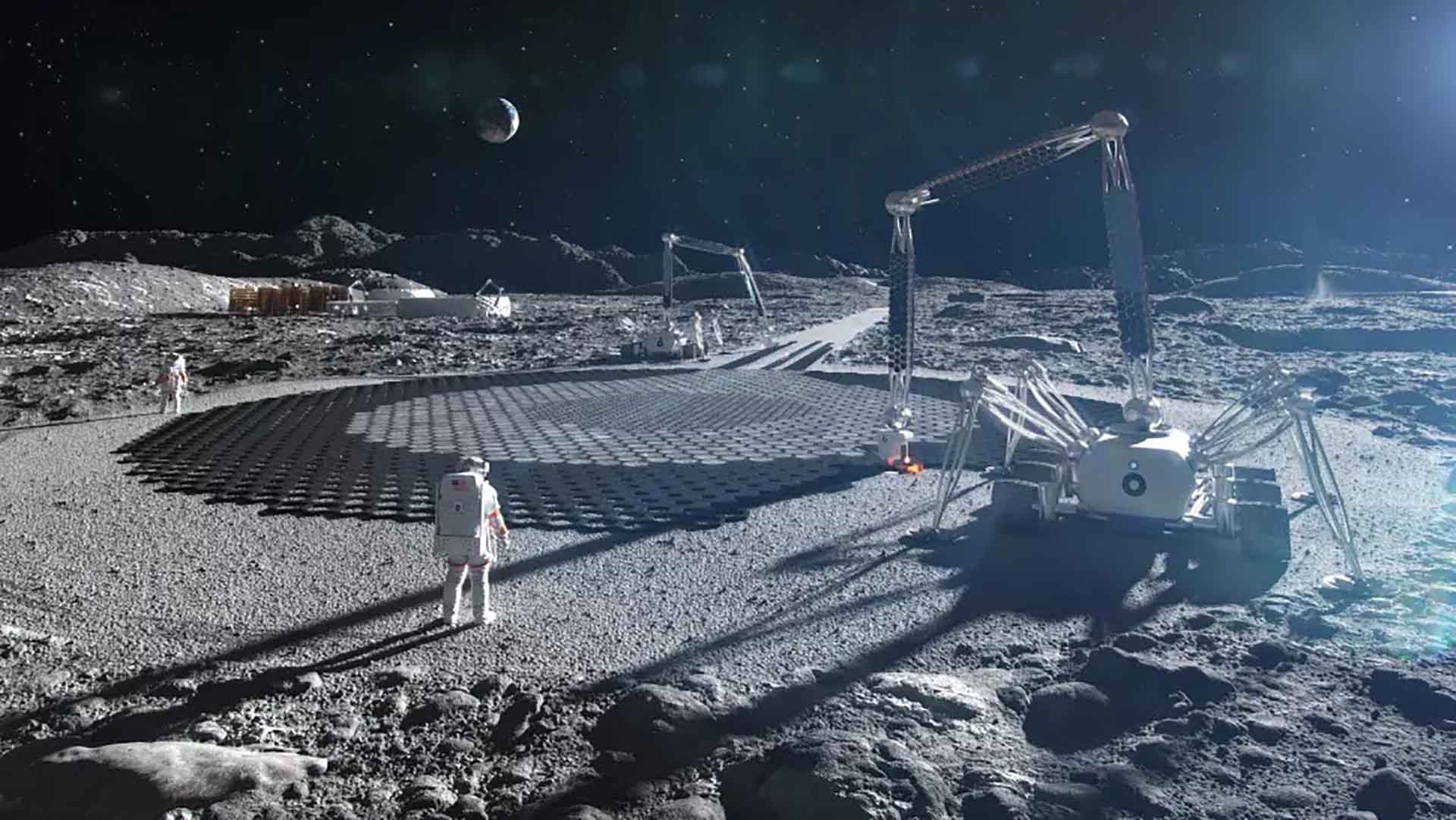
| Simulation of construction on the Moon. (Source: ICON) |
Surpassing all other nations, the United States is the leading country in its efforts to conquer Earth's natural satellite, with its Artemis program.
Artemis Missions
It all started with the Artemis Mission I, successfully launched by the US National Aeronautics and Space Administration (NASA) from the Kennedy Space Center on November 16, 2022.
Immediately afterward, NASA launched the Artemis II project, scheduled for launch in November 2024.
The Artemis II crew consists of four people who will fly around the Moon and return to Earth. This includes three American astronauts working for NASA and one Canadian astronaut.
Notably, electrical engineer Christina Koch, 44, who participated in the first all-female spacewalk while on the ISS, will be the first woman to orbit the Moon. “This marks the beginning of an era that will take us even further, bringing the lessons we learned on this mission back to Earth and applying them to exploring space at a deeper level,” Koch shared.
Looking back at history, Apollo 11 was the space flight that landed the first people on the Moon, two American astronauts, Neil Armstrong and Buzz Aldrin, at 8:18 PM on July 20, 1969. Armstrong became the first person to set foot on the surface of the Moon six hours later, on July 21, 1969.
The last time the U.S. sent a crew to the Moon was in 1972, marking the final mission of the Apollo spacecraft.
It's no coincidence that NASA named its moon return program Artemis – after the goddess who was the twin sister of Apollo, the god of light in Greek mythology. The Artemis program followed the famous Apollo program by launching a manned spacecraft to the Moon.
The Artemis program aims to send a multi-ethnic crew to the Moon and, for the first time, explore the Moon's South Pole, which lies in the dark side. This ambitious program also aims to establish a sustainable settlement on the Moon.
According to plan, Artemis III will be launched in 2025 or 2026, depending on the readiness of the Starship launch system developed by SpaceX. Artemis IV will be launched later this decade.
Russia's priority
For Russia, the mission to send humans to explore the Moon between 2029 and 2030 is considered a top priority.
Igor Komarov, head of the Russian space agency Roscosmos, affirmed that Russia and the United States could cooperate on this program.
Russia's mark in the space race was marked by the successful launch of the Sputnik 1 artificial satellite and astronaut Yuri Gagarin becoming the first person to fly into space in 1961. In 1974, the Lunokhod 1 and Lunokhod 2 rovers traveled 40 km across the lunar surface, taking panoramic photographs and analyzing soil samples.
China accelerates
Although it started somewhat later, with China not launching its first satellite into orbit until 1970, the country is developing very rapidly.
Chinese officials announced new details on July 13 regarding plans to launch a spacecraft carrying astronauts to the moon, hoping to make China the second nation to send humans to the moon.
According to Xinhua News Agency, at the aerospace summit held in Wuhan on July 13, Zhang Hailian, Deputy Chief Engineer of the China Manned Space Administration (CMSA), revealed that a lunar exploration mission is expected to take place before 2030.
This is part of a project to establish a lunar research station. He said they will explore in detail how to build the facility and carry out exploration missions and other experiments.
In 2013, China landed a robot on the Moon, becoming the third country to achieve this feat. In 2019, China became the first country in the world to land a spacecraft on the far side of the Moon.
By 2020, the country continued its success by becoming the third nation to collect samples from the Moon.
China's Chang'e-4 probe and Yutu-2 rover are currently the only active exploration devices on the lunar surface.
Over the years, China has built its own space station called Tiangong. When the International Space Station (ISS) retires (expected in 2030), Tiangong could become the only space station operating in Earth orbit.
Indian influence
Recently, India successfully launched a lunar lander. The LVM3 rocket carried the lander and the Chandrayaan 3 mission robot from India's Satish Dhawan Space Centre at 4:05 PM on July 14th ( Hanoi time).
The Chandrayaan-3 rocket's landing site is located in the lunar South Pole, near the planned landing site of the Russian Luna 25 spacecraft, scheduled for launch in August.
As a "hot spot" in the field of space exploration, the Moon's South Pole is believed to contain abundant water ice, with the potential to be used as rocket fuel and could support life on the Moon.
Chandrayaan-3 is expected to land on the Moon on August 23 or 24. If successful, this would be a historic milestone because missions to the Moon's South Pole often fail. This is because the South Pole only receives light at low angles, and the darkness makes controlling the spacecraft a major challenge for humans.
There are many reasons why this race to conquer the moon is heating up again; however, as reported by The Conversation, Dr. Florian Vidal of the French Institute of International Relations (IFRI) and Professor José Halloy, a physicist at the University of Paris, have outlined several reasons explaining why countries are returning to the race to conquer the moon.
Firstly, the Moon is considered a potential launching point for manned spaceflights to Mars or other planets due to its fuel efficiency. Secondly, the Moon could be a training ground for astronauts planning long-term space travel. Thirdly, it could be a testing ground for devices such as manned vehicles and vehicles operating from fixed-station platforms.
Source



![[Photo] General Secretary and President To Lam meets with National Assembly delegates from ethnic minorities.](https://vphoto.vietnam.vn/thumb/1200x675/vietnam/resource/IMAGE/2026/04/20/1776696701056_a1-bnd-8331-3342-jpg.webp)

![[Image] National Assembly discusses the implementation of the socio-economic development plan.](https://vphoto.vietnam.vn/thumb/1200x675/vietnam/resource/IMAGE/2026/04/20/1776696707422_ndo_br_img-20260420-185419-jpg.webp)





























































































Comment (0)