

According to Krishan Gopaul, senior EMEA analyst at the World Gold Council (WGC), after a pause in July, central banks resumed strong gold purchases in August.
Leading the way is the National Bank of Kazakhstan, which, along with Bulgaria and El Salvador, has joined the list of countries that will buy gold in 2025.
Central banks added a net 15 tonnes to global gold reserves in August, based on data released by the IMF and central banks. This is equivalent to the average monthly net purchases from March to June, indicating a return to gold buying after global reserves remained unchanged in July.
Gopaul said that seven central banks increased their gold reserves by at least one ton in August, while only two reported a decrease.
The National Bank of Kazakhstan has added 8 tonnes to its reserves, marking the sixth consecutive month of purchases. Kazakhstan's total gold reserves now stand at 316 tonnes, 32 tonnes higher than at the end of 2024.
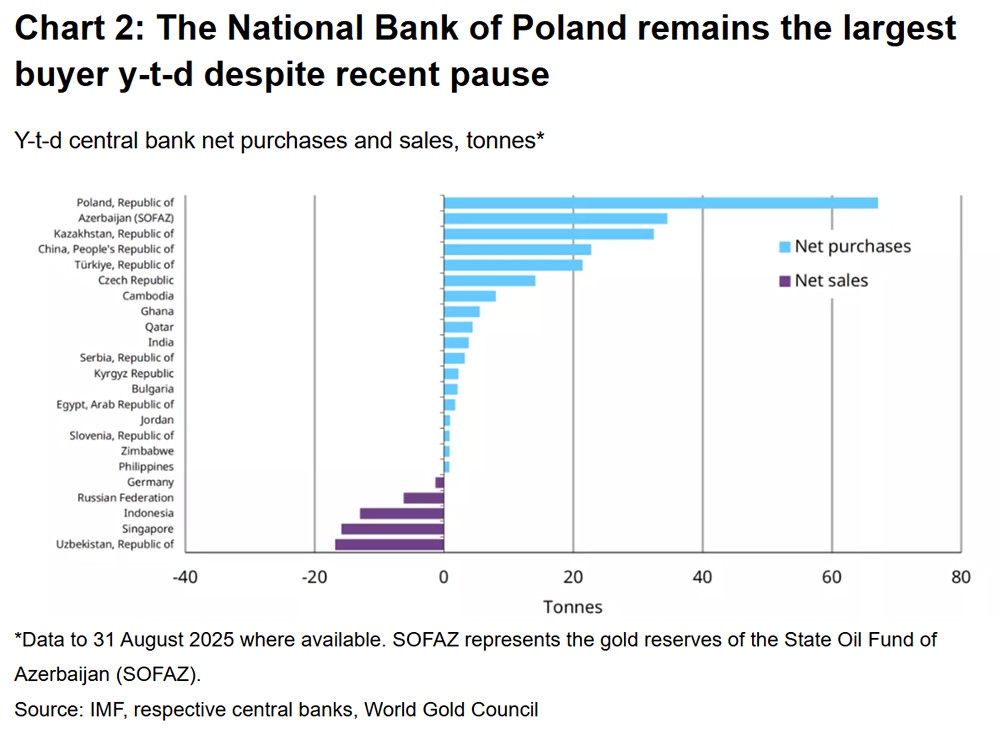
The National Bank of Bulgaria increased its gold reserves by 2 tonnes – the largest monthly increase since it purchased 8 tonnes in June 1997 – bringing its total reserves to 43 tonnes. From January 2026, Bulgaria will become the 21st member state of the eurozone and may have to transfer a portion of its gold to the ECB as part of the accession procedure.
The Turkish Central Bank also added 2 tons to its official gold reserves. Since the beginning of the year, official reserves have increased by 21 tons, reaching 639 tons.
The People's Bank of China reported purchasing an additional 2 tonnes, marking the 10th consecutive month of increasing its gold reserves. Total gold holdings have surpassed 2,300 tonnes, but this still only represents 7% of its total foreign exchange reserves.
The Central Bank of Uzbekistan also purchased an additional 2 tons this month. Total gold reserves now stand at 366 tons, 17 tons lower than at the end of 2024.
The Czech National Bank (CNB) continues its steady accumulation process, purchasing an additional 2 tons. This extends its monthly gold purchases to 30 consecutive months, raising its total gold reserves to 65 tons. The CNB aims to reach 100 tons of gold in its international reserves by the end of 2028.

The Bank of Ghana also purchased an additional 2 tons, bringing its total gold purchases since the beginning of the year to 5 tons and its reserves to 36 tons.
Conversely, the Central Bank of Russia (3 tons) and the Bank of Indonesia (2 tons) were the only two entities selling gold. The reduction in Russia's gold reserves may be related to its coin minting program.
Poland, the largest gold buyer last year, has also indicated it has no intention of slowing down its purchases. The National Bank of Poland (NBP) confirmed it will raise its target for the proportion of gold in its foreign exchange reserves from 20% to 30%. The NBP had already met its target earlier this year thanks to both strong buying activity and the rising price of gold.
Even with the recent pause, the NBP remains the largest central bank buyer of gold this year, adding 67 tonnes to its reserves by 2025, bringing its total holdings to 515 tonnes by the end of August.
The Central Reserve Bank of El Salvador also reported adding 13,999 ounces (less than 0.5 tons) of gold to its reserves in September. The gold purchases are a long-term strategy based on a prudent balance in the international reserve asset structure. The bank currently holds nearly 2 tons of gold in reserves.
A 2025 survey by the WGC found that 95% of central banks surveyed believe global gold reserves will increase within the next 12 months. Notably, a new record was set with 43% indicating their gold reserves would increase during this period. None of the banks predicted a reduction in their gold holdings.
The factors driving this trend are believed to be gold's stable performance during crises, its ability to diversify investment portfolios, and its role as an inflation hedge. Additionally, gold continues to be seen as a strategic asset due to its ability to retain value and its effectiveness in reserve allocation.
The proportion of central banks actively managing gold reserves has increased from 37% in 2024 to 44% in 2025.
Regarding storage locations, the Bank of England remains the most preferred option, with 64% of surveyed banks depositing gold there.
Source: https://vietnamnet.vn/cuoc-dua-gom-vang-dai-gia-moi-lo-dien-2449149.html



































































































Comment (0)