

On March 30th, Xuyen A General Hospital in Tay Ninh announced that after a week of emergency care and treatment, female patient B. (born in 1986, residing in Go Dau - Tay Ninh) was saved and regained her functions after suffering a serious back injury.
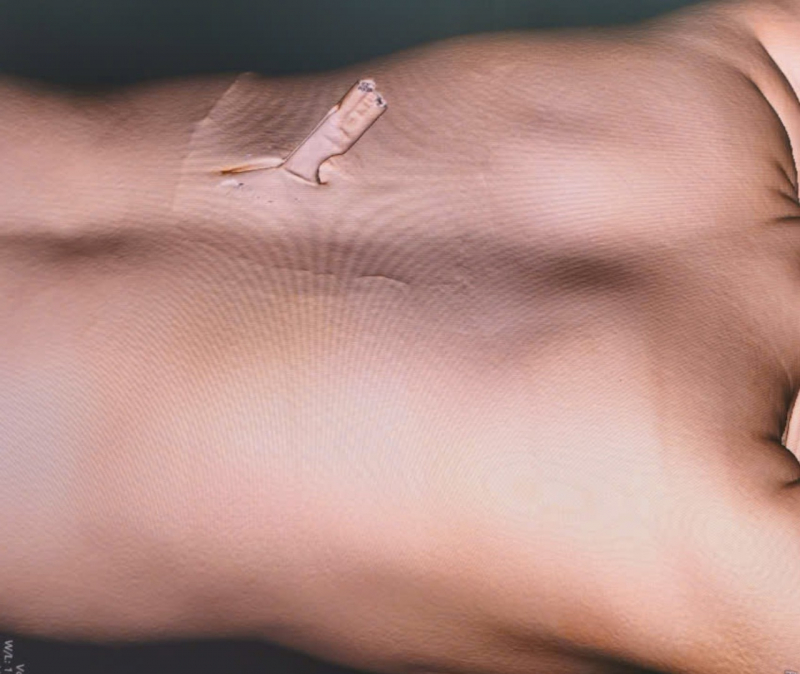
Earlier, on the evening of March 23rd, the hospital received an extremely serious emergency case. The patient was in critical condition, with a knife piercing through their back. A red alert was activated, and the Neurosurgery team began a race against time, forced to "slow down" while under immense pressure to act quickly.
The patient, Ms. B. (born in 1986, residing in Go Dau - Tay Ninh), was admitted to the hospital with a fruit knife still deeply embedded in her back (a wound resulting from a family dispute - PV). This area is close to the spine, where even a small displacement can have long-term consequences for mobility and sensation.
Upon arrival, the emergency team had almost no time to consider the situation. The foreign object remaining in the body indicated both the depth of the injury and created a state of "temporary equilibrium"; improper removal could significantly increase the risk of nerve and blood vessel damage.
Imaging revealed a more complex lesion than its external appearance suggested: a small, knife-like foreign body penetrating the soft tissue and paraspinal muscle mass on the left side, passing through the D11 vertebral body, obliquely descending into the spinal canal, and embedding itself in the D12 vertebral body. This trajectory posed a potential risk to the spinal cord, while the metallic artifacts made detailed assessment more difficult.
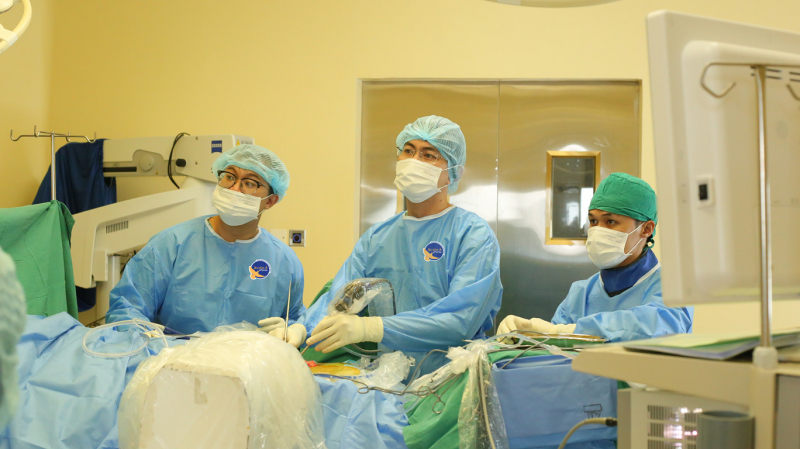
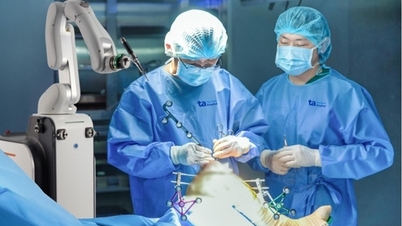
The surgery performed by Dr. Ho Hoai Hung, Head of the Neurosurgery Department, and his team was not simply about removing a foreign object, but a process of meticulous control at every step of the approach.
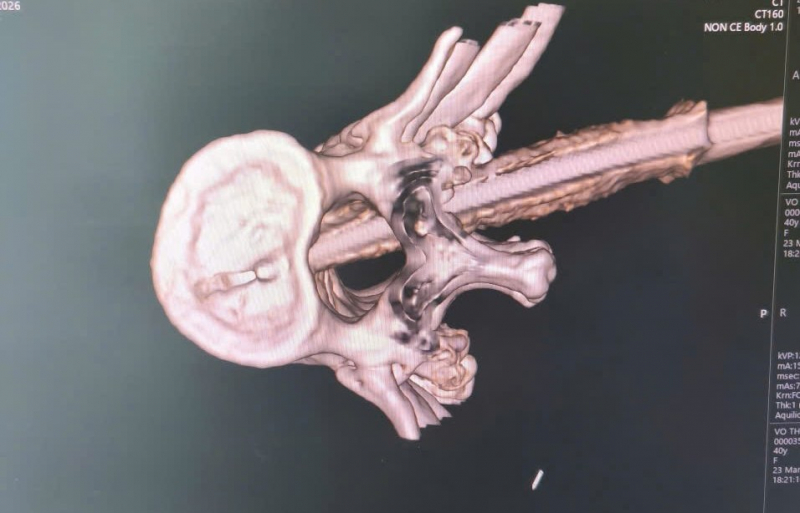
With the assistance of the C-arm system, the path of the foreign body was clearly identified during surgery. The team chose spinal endoscopy to optimally expose and control the spinal canal and scalpel blade before proceeding with the foreign body removal procedure.
Once the foreign object was removed, the biggest concerns were temporarily alleviated. The patient was closely monitored post-surgery, and no neurological damage was observed.
Five days after the surgery, the patient was able to stand up and walk on their own.
Cases of foreign objects penetrating the back are not uncommon, but each case carries its own risks. Dr. Ho Hoai Hung advises that in similar situations, it is necessary to leave the foreign object in place, minimize movement of the victim, and quickly transport them to a medical facility capable of emergency care and specialized surgery.
Source: https://cand.com.vn/y-te/cuoc-giai-cuu-nghet-tho-tu-bao-dong-do-i801080/
![[Photo] The moment of seasonal change at Thong Nhat Park](https://vphoto.vietnam.vn/thumb/1200x675/vietnam/resource/IMAGE/2026/03/30/1774870546141_ndo_br_b773e4e7b1a230fc69b313-jpg.webp)

![[Photo] General Secretary To Lam presents the Military Merit Order and Party Badge to senior leaders.](https://vphoto.vietnam.vn/thumb/1200x675/vietnam/resource/IMAGE/2026/03/30/1774878643606_a1-bnd-5651-8284-2398-1124-jpg.webp)

![[Photo] General Secretary To Lam attends the ceremony commemorating the 75th anniversary of the founding of the Central Military Hospital 108.](https://vphoto.vietnam.vn/thumb/1200x675/vietnam/resource/IMAGE/2026/03/30/1774866343623_a1-bnd-5435-7415-jpg.webp)




















































































Comment (0)