

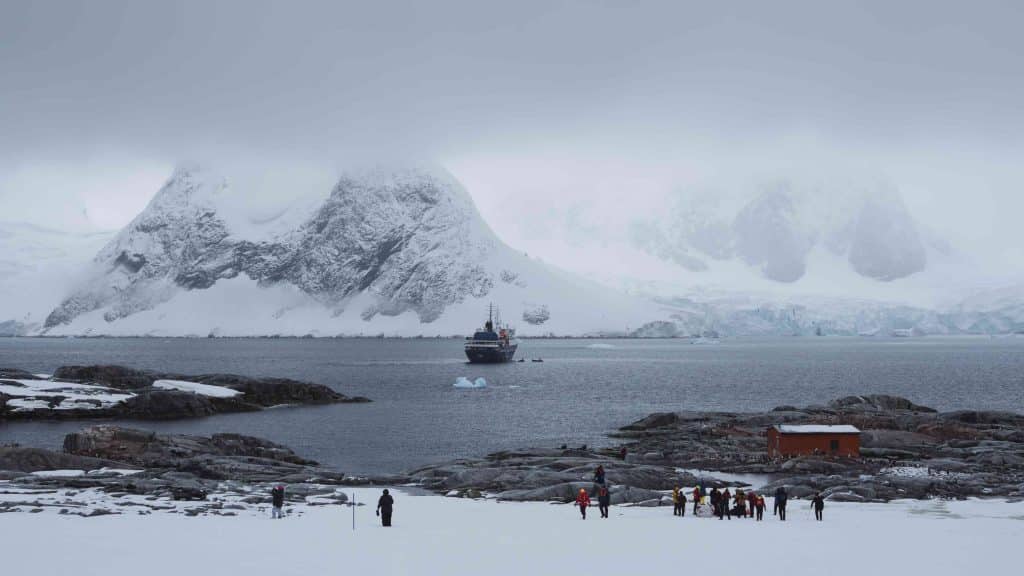
Tourists flock to Petermann.
This is my fifth trip to Antarctica , and I'm still as excited and hopeful as I was on the first day. This place is dearer to me than ever before; it's no longer just a destination but more like a "second home."
Crossing the world's most challenging strait.
To reach Antarctica, the expedition flew to Ushuaia, a city dubbed the "end of the world," where passengers boarded a ship to begin their journey to the other side of the continent. The greatest challenge on that journey was perhaps crossing the Drake Passage, one of the world's most treacherous seas. Alfred Lansing once described it as "the most terrifying ocean on the planet" during explorer Ernest Shackleton's voyage to Antarctica. This strait connects the southern tip of South America to the northernmost point of the Antarctic Peninsula, measuring approximately 1,000 km wide and reaching depths of up to 4,800 m. The Drake Passage is known for its large waves, harsh weather, and powerful currents.
Crossing the Drake Passage is not just a geographical obstacle, but also a test of self-control, as each traveler must confront their own fears. I had heard many stories about the fierce waves here, so as the ship began to leave the harbor, a feeling of anticipation seemed to spread and grow in my chest. As we ventured deeper into the pass, the waves grew larger, and the ship's crew constantly reminded everyone to hold on tight to the railings, take seasickness medication if needed, and go to the doctor's office if they experienced any difficulties. Throughout the journey, I felt the power of the ocean; the waves crashing against the sides of the ship made me realize that we were in the midst of a battle between man and nature. These challenges made the journey even more exciting and thrilling than ever before.
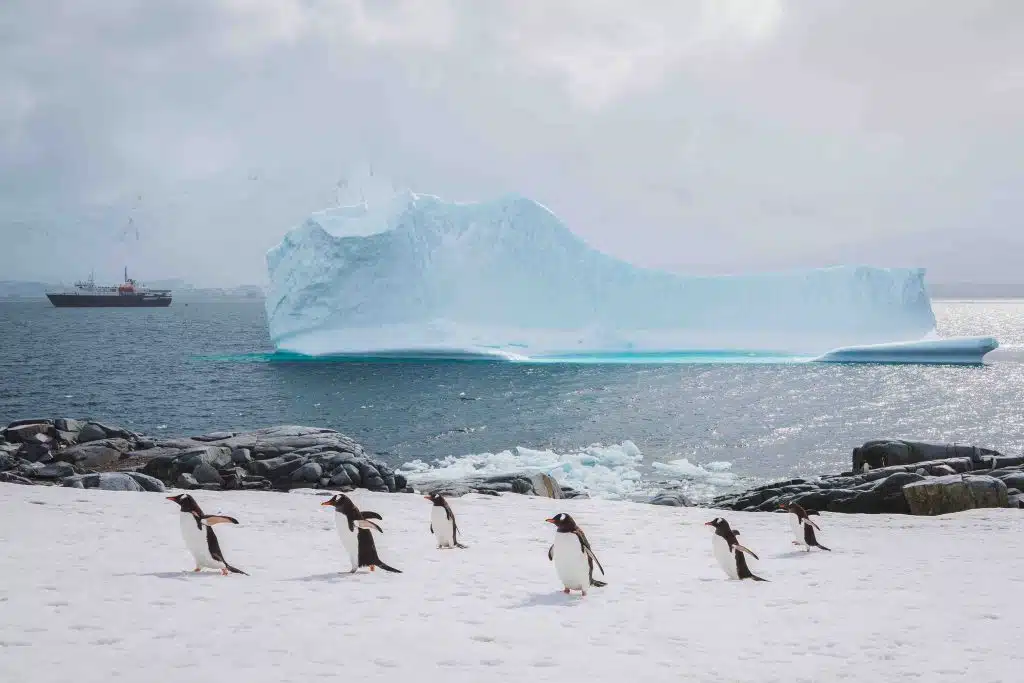
Gentoo penguins move in formation on the icy coastline.
The gateway to the Antarctic mainland.
After crossing the Drake Passage, the tour group arrived at Portal Point, one of the first stops in Antarctica. This is a place where many explorers have set foot on their previous expeditions to Antarctica. Portal Point presents a magical and enchanting landscape with snow-capped mountain ranges and icebergs sparkling in the sunlight.
Portal Point is located at the entrance to Charlotte Bay on the Reclus Peninsula in the western waters of Graham Island. The British built rescue camps here in 1956, then moved to another island in 1997. It served as a gateway to the Antarctic mainland for early explorers.
Because we had ventured deep inland, the land was completely covered in ice and snow, with only a small patch of land visible near the sea surface—the nests of the Gentoo penguins. We felt like we were lost in a magical world of colorful icebergs, ranging from white to blue, in all shapes and sizes, with giant icebergs resembling majestic white castles rising from the sea. While cruising around Portal Point in a rubber boat, passengers could admire terns, famous for the world's longest migration—round trip between the South Pole and the Arctic. This was also home to kelp, a species of seagull with about a million individuals living in the Southern Ocean. They were easily recognizable by their gray feathers and yellow beaks. They often perched on icebergs, providing photographers with opportunities to capture beautiful images.
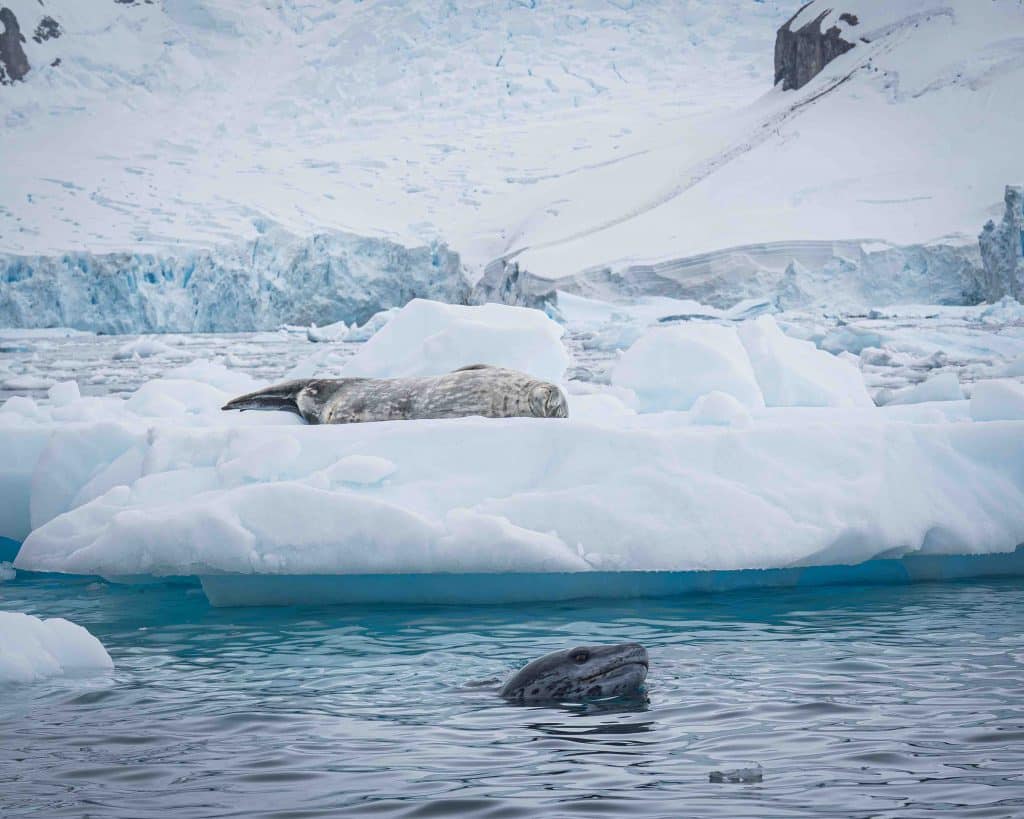
Weddell seals sleep while leopard seals stalk beneath the ice floes.
Wonders of nature and fascinating creatures
Continuing our journey, we arrived at Neko Harbor, one of Antarctica's most famous attractions. With its stunning scenery and rich biodiversity, Neko is not only an ideal location for admiring icebergs but also home to many rare animal species.
Neko Harbor is located on the eastern coast of Andvord Bay, 11 km south of the Errera Strait. Discovered by the explorer De Gerlache during the Belgian Antarctic expedition (1897–1899) and named after the whaling ship Neko, it was a major British whaling station during the periods 1911–1912 and 1923–1924.
The rubber boat took us on a tour through a landscape of thick snow and ice. Suddenly, a humpback whale surfaced, thrashing its tail to the cheers of the group, despite our reminders to be quiet. It's understandable; witnessing a whale weighing 36 tons and measuring 19 meters in length swimming before you is an incredibly exhilarating experience. Encountering a humpback whale is a stroke of luck, as only about 38,000 individuals of this species are recorded worldwide.
Along with Neko Harbor, Paradise Bay is one of the two main anchorage areas for ships in Antarctica. It's known as paradise thanks to its enchanting scenery, with towering mountains shielding against storms, creating an unusually calm surface. Here, visitors can enjoy kayaking and sightseeing, while those who choose to go in inflatable boats can observe the lives of birds, especially the blue-eyed cormorants nesting on the cliffs. In the distance, flocks of Gentoo penguins can be seen swimming amidst the swirling snow. The scene is truly magical!
One of the most memorable moments of this trip was the moment we entered the Lemaire Strait. The strait is 11km long, with its narrowest point only about 800m wide, surrounded by snow-capped peaks up to 300m high. As the ship slowly entered, the water was perfectly calm, shimmering and reflecting the majestic mountains.
Antarctica, with its surreal beauty of ice and snow, has given us unforgettable experiences. Our journey exploring this land was not only an adventure but also a clear testament to the power of nature and the miraculous resilience of many animal species amidst harsh weather conditions.
Source: https://heritagevietnamairlines.com/cuoc-phieu-luu-den-vung-dat-bang-gia/

![[Photo] Memorable moments at the 10th Vietnam-China Border Defense Friendship Exchange](https://vphoto.vietnam.vn/thumb/1200x675/vietnam/resource/IMAGE/2026/03/20/1773986226876_giao-luu-bien-gioi-vntq-lan-10-ben-tq-9737-4225-jpg.webp)



























































































Comment (0)