In Thanh Hoa , the province with the largest number of DNA samples of fallen soldiers' relatives collected nationwide, journeys through mountains and forests, and the blood of mothers, sisters, and daughters of fallen soldiers are extending the daily path of bringing those who have fallen back to their rightful place.

The return after 54 years
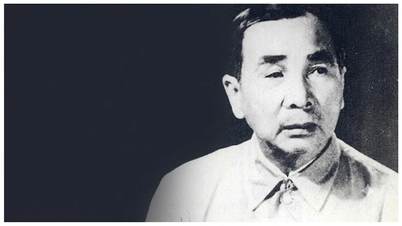
For 54 years since receiving the death certificate, the family of martyr Nguyen Trong Cat has never stopped hoping to know the exact resting place of their son and brother. Born in 1952 in Minh Dan commune, Trieu Son district (now Hop Tien commune, Thanh Hoa province), the platoon deputy commander bravely sacrificed his life on October 20, 1972, at a very young age. For more than half a century, his grave at the Nga Bay - Phung Hiep Martyrs' Cemetery ( Can Tho City) has lacked complete information about his identity.
Then one day, a phone call from the authorities brought the family the joyful news that many generations had been waiting for. DNA testing and comparison with biological samples from relatives confirmed that the remains buried in grave number 52, row 2, block B, section B, Nga Bay - Phung Hiep Martyrs' Cemetery were indeed those of martyr Nguyen Trong Cat. After 54 years, the soldier from Minh Dan commune, Trieu Son district (now Hop Tien commune, Thanh Hoa province) was finally recognized by his rightful name.
The return of martyr Nguyen Trong Cat not only concludes a search that lasted more than half a century for a family, but also serves as compelling evidence of the value of the DNA database for the relatives of fallen soldiers. Behind this result are tens of thousands of silent trips by task forces to every village, hamlet, and household throughout Thanh Hoa province to collect biological samples from the relatives of fallen soldiers. Each drop of blood preserved today is not only a biological sample for comparison, but could also become the key to unlocking the door of memory, restoring the name of a soldier who has remained anonymous for more than half a century.
Currently, there are still approximately 500,000 martyrs nationwide whose identities remain unknown. Thanh Hoa province alone has over 55,000 martyrs, of which about 37,720 cases lack sufficient information to locate their graves. Behind these numbers lie tens of thousands of unfinished stories: mothers who have lived their entire lives without knowing where their sons are buried, wives whose hair has turned gray but can only light incense before makeshift altars, and siblings who carry the lifelong burden of never having found their brothers.



As time passes, the journey becomes increasingly urgent. After decades buried underground, many remains have severely decomposed due to the effects of climate and natural conditions. Meanwhile, those closest to the fallen soldiers, especially their maternal relatives, are mostly over 80, 90, or even over 100 years old. Every day of delay means the risk of losing another valuable source of samples, reducing the chances of identifying those who have fallen.
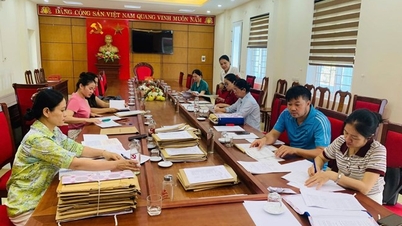
Therefore, immediately after the Ministry of Public Security issued Plan No. 356 on the implementation of DNA information collection for relatives of unidentified martyrs, the Thanh Hoa Provincial Police chose a different approach: Instead of waiting for the general implementation schedule, they proactively took a step ahead. Based on the advice of the police force, the Provincial People's Committee quickly issued a plan for implementation throughout the province; departments, agencies, and local authorities simultaneously participated; martyrs' files were reviewed from scratch; and information on relatives was verified and updated for each case. All work was geared towards the highest goal: ensuring that no eligible relative was overlooked for sample collection and that no opportunity to identify a martyr was missed.
Racing against time
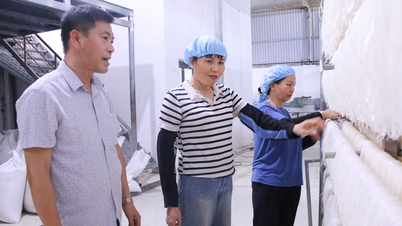
While in the lowlands, sample collection mainly takes place at centralized locations, in the mountainous regions, each DNA sample is the result of arduous journeys. Motorbikes cannot continue further, so officials have to leave their vehicles in the villages below and walk many kilometers. Their biggest concern is not the hardship, but how to get the collected biological samples back to Hanoi on the same day to ensure quality for DNA analysis.
In many families, the only documents related to fallen soldiers are faded certificates of recognition from the nation or old death notices. Those who once knew the soldiers well now have memory lapses. Therefore, verifying blood relationships and completing the dossiers becomes extremely meticulous. Every piece of information must be cross-checked multiple times, because even a small error can affect the results of the subsequent assessment.
The workload in Thanh Hoa is considered the largest in the country. Over 37,000 eligible cases require tens of thousands of reviews, verifications, and information cross-referencing. The pressure is immense, but this also fuels even greater determination. Two peak periods were implemented simultaneously in May and July 2025. 94 sample collection points were organized throughout the province, combined with dozens of mobile task forces that visited the homes of the elderly, infirm, and sick.
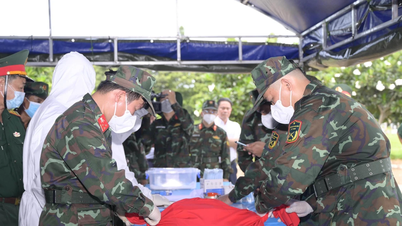
Regardless of holidays or weekends, many officials worked from early morning until late at night. Some days, after completing sample collection in mountainous areas, they would immediately return to seal, preserve, and transport the samples to the specialized unit for analysis overnight. As a result, Thanh Hoa completed the collection of 37,808 DNA samples from relatives of fallen soldiers, achieving 100% of eligible individuals, becoming the locality with the largest number of DNA samples collected from relatives of fallen soldiers nationwide. This is not just an achievement in terms of progress. More importantly, Thanh Hoa has built a large-scale DNA database, providing a foundation for matching and identifying the remains of fallen soldiers in the next phase of the "500-Day Campaign to Intensify the Search, Collection, and Identification of the Remains of Fallen Soldiers" currently being implemented nationwide.



Perhaps, there is still a very long way to go. Tens of thousands of martyrs from Thanh Hoa and hundreds of thousands nationwide are still awaiting identification. The race against time continues as immediate family members grow older and frail, and as natural conditions continue to erase the scars of war. But from these initial results, there is more reason to believe that more and more soldiers will be brought home.
It is a journey where science and technology have become a bridge of gratitude. It is also a journey for today's generation to fulfill a sacred promise to those who have fallen for the Fatherland: No sacrifice should remain anonymous, and no soldiers who dedicated their youth to the country should have to wait any longer for a return.
Source: https://baovanhoa.vn/doi-song/cuoc-tro-ve-sau-hon-nua-the-ky-241296.html
![[Photo] Strengthening character and expertise: Intense training for artillery soldiers.](https://vphoto.vietnam.vn/thumb/1200x675/vietnam/resource/IMAGE/2026/06/30/1782815602541_lu-368-1875-4571-jpg.webp)














![[Video] Path of low pressure system entering the South China Sea, likely to strengthen into a typhoon](https://vphoto.vietnam.vn/thumb/402x226/vietnam/resource/IMAGE/2026/06/30/1782832701190_bao-jpg.webp)