


Visiting temples to worship Buddha is a beautiful and age-old spiritual and cultural tradition of the Vietnamese people.
Buddhism is a system of philosophy and moral education founded by Siddhartha Gautama, the Buddha. The core meaning of Buddhism is to guide people towards self-enlightenment, self-mastery, and the cessation of suffering (liberation) through practice, understanding karma, and living ethically. Buddhism was introduced to Vietnam very early, gradually taking shape and developing strongly. The image of the Buddha is a sacred symbol of wisdom, compassion, and liberation.
In an article about the intermingling and transformation of the cultural beauty of visiting temples and worshipping Buddha, both past and present, in Vietnam, the late Professor Ngo Duc Thinh profoundly observed: "Vietnamese people, especially farmers and city dwellers, receive Buddhism not for its profound, scholastic doctrines, but primarily for its concepts of lifestyle and way of life, based on the ideology of promoting good deeds and eliminating evil according to the law of karma—that good deeds are rewarded, harmonious social conduct, and living in a way that brings blessings to their descendants..."
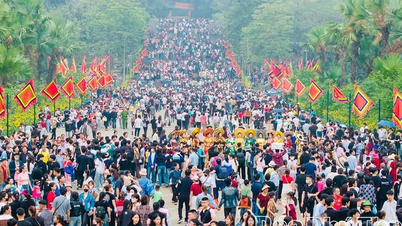
For most Vietnamese people, visiting temples to worship Buddha is a personal need, a deep-seated urge within their hearts. Whenever they need a place of tranquility, when their souls seek a peaceful anchor, the image of a serene temple, with its fragrant incense smoke and the faint sound of prayers, constantly comes to mind. Especially during holidays, festivals, the beginning and end of the year, and on the 15th and 1st of each lunar month, the number of people visiting temples to worship Buddha increases, creating a bustling atmosphere. This is because, according to Vietnamese belief, these are sacred moments, when yin and yang harmonize, connecting the spiritual realm.
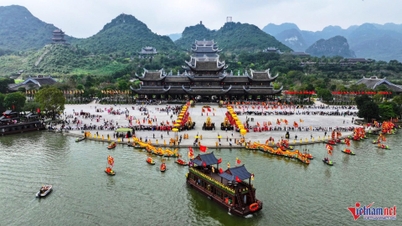
In the final days of the Year of the Snake 2025, despite being busy with work, Ms. Trinh Phuong Loan's family (45 years old, Dong Quang ward) still managed to return to their hometown to tend to their grandparents' graves and prepare offerings to present at Thanh Ha Pagoda (Hac Thanh ward). This is a beautiful and famous pagoda, considered one of the most sacred in Thanh Hoa province. Ms. Loan shared: "Modern life sweeps us along in a whirlwind of worries and busyness, so many things we do for ourselves are neglected and forgotten. However, there are two things I always keep in mind and never neglect: taking care of the graves and worshiping our ancestors in our hometown, and going to the pagoda, especially the New Year's ceremony and the thanksgiving ceremony at the end of the year."
The thanksgiving ceremony that Ms. Loan mentioned, simply understood, is a ritual of expressing gratitude to the gods and Buddhas at the places where one visited at the beginning of the year to "seek blessings," entrusting wishes and hopes for a new year filled with good health, peace, smooth and successful work, and abundant happiness... The thanksgiving ceremony not only reflects the spiritual concept of "what goes around comes around" but is also a beautiful symbol of the tradition of "drinking water, remembering the source," passed down and continued for thousands of years by the Vietnamese people.
In the spacious and airy temple grounds, surrounded by breathtaking natural scenery, Ms. Nguyen Thi Tam (from Hoang Hoa commune) and her daughter offered prayers at the altars of Nhon Temple (Hoang Loc commune). The year-end thanksgiving offerings didn't need to be elaborate or ostentatious; the main thing was to express the sincerity and good heart of the person preparing the offerings. Like many others, Ms. Tam was mindful and careful in her actions, demeanor, and words; her attire was neat and respectful. Wherever she went, Ms. Tam sincerely knelt before the altar, clasped her hands in prayer, and expressed her wishes.
Each time we clasp our hands in prayer, we sow seeds of faith and hope, reaping peace. Spiritual matters and beliefs tell the story of people's faith, admiration, and reverence for gods and Buddhas, often expressed through rituals and traditional customs. They create mental peace, unite communities, and reflect the unique characteristics of local culture.
Because of these benevolent meanings, visiting temples to worship Buddha in general, and offering thanks at the end of the year in particular, has become a deeply ingrained spiritual practice in the Vietnamese people's lives, a beautiful aspect of Vietnamese traditional culture. Going to the temple brings inner peace, a realization of the need for self-cultivation to live better each day, and the understanding that truth, goodness, and beauty are both the starting point and the goal, the sweet fruits of a lifetime's hard work and nurturing.
Text and photos: Dang Khoa
Source: https://baothanhhoa.vn/cuoi-nam-len-chua-le-phat-277033.htm

















































Comment (0)