|
Photo: Instagram . |
Kim Cho-Yup's novel, * If We Cannot Go at the Speed of Light*, has sold over 400,000 copies in South Korea.
In China, this work won the gold award in the translated book category at the 14th China Nebula Prize, the country's most prestigious science fiction award.
This collection of short stories is now available in English, as Anton Hur's translation introduces science fiction star Kim Choyeop to Western readers.
Science fiction transcends traditional boundaries.
No other South Korean science fiction book in recent times has transcended genre boundaries to achieve such international success. Some international readers begin their positive reviews with the phrase, “I don’t usually read science fiction, but…” and offer numerous accolades for the book.
The term science fiction often conjures images of spaceships, aliens, robots, and typically a bleak, grim future. Traditionally, the publishing industry has categorized fiction into hard fiction, which prioritizes scientific accuracy and technical detail, and soft fiction, which emphasizes characters, social change, and human emotions.
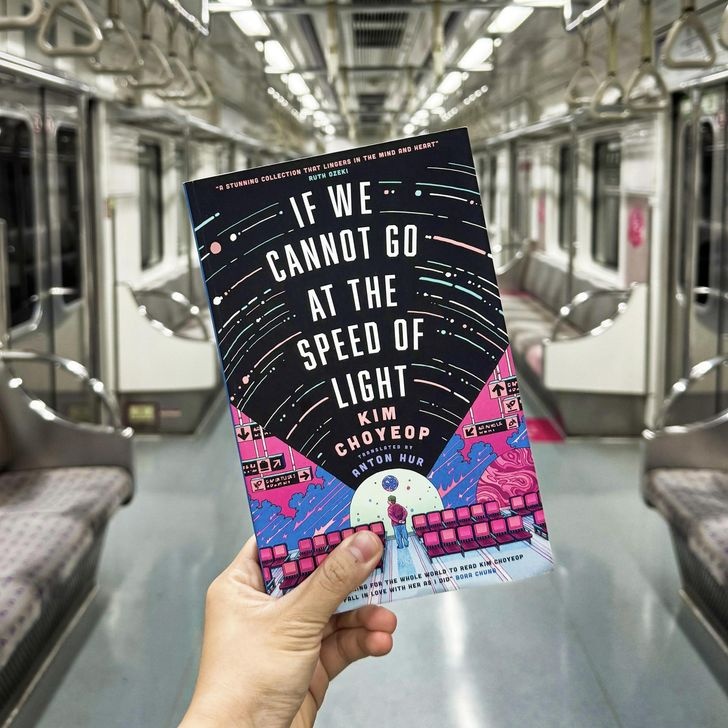 |
The book was released on April 28. Photo: Korea Times. |
Fans of the first genre are drawn to bold scientific theories based on a piece of reality, such as Liu Cixin's Three-Body Problem . Those who prefer the second genre are impressed when a work expands human imagination beyond the limits of space and time, like Frank Herbert's space epic , Dune .



Readers expecting If We Cannot Go at the Speed of Light to fall into either of those two genres may be disappointed. However, they will find something even more special: science fiction that touches the heart by exploring the most important universal questions in everyday life.
Encourage readers to find the answers themselves.
Instead of delving into abstract theories of astrophysics and engineering, Kim focuses on the impact of technology on individuals and society. Her stories raise numerous questions that serve as stepping stones, encouraging readers to find their own answers.
The first story in the collection, Symbiosis Theory , imagines an alien species coexisting with humans, not unlike the microbial world living in the human gut.
Kim poses the question: What makes us human? What would happen if the characteristics we consider "human" were present in the creatures that have lived inside us all along?
This story is perfectly relevant to the current context. As AI increasingly takes over jobs and is seen as a major threat to creativity, something humans have always considered their prerogative, humanity is forced to look and reflect on the future.
As change relentlessly unfolds, Kim writes about things that remain unchanged. The short story, which shares the same title as the book, transports the reader to a future where space travel expands the boundaries of human habitation far beyond even the wildest dreams.
However, the story of a stubborn old woman waiting for a spaceship that will never return is something that today's age can empathize with. It's a struggle to balance work and family, the bitterness of shattered ambitions, and the emptiness of homesickness that cannot be reached.
Although the book was published in Korean seven years ago and includes works written in an earlier period, the author's talent for accurately identifying major human experiences ensures that the work retains its value over time.
In fact, some of the stories remain highly relevant today. In *The Materiality of Emotions *, a mysterious company invents products that can instantly make people feel specific emotions, from anticipation and calm to fear and depression. Kim writes: “Is the reason people consume everything simply to get the emotions that come with it? Are humans always pursuing some kind of meaning?”
This story is reminiscent of the hobby of owning accessories or bag charms that students and working adults today find indispensable. Despite the passage of time, these phenomena remain relevant and unexplained, with no solutions yet found.
Among the many strengths of If We Cannot Go at the Speed of Light , the most impressive is that none of the seven stories are boring. Unlike anthologies that are merely a mix of a few prominent names and the "rest," each of Kim's stories stimulates the imagination and takes the reader's thoughts down a winding, previously unexplored path.



With her straightforward and evocative writing style, Kim makes science fiction more accessible to the general reader.
Source: https://znews.vn/cuon-sach-khien-doc-gia-trung-han-phat-cuong-post1662239.html