

 |
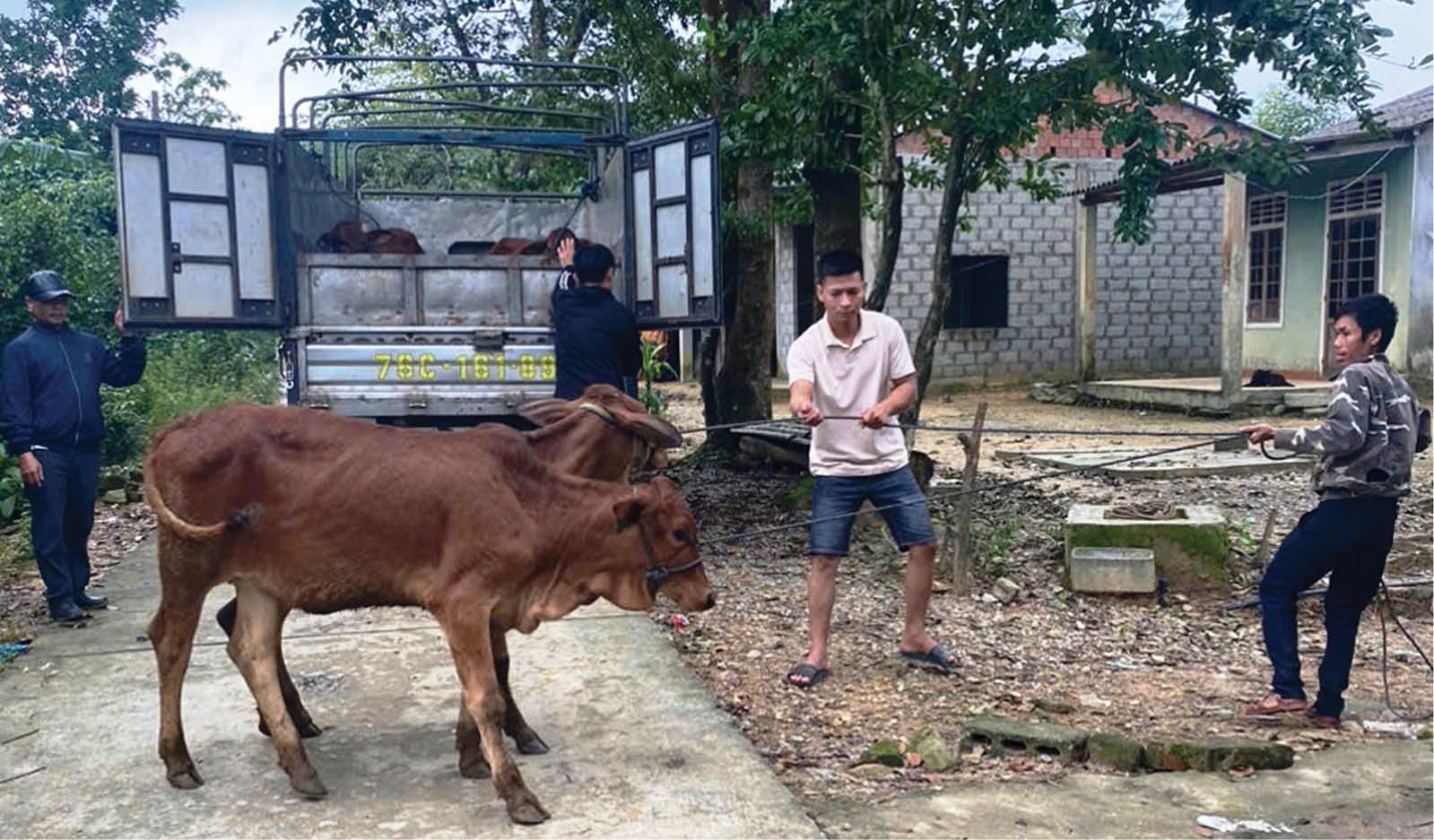
| The program to support production, especially providing breeding cattle to poor households in Binh Dien commune, has been implemented effectively. |
Mobilize multiple resources
After accessing preferential loans and receiving livelihood support from the commune's poverty reduction program, Mr. Nguyen Van Xe in Binh Dien commune, one of the particularly disadvantaged households in this mountainous area, has had the opportunity to rise out of poverty. He now has a sturdy house and a pair of breeding cows to support his livelihood, giving him more confidence to work hard and escape poverty. “I was overjoyed to receive two cows to develop my family's economy , and to have my house repaired by the commune's departments with a budget of over 20 million VND. Before receiving the breeding cows, I also received training on the process of raising, caring for, and composting straw to feed the cows. Now, my family has overcome the difficult period,” said Mr. Nguyen Van Xe.
Having clearly identified the advantages and disadvantages of implementing poverty reduction efforts, in recent years, localities such as Binh Thanh, Binh Tien, and the former Huong Binh (now Binh Dien commune) have applied a targeted poverty reduction model. Each committee, agency, and organization is assigned to oversee a specific number of poor households, and based on this, they develop plans to mobilize resources to support those lacking in order to ensure that people meet the criteria for escaping poverty. Accordingly, the program to support production for poor households in Binh Dien commune is implemented in various forms, but the most common is providing breeding cows.
Ms. Le Thi Hiet, a member of the Pa Hy ethnic minority in Binh Dien commune, said: "The commune provided me with two cows to create a livelihood, which is very suitable for my family's working conditions. Currently, my family continues to be included in the list of those receiving support for agricultural development, creating additional income to escape poverty sustainably..."
All communes and wards in the city have developed plans to help poor households escape poverty; identifying the causes of poverty and the support needs of each poor household, mainly focusing on support for building and repairing houses, livelihood models, loans, and support for production land…
Some localities have demonstrated innovative and outstanding approaches in poverty reduction, such as Huong Tra ward, which has developed a plan to support poor households with chicks, feed, and the construction of livestock pens to increase their income; and mobilized funds to support 30% of the cost of health insurance for newly-escaped-poverty households. Kim Tra ward has implemented a model of supporting the raising of hybrid fighting chickens for dozens of poor and near-poor households with a total amount of hundreds of millions of VND; and organized cultural programs and sold lottery tickets to raise funds to support poor households…
According to Mai Van Xuan, Vice Chairman of the Kim Tra Ward People's Committee, the Party Committee has directed the local government, departments, and mass organizations to actively disseminate information to the people about the support policies so that they can select beneficiaries based on the poverty reduction targets. At the same time, the entire political system is mobilized to regularly monitor, supervise, and implement poverty reduction efforts, and to encourage people to unite and help each other in developing production and livestock farming, promoting the effectiveness of supported livelihood models to strive to reduce the poverty rate to meet and exceed the set targets.
The poverty rate decreased by nearly 1% annually.
Sustainable poverty reduction is one of the overarching goals that the Party committees, government, and people of the entire city are determined to achieve. Local authorities and relevant sectors have mobilized the entire political system and leveraged all available resources to achieve sustainable poverty reduction.
In reality, in implementing poverty reduction efforts, each locality has integrated poverty reduction support policies and projects under the National Target Program for Sustainable Poverty Reduction with projects of the New Rural Development Program and socio-economic development programs for ethnic minority areas. Simultaneously, they have created policy mechanisms for joint investment by the people and the State, aiming to improve access to basic social services. Investment is prioritized for disadvantaged communes; localities prioritize investment and support for poor households, near-poor households, and ethnic minority households in a focused manner, avoiding scattered spending.
According to Deputy Director of the Department of Agriculture and Environment Le Van Anh, localities are regularly and synchronously implementing poverty reduction projects, sub-projects, and policies, as well as social policy credit to support poverty reduction. At the same time, they are strengthening inspection, supervision, and urging the implementation of sustainable poverty reduction work at the local level. With high determination and the active participation of the entire political system, the city is expected to reduce the poverty rate by an average of 0.95% per year during the 2022-2025 period, exceeding the target of 0.7-0.75% per year set by the Government and the City Party Committee. This will also contribute to narrowing the poverty gap between urban and rural areas, and between rural areas and ethnic minority regions.
"According to the plan of the City People's Committee, the unit will continue to develop and propose economic and social welfare policies suitable to the current situation in order to strive to reduce the poverty rate to below 1.2% by the end of 2025...", Mr. Le Van Anh said.
Source: https://huengaynay.vn/kinh-te/nong-nghiep-nong-thon/da-dang-mo-hinh-sinh-ke-giup-do-ho-ngheo-160437.html





![[Photo] Prime Minister Pham Minh Chinh receives the Chinese Ambassador to Vietnam](https://vphoto.vietnam.vn/thumb/1200x675/vietnam/resource/IMAGE/2026/04/05/1775397481797_ndo_br_dsc-5512-jpg.webp)











































































Comment (0)