

UNIQUE ANCIENT ARCHITECTURE
According to documents from the Dong Thap Provincial Museum, Binh Dang communal house is the site of a long-standing cultural and religious institution, which was first built in October 1819 (the year of the Rabbit).

The formation and development of the communal house is closely linked to the process of land reclamation, settlement, and community organization of people in Central Vietnam, especially those who migrated from Nghe An to the Southern region.
The communal house was established to worship the tutelary deity of the village; at the same time, it became a space for gathering and preserving the unique folk cultural values of the locality.
For over two centuries, Binh Dang communal house has become a "living witness" to the process of cultural exchange and transformation in the region throughout the 19th century.
Binh Dang Temple bears the mark of unique architecture, built in a sturdy and elaborate style, with cultural, historical, religious, and spiritual values. Currently, Binh Dang communal house still preserves 2 royal decrees of Dai Can Quoc Gia Nam Hai, 2 royal decrees of Bao An Thanh Hoang issued by King Thieu Tri in 1845, along with 2 royal decrees from King Tu Duc in 1850, and also retains 13 sets of ornate wooden panels, 8 horizontal plaques, and dragon pillars, all exquisitely carved… |
Throughout its existence, the temple has undergone 10 renovations, most notably two major renovations in 1892 (the 45th year of the reign of Emperor Tự Đức) and 1921 (the 6th year of the reign of Emperor Khải Định).
In particular, the major renovation in 1921 marked a significant turning point when the temple was renovated according to modern architectural trends, harmonizing the French neoclassical style with the traditional Eastern village temple model.
The unique feature of Binh Dang communal house's architecture lies in the harmonious blend of traditional wood carving and Western-style relief sculpture.
Decorative wooden motifs such as dragon pillars, horizontal plaques, couplets, and decorative panels are intricately carved using various techniques including openwork carving, relief carving, and recessed carving.
Notably, the relief panels feature floral, vine, and geometric motifs in a Western style, but have been subtly adapted to Vietnamese culture, creating a unique and relatable artistic form.
Furthermore, the principle of axial symmetry between the bays and wings in the overall temple architecture clearly reflects the influence of early 20th-century French architectural art, bringing harmony and balance to the worship space.
In terms of color, Binh Dang communal house stands out with its red and gold lacquer paint combined with a white lime base, natural wood brown, and shades of red, black, and deep yellow… colors common in Nguyen Dynasty religious architecture.
According to local elders, this color scheme has been preserved since the major restoration in 1921, contributing to the continuity and originality of the temple's architectural space.
It can be affirmed that Binh Dang communal house is a typical example of the localization process of the Northern Vietnamese village communal house model, vividly reflecting the intermingling of tradition and modernity, and between Asian and European architecture.
Therefore, Binh Dang communal house not only possesses great architectural and artistic value, but also serves as important evidence of the transformation, interaction, and development of traditional village communal house architecture within the historical and cultural context of Southern Vietnam at that time.
PRESERVING AND PROMOTING THE VALUE OF HISTORICAL SITES
In order to protect and promote the architectural relic of Binh Dang communal house, the People's Committee of Dang Hung Phuoc commune previously established and strengthened the Communal House Management Board, whose nhiệm vụ was to preserve, protect, and organize the communal house's festivals.

To establish a legal basis for long-term protection of the relic, Mr. Nguyen Thanh Tam, Head of the Culture and Social Affairs Department of Tan Thuan Binh commune, said: "In 2024, the People's Committee of Cho Gao district (formerly) proposed to the Department of Culture, Sports and Tourism of the province to research and prepare a scientific dossier on the Binh Dang communal house, a provincial-level architectural and artistic relic, to submit to the Ministry of Culture, Sports and Tourism for consideration of ranking it as a national-level architectural and artistic relic."
Therefore, the Bình Đăng communal house management board, the People's Committee of Đăng Hưng Phước commune, the Department of Culture, Science and Information, and other relevant agencies advised the District People's Committee to coordinate with the former Department of Culture, Sports and Tourism to organize a seminar to assess the historical, cultural, scientific, and aesthetic values of the relic; these results were used as the basis for compiling a summary dossier and submitting a report to the Provincial People's Committee.

Following the merger of the two levels of local government, the Party Committee and People's Committee of Tan Thuan Binh commune continue to request the People's Committee of Dong Thap province and the Department of Culture, Sports and Tourism of Dong Thap province to consider the matter; subsequently, they will submit the scientific dossier for ranking Binh Dang communal house as a national-level architectural and artistic relic to the Ministry of Culture, Sports and Tourism in the near future.”
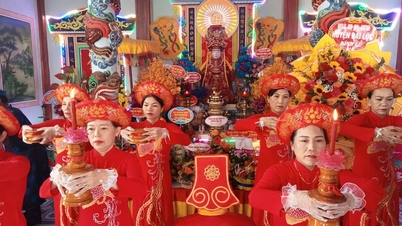
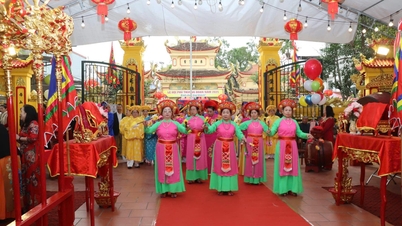
Every year, the communal house maintains a fairly complete set of rituals, especially the Ky Yen Ceremony, which is held during the two ceremonies: the Lower Field Ceremony (June 16th of the lunar calendar) and the Upper Field Ceremony (December 11th of the lunar calendar) to express gratitude to ancestors and to pray for favorable weather, abundant harvests, etc.; contributing to preserving national cultural identity and strengthening community bonds, reflecting the close relationship between people and nature, between folk beliefs and religions in a harmonious whole.
As the person directly in charge of maintaining and cleaning the communal house, Mr. Tran Van Nhieu, residing in Binh Phu Quoi hamlet, Tan Thuan Binh commune, said: "During festivals, people from the hamlet and other places come to the communal house to perform rituals, offer incense to remember their ancestors and the deities who protect the village."
Following in my father's footsteps, I am responsible for maintaining the incense burning, sweeping the temple, and ensuring the worship space is always clean and solemn. Besides major ceremonies, I regularly inspect and clean the temple's structures… This work is both a responsibility and a source of pride for me, as I am contributing to preserving this long-standing cultural heritage.”
Ms. Cao Thi Be, residing in Binh Phu Quoi hamlet, Tan Thuan Binh commune, shared: “My family and many households in the hamlet have always been closely associated with the communal house. We participate in cleaning and maintaining the communal house, preparing offerings, and organizing traditional festivals together.”
In my opinion, these activities not only preserve the solemnity and traditional customs, but also provide an opportunity for people to meet and strengthen community bonds."
LIGHTHOUSE
Source: https://baodongthap.vn/dac-sac-kien-truc-co-hon-2-the-ky-a234224.html
![[Photo] General Secretary and President To Lam presents the Politburo's Decision on personnel matters to 4 Party Committees directly under the Central Committee.](https://vphoto.vietnam.vn/thumb/1200x675/vietnam/resource/IMAGE/2026/04/13/1776077847172_a1-bnd-8005-950-jpg.webp)

![[Photo] Prime Minister Le Minh Hung and Prime Minister Robert Fico attend the Slovakia-Vietnam Business Forum](https://vphoto.vietnam.vn/thumb/1200x675/vietnam/resource/IMAGE/2026/04/13/1776075264359_ndo_br_dsc-6775-jpg.webp)
![[Photo] General Secretary and President To Lam holds telephone conversation with Chairman of the Liberal Democratic Party of Japan and Prime Minister of Japan Takaichi Sanae](https://vphoto.vietnam.vn/thumb/1200x675/vietnam/resource/IMAGE/2026/04/13/1776077840503_a1-bnd-7942-6402-jpg.webp)






















































Comment (0)