


EVIDENCE OVER 3 CENTURIES
No one knows exactly when the kơ nia tree (locally known as the cốc tree) that grew on the flat mound next to the Lady's Shrine in Mỹ Sơn village (Duy Phú commune, Duy Xuyên district, Quảng Nam province ) took root. According to the elders in the village and the assessment of the Vietnam Association for the Protection of Nature and Environment, the kơ nia tree at the Lady's Shrine in Mỹ Sơn is over 300 years old. On May 15, 2023, this kơ nia tree was recognized as a Vietnamese Heritage Tree.
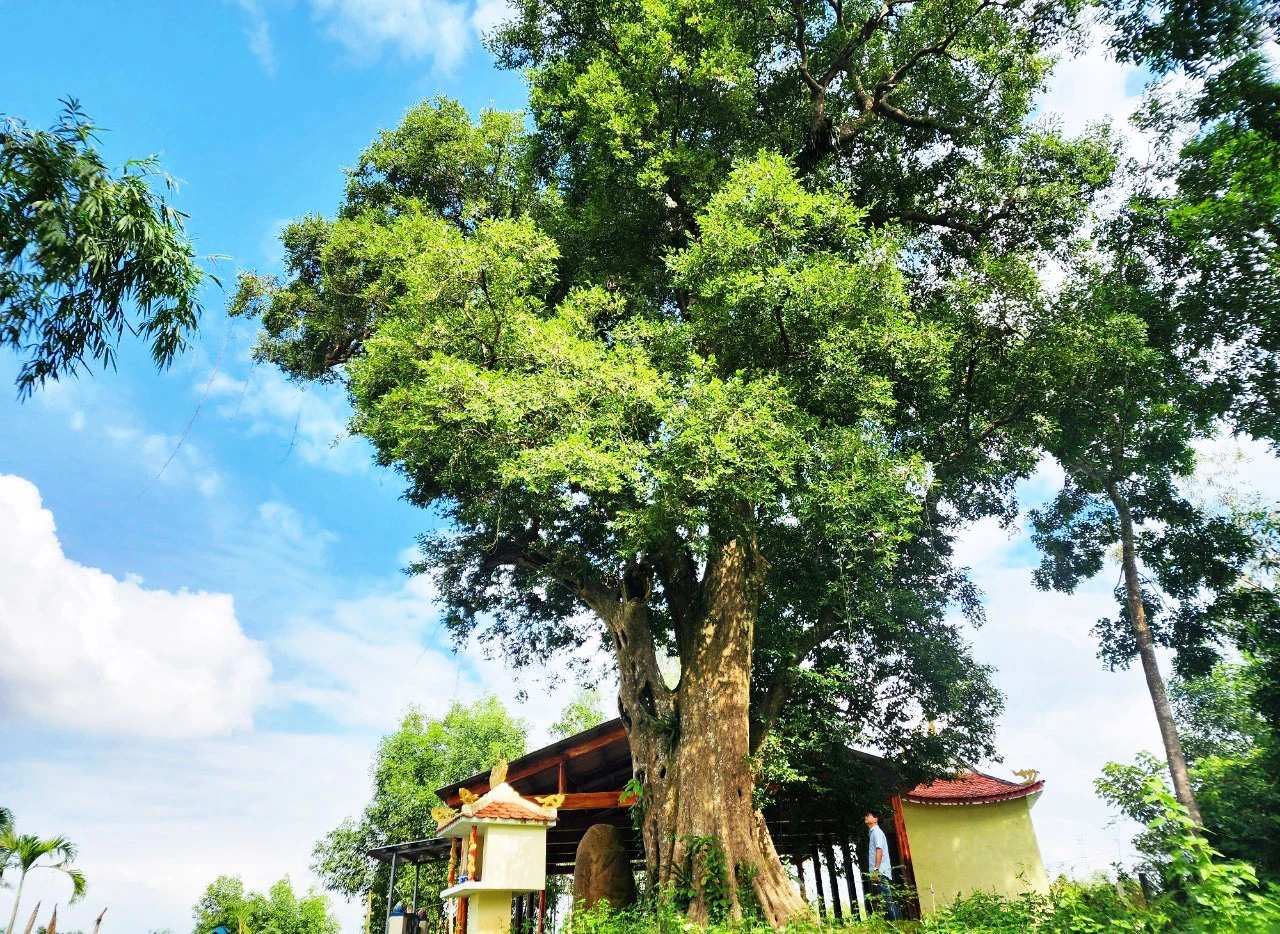
The kơ nia tree next to the Lady's Shrine in Quang Nam is over 300 years old.
We arrived at the Lady's Shrine just as Mr. and Mrs. Tran Sau, the village head of My Son, had finished clearing the wild bushes surrounding the shrine and the ancient kơ nia tree. Mr. Sau was "authorized" by the villagers to look after and care for the Lady's Shrine. Mr. Sau recounted that he heard that more than 300 years ago, when the clans first settled this land, the kơ nia tree was already there. "From the elderly to the young, everyone in our village respectfully calls the kơ nia tree 'Grandfather.' Through many ups and downs of history, through bombs and bullets, the old kơ nia tree still stands strong and has become a witness to history," Mr. Sau began his story.
During the war against the Americans, My Son village was a barren wasteland, relentlessly bombarded by the enemy, leaving not a single house or bush intact. Only the kơ nia tree at the Lady's Shrine stood proudly, becoming a revolutionary observation post, helping local soldiers and guerrillas monitor enemy sweeps and troop positions from afar. From 1968 to 1970, the enemy tried every means to destroy the kơ nia tree by using mines and bulldozers, but the ancient tree remained standing.

Mr. Nguyen Huu Hoang recounts mysterious stories associated with the kơ nia tree at the Lady's shrine.
By 1973, the kơ nia tree was the flagpole used by the National Liberation Front of South Vietnam to claim territory, as it was the only high point where a flag could be hoisted at that time. "At that time, the enemy fired directly at the kơ nia tree, but only broke the flagpole; the tree itself remained unharmed. In My Son village, there are eight kơ nia trees, but seven have been felled by the enemy. Only the kơ nia tree at the Lady's Shrine has remained standing through the years, despite constant bombing and shelling," Mr. Sau said.
According to the elders, the kơ nia tree predates the Bà Shrine. The Bà Shrine is a sacred place of worship dedicated to Bà Cốc Dinh. Bà Cốc Dinh was a traditional healer. During difficult times, she frequently treated illnesses and provided free medicine to save people. When Bà Cốc Dinh passed away, the villagers buried her right next to the kơ nia tree to honor her virtues. After liberation, the villagers contributed labor and resources to build a small shrine near the tree to worship her. After several renovations, the Bà Shrine was rebuilt and expanded in 2017. The kơ nia tree, like a giant umbrella, provides shade for the Bà Shrine.
MYSTERY AT THE ROOT OF KƠ NIA
Villagers still tell stories about how, before the temple was renovated, the kơ nia tree always had yellow leaves and bore abundant fruit. But for about the last four years, whenever people prepare offerings, incense, and flowers to worship the Goddess, the tree remains green and healthy all year round, and bears no fruit.
Mr. Tran Sau, head of My Son village, is very pleased with the recognition of the kơ nia tree as a Vietnamese Heritage Tree, because this "ancient tree" contributes to honoring the cultural beauty and is also a source of pride for the people. "Many generations in My Son village have always reminded and encouraged each other to protect the kơ nia tree. Protecting the kơ nia tree is protecting the roots of this sacred land," the village head of My Son shared.
Mr. Nguyen Huu Hoang (86 years old, from My Son village) recounts that this is a sacred land of the ancient Cham people. Since childhood, his grandfather has told him many legends associated with the kơ nia tree at this temple, including spiritual and mysterious stories that remain unexplained to this day.
"There's a story passed down that during the war, the Song Lo Party Branch secretly established a base right under a kơ nia tree to carry out revolutionary activities. After a while, the base was discovered, and the enemy launched a secret attack. Remarkably, at that time, some people were still discussing battle plans right under the tree, but the enemy... didn't detect them. People believe that the liberation army wasn't discovered because they were protected by the kơ nia tree and Mrs. Coc Dinh," Mr. Hoang recounted.
When he was a child, Mr. Hoang and many others would stop and bow to the kơ nia tree whenever they passed by the Lady's Shrine and saw it. "Not only during the war but also in peacetime, the kơ nia tree has always protected and sheltered this village, keeping it peaceful after so many storms," Mr. Hoang affirmed.
Ms. Tran Thi Duong, Chairwoman of the Duy Phu Commune People's Committee, said that every year on the 11th day of the 2nd lunar month, the people of My Son village prepare offerings to worship the Goddess, commemorating their ancestors who protected the villagers. This is also an occasion for descendants of My Son village from all over to gather and respectfully offer incense to the Goddess. "The recognition of the Kơ Nia tree at the Goddess's shrine as a Vietnamese Heritage Tree contributes to protecting biodiversity and the rural environment, aiming to develop this place into a tourist attraction for visitors outside the My Son World Heritage site," Ms. Duong said. (to be continued)
Source link















































Comment (0)