

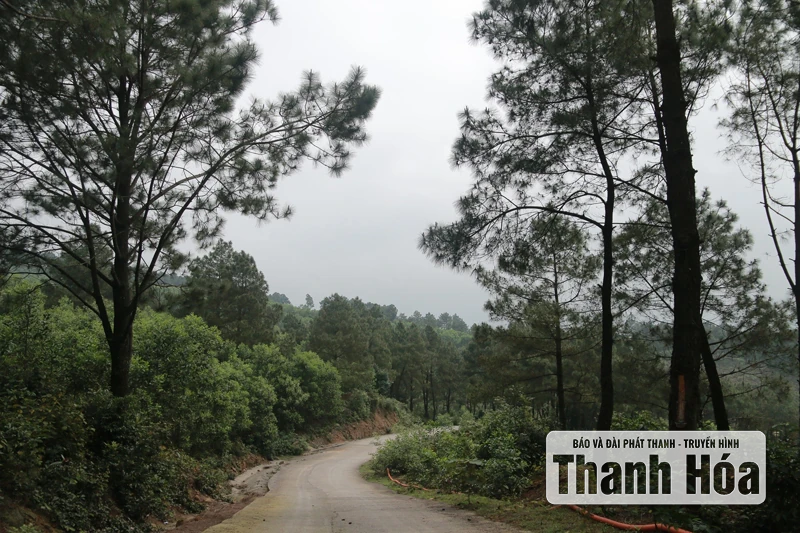
The path leading up to Am Cac Pagoda.
Anyone who has ever strolled along the path leading up Truong Le Mountain on warm spring days or vibrant summer days will surely not forget the excitement and joy in the bustling footsteps of countless tourists from all over. In autumn, that path takes on a unique beauty and charm, evoking a sense of wildness and freedom, yet also romance and poetry. The mountain rocks remain deep and sturdy. The forest trees still rustle with mysterious, unidentifiable sounds. The small, winding paths intertwine, supporting the footsteps of travelers. On either side, dry leaves form a soft brown carpet, while the dew-soaked leaves begin to decompose.
Here, during the autumn days, everything seems to settle down. From the moment you set foot on the path leading up the mountain, you feel as if you've temporarily set aside the hustle and bustle to immerse yourself in the natural scenery, opening your lungs to enjoy the fresh air. Above all, Truong Le Mountain allows visitors to deeply appreciate the historical, cultural, and spiritual values embedded in the legends and myths passed down from generation to generation, in each of the relics present here.
It's a touching story about motherly love intertwined with the formation of Truong Le Mountain; the legend of the Drum and Rooster Rock - a love story of Thanh Hoa province; the legend of the god Doc Cuoc - a giant who sacrificed himself to defeat sea demons, splitting his body in two to protect the lives of the people... The roads lead us through a region of unique historical, cultural, and spiritual relics with a system of sacred temples and pagodas such as: Doc Cuoc Temple, Co Tien Temple, To Hien Thanh Temple, Tranh Pagoda... Truong Le Mountain bears the imprint of the French's development of resorts in the Sam Son coastal area from a hundred years ago; it also holds deeply moving and proud memories of President Ho Chi Minh's third visit to Thanh Hoa .
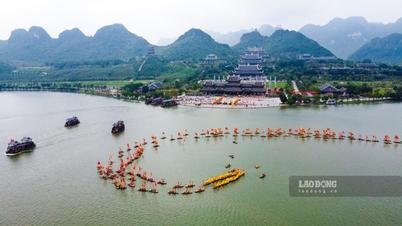
In the gentle golden sunlight, amidst the vast blue sky and the crisp autumn breeze, the road leading up to Mount Cac (Dinh Hai commune) is breathtakingly beautiful. From the foot of the mountain, the panoramic view of Hao Hao Lake evokes admiration from many. And yet, strolling beneath the pine trees lining the path, one's mind is captivated by this poetic and romantic scenery. Many young people will exclaim with delight at the sight of dried pine cones scattered along the path, happily selecting the most beautiful ones to keep as cherished mementos of this land – the "miniature Da Lat" of Thanh Hoa province.
The steep road, approximately 3km long, is not only impressive with its natural scenery but also leads visitors to Am Cac Pagoda. This is one of the largest and oldest Buddhist complexes in Thanh Hoa province, with destinations such as Trinh Pagoda, Ha Pagoda, Trung Pagoda, Thuong Pagoda, and Mau Temple. Among them, Ha Pagoda is the architectural center. Ha Pagoda faces east, its back against Cac Mountain, with mountain ranges embracing the pagoda on either side. Along the way, visitors are delighted to encounter rocks shaped like wooden gongs and bells, ancient wells, and large stones carved with images of Buddha...
Previously, Am Cac Pagoda was a forgotten ruin nestled amidst the wild, secluded mountains and forests. The path to the pagoda was difficult, mainly following a trail overgrown with vegetation. In 2014, Venerable Thich Nguyen Dai came here and, overcoming numerous difficulties and hardships, mobilized all resources to restore and renovate the pagoda from a ruin into an attractive spiritual tourist destination, drawing the attention of researchers and archaeologists. Since then, Am Cac Pagoda has undergone several archaeological surveys and excavations, uncovering many valuable artifacts. These artifacts provide crucial information for determining the pagoda's age, planning its preservation, and promoting its value.
In a lifetime, who can count all the lands they've traveled, all the paths they've set foot on? But there are certain paths that leave a lasting impression, paths they long to return to again and again. Just like how many tourists have traveled along the roads leading up to Truong Le Mountain, Cac Mountain, Nua Mountain, and others, calling them the paths to the cultural and spiritual heartland of Thanh Hoa province.
Text and photos: Dang Khoa
Source: https://baothanhhoa.vn/dan-loi-ve-mien-van-hoa-tam-linh-260750.htm

![[Photo] General Secretary and President To Lam meets with National Assembly delegates from ethnic minorities.](https://vphoto.vietnam.vn/thumb/1200x675/vietnam/resource/IMAGE/2026/04/20/1776696701056_a1-bnd-8331-3342-jpg.webp)
![[Image] National Assembly discusses the implementation of the socio-economic development plan.](https://vphoto.vietnam.vn/thumb/1200x675/vietnam/resource/IMAGE/2026/04/20/1776696707422_ndo_br_img-20260420-185419-jpg.webp)















































































Comment (0)