

In a report explaining and incorporating feedback on the draft Land Law held on the morning of January 15th, the Chairman of the National Assembly's Economic Committee, Vu Hong Thanh, stated that a higher tax rate should be applied soon to those who own multiple houses and land plots in order to regulate the land rent differential resulting from state planning.
Going back in time, at the conference chaired by the Prime Minister on resolving difficulties in the real estate market on August 3, 2023, Deputy Minister of Finance Nguyen Duc Chi also stated that the Ministry of Finance was studying the taxation of second homes and underutilized land.
At that time, the Deputy Minister of Finance argued that each tax policy introduced had different and multifaceted impacts. Therefore, a tax policy might achieve the goal of preventing speculation but would also limit overall demand for the real estate market.
Furthermore, the government had previously proposed a pilot property tax (on housing) in Ho Chi Minh City in 2017. The Ministry of Finance also submitted a draft Property Tax Law to the government in 2018. However, these policies subsequently received mixed reactions from the public and were not approved by the competent authorities.
Now, the issue of taxing those who own multiple houses and land plots is being scrutinized again following the recent passage of the amended Land Law.
Property tax - a double-edged sword.
Speaking to Nguoi Dua Tin about this issue, Professor Dang Hung Vo - former Deputy Minister of Natural Resources and Environment - said that the above policy had been planned and discussed many times by the State since 2008, but despite "very enthusiastic development and many discussion points," it has still not been concretized and applied in practice.
Professor Vo stated that one of the main objectives of this tax is to establish a reasonable real estate price level, preventing inflation and speculation. A reasonable tax policy would curb land speculation, immediately lowering real estate prices and benefiting the lower classes. However, he also believes that creating too many undeclared taxes would lead to numerous problems.
"The challenge is to find a way to 'strike' appropriately to combat speculation without stifling the supply of real estate in the market," Mr. Vo said.
Accordingly, the professor argued that reforming a tax law requires a roadmap, but he particularly emphasized that taxation in the Vietnamese market at this time should aim to change supply and demand first, rather than immediately prioritizing changes in real estate prices.
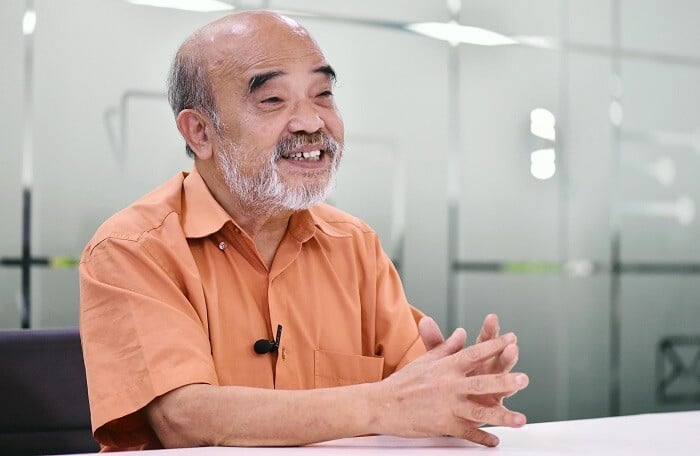
Professor Dang Hung Vo - former Deputy Minister of Natural Resources and Environment.
Sharing his views on the matter, Mr. Nguyen Quoc Anh, Deputy General Director of Batdongsan.com.vn, commented that taxation is a good solution in the current context, but the issue of taxation also has two sides to it.
On the positive side, taxation will help increase government revenue and contribute to market regulation in the short term, from the first few months to the first few years.
However, on the other hand, imposing higher taxes on those who own multiple houses and land plots, according to Mr. Quoc Anh's assessment, is not necessarily a long-term solution.
Furthermore, given the current real estate market facing a supply shortage and scarcity of available properties, imposing taxes may not be fully effective.
Citing examples from some developed countries, Mr. Quoc Anh stated that direct taxation on property ownership has not been effective in controlling housing and land prices or truly regulating prices in the market. In fact, real estate prices remain high and speculation continues despite the use of tax tools.
Be especially careful when making laws.
Given the opportunities and challenges arising from imposing higher taxes on those who own multiple properties, the Deputy General Director of Batdongsan.com.vn believes that thorough preparation is needed in terms of legal frameworks, regulations, criteria, and tax segments.
Firstly, it is necessary to clearly distinguish between different segments of the real estate market, breaking them down into specific types to have separate mechanisms, avoiding a one-size-fits-all approach that could lead to conflicts.
Secondly, it is necessary to study and apply appropriate tax rates for each type of property and each social class. This helps ensure a balance between supply and demand in the market, maintaining stable growth in real estate, and promoting supply rather than restricting it.
Thirdly, while the above policy is correct, it needs to align with the direction and shifts of the real estate market. Regardless of the purpose, taxation should be geared towards long-term sustainability and solving the overall problem, not focusing on short-term gains.
And in particular, Mr. Quoc Anh emphasized that while the imposition of taxes is intended to balance the market and combat real estate speculation, it also takes into account the right of people to own and accumulate assets, especially those with low incomes and those who are vulnerable in society.

Mr. Nguyen Quoc Anh - Deputy General Director of Batdongsan.com.vn.
In addition, Professor Dang Hung Vo stated that taxes are used to regulate the use of assets and ensure social equity. Property tax is a direct tax, applied directly to those who use and own assets. Therefore, if it is not applied to the correct subjects and in the correct circumstances, it will create difficulties in implementation and undermine the original good purpose of this tax revenue.
Therefore, taxing the largest landowners requires clear regulations specifying who is or is not subject to taxation, and regular evaluation of its effectiveness during implementation to ensure it aligns with the Party and State's policies.
"It is necessary to carefully study and calculate the appropriate fee levels, types of fees, and target groups to receive high levels of public consensus and agreement," Mr. Vo said .
In a petition sent to relevant authorities, the Ho Chi Minh City Real Estate Association (HoREA) requested that the Ministry of Finance, when drafting the Property Tax Law (Real Estate Tax), conduct a thorough and accurate assessment of the tax law's impact on all taxpayers.
In particular, for households and individuals, it is necessary to fully and accurately assess the impact of tax laws so that they both generate revenue for the state budget and are appropriate for the taxpayers, fostering revenue growth without excessive taxation, and serving as an effective tool to regulate the real estate market for healthy and sustainable development.
HoREA proposes that the pilot program to increase non-agricultural land use tax on residential land should not be implemented at present, and that personal income tax should not be increased when transferring ownership of a second or subsequent property in Ho Chi Minh City.
Source




![[Photo] General Secretary and President To Lam meets with National Assembly delegates from ethnic minorities.](https://vphoto.vietnam.vn/thumb/1200x675/vietnam/resource/IMAGE/2026/04/20/1776696701056_a1-bnd-8331-3342-jpg.webp)
![[Image] National Assembly discusses the implementation of the socio-economic development plan.](https://vphoto.vietnam.vn/thumb/1200x675/vietnam/resource/IMAGE/2026/04/20/1776696707422_ndo_br_img-20260420-185419-jpg.webp)























































































Comment (0)